Power Of Myth
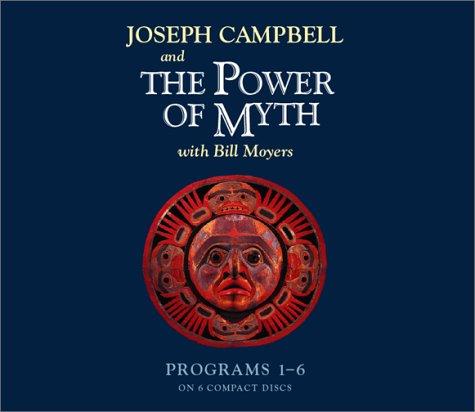
The companion book for the series, The Power of Myth, (Joseph Campbell, Bill Moyers, and editor Betty Sue Flowers) was released in 1988 at the same time the series aired on PBS. In the editor's note to The Power of Myth, Flowers credits Jacqueline Kennedy Onassis, as "the Doubleday editor, whose interest in the ideas of Joseph Campbell was the prime mover in the publication of this book." The book follows the format of the documentary and provides additional discussions not included in the original six hour release. Chapters: 1.Myth and the Modern World 2.The Journey Inward 3.The First Storytellers 4.Sacrifice and Bliss 5.The Hero's Adventure 6.The Gift of the Goddess 7.Tales of Love and Marriage 8.Masks of Eternity 9.The Tale of Buddha Chapter I, Myth and the Modern World Summary and Analysis "The Power of Myth" is based on the interviews between Joseph Campbell and Bill Moyers that became a famous television series. It deals with the universality and evolution of myths in the history of the human race and the place of myths in modern society. Campbell blends accounts of his own upbringing and experience with stories from many cultures and civilizations to present the reader with his most compelling thesis that modern society is going through a transition from the old mythologies and traditions to a new way of thinking where a global mythology will emerge. Some of the material in this chapter comes from Campbell's previously published books, "The Hero with a Thousand Faces" and "The Masks of God." The main theme of the book is the universality of myths that occur throughout the history of mankind, no matter which epoch or whichever culture or society is considered. Myths are the body of stories and legends that a people perceive as being an integral part of their culture. Before the invention of writing, these stories and legends were handed down from generation to generation in the form of rituals and oral traditions. The reappearance of certain themes, time and again, in different mythologies, leads to the realization that these themes portray universal and eternal truths about mankind. Campbell defines the function of a mythology as the provision of a cultural framework for a society or people to educate their young, and to provide them with a means of coping with their passage through the different stages of life from birth to death. In a general sense myths include religion as well and the development of religion is an intrinsic part of a society's culture. A mythology is inevitably bound to the society and time in which it occurs and cannot be divorced from this culture and environment. This is true even though Western society previously learnt from, and was informed by, the mythology of other cultures by including the study of Greek and Roman writings as part of its heritage. The record of the history of the development of a culture and society is embodied in its mythology. For example, the Bible describes the evolution of the Judeo-Christian concept of God from the time when the Jews were in Babylon and the god they worshipped corresponded to a local tribal god, to when the concept became that of a world savior as a result of the Hebrews becoming a major force in the East Mediterranean region. The geographic context of a specific mythology also plays a role in its evolution. The physical scope of Biblical mythology was limited to the general area of the Middle East but in other parts of the world, Chinese and Aztec religions and cultures emerged as separate and distinct belief systems. When different cultures expand their spheres of influence they eventually come into contact with each other, and the outcome of the collision, be it conquest, subjugation, or amalgamation, will be evident in the resultant mythology. The form and function of mythology in the modern world is the main topic of this chapter and to illustrate his ideas, Campbell recounts aspects of his own earlier life. Without specifically stating it, the assumption is made that the modern world under consideration is that of Campbell's world—the Christian-based, urbanized culture of North America, the so-called Modern Western Society. Campbell describes his own upbringing as a Roman Catholic and his early fascination with the myths and stories of the American Indians. He recalls the excitement he felt when he realized that the motifs of creation, death, resurrection, and ascension into heaven, which the nuns were teaching him at his school, also occurred in American Indian myths. This was the beginning of his lifelong interest in comparative mythology. Later on in life he found the same universal themes in Hinduism and in the medieval Arthurian legends. The discussion considers the role of myth and ritual in contemporary society. Contemporary rituals are carried out to mark special events in private lives, such as an individual's marriage or enlistment in a branch of the armed forces and, on public occasions such as the inauguration of civil and national leaders. In the Introduction to the book, Moyers recalls Campbell's description of the solemn state funeral after the assassination of John F. Kennedy, as an "illustration of the high service of ritual to a society," and where Campbell identifies the ritualized occasion as fulfilling a great social necessity. In general, however, Campbell and Moyers, reach the conclusion that there is a lack of effective mythology and ritual in modern American society. They find nothing that compares with the powerful puberty rituals of primitive societies. They claim that the exclusion of classical studies from the modern educational syllabus has led to a lack of awareness of the mythological foundations of western society's heritage. This, combined with an increased materialism and emphasis on technology, has led to modern youth in New York, becoming alienated from the main stream of society and inventing their own morality, initiations and gangs. It is of course true that the ancient rites of passage, such as circumcision, are no longer practiced in American society, but the consideration of their replacement by the Jewish celebration of Bar Mitzvah or college graduation ceremonies could, and perhaps should, be made. Likewise, as a form of ritualized warfare, the weekly college and professional football games serve to provide a socially acceptable outlet for controlled aggression. The community support for local teams certainly functions to give individuals a sense of belonging to a larger social group. Campbell and Moyers do not consider these social pageants and trends as possible components in a new emerging set of myths and rituals. Marriage, as an example of a paramount modern social institution, becomes the next subject of discussion. Campbell differentiates between marriage and love affairs and imparts some very lofty ideals to marriage, in contrast to love affairs, that he categorically states inevitably end in disappointment. True marriage, in Campbell's opinion, embodies a spiritual identity and invokes the image of an incarnate God. In doing so he appears to limit the discussion to Christian marriages and to preclude the possibility that love affairs might lead to marriage. Campbell and Moyers agree, somewhat surprisingly, that the main objective of marriage is not the birth of children and the raising of families. They discard the concept of perpetuation of the human species as being the primary function of marriage and relegate this to a first stage. This first stage is followed by a second one where the offspring have departed into the world and only the couple is left. Campbell invokes the image of marriage as being an ordeal in which the ego is sacrificed to a relationship in which two have become one. This, he states, is a mythological image that embodies the sacrifice of the visible for a transcendent good. Campbell labels this stage of marriage as the alchem