Category
page 1Anti-American sentiment in the Middle East

Osama bin Laden
Osama bin Muhammad bin 'Awad bin Laden was the founder and first general emir of al-Qaeda from 1988 until his death in 2011. A pan-Islamist, bin Laden organized and funded numerous jihadist or anti-Western militants and terrorist attacks worldwide. Al-Qaeda's attacks against the United States on 11 September 2001 (9/11) directly killed 2,977 victims, causing the global war on terror.

Saddam Hussein
Saddam Hussein was an Iraqi politician and revolutionary who served as the fifth president of Iraq from 1979 until his overthrow in 2003 during the United States-led invasion of Iraq. He previously served as the vice president from 1968 to 1979 and also as the prime minister from 1979 to 1991 and later from 1994 to 2003. A leading member of the Ba'ath Party, he was a proponent of Ba'athism, a mix of Arab nationalism and Arab socialism. The policies and ideologies he championed are collectively known as Saddamism, a right-wing variant of Ba'athism.

Islamic State
Salafi jihadist militant Sunni Islamist group

Bashar al-Assad
President of Syrian Arab Republic from 2000 to 2024

Hamas

Hezbollah
Hezbollah is a Lebanese Shia Islamist political party with an active paramilitary group wing that has been banned by the Lebanese government. Hezbollah's paramilitary wing is the Jihad Council, and its political wing is the Loyalty to the Resistance Bloc party in the Lebanese Parliament. Its armed strength was assessed to be equivalent to that of a medium-sized army in 2016.

Ayman al-Zawahiri
al-Qaeda terrorist leader (1951–2022), Muslim jurist and theologian (Sunni), surgeon
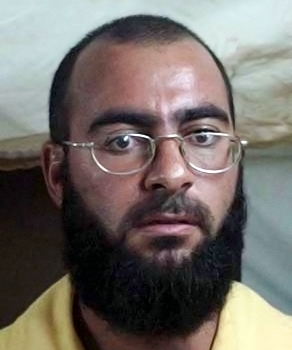
Abu Bakr al-Baghdadi
Leader of the Islamic State (1971-2019)

Houthis
The Houthis, officially known as Ansar Allah, is a Zaydi revivalist and Shia Islamist political and military organization that emerged from Yemen in the 1990s. It is predominantly made up of Zaydis, whose namesake leadership is drawn largely from the al-Houthi family. The group has been a central player in Yemen's civil war, drawing widespread international condemnation for its human rights abuses, including targeting civilians and using child soldiers. The movement is designated as a terrorist organization by some countries. The Houthis are backed by Iran, and they are widely considered part

Sayyid Qutb
Egyptian political theorist and revolutionary (1906–1966)

Nouri al-Maliki
Prime Minister of Iraq from 2006 to 2014

Al-Nusra Front
Syrian islamist organization

Khalid Sheikh Mohammed
Pakistani militant who was a member of al-Qaeda

Muntadhar al-Zaidi
Iraqi journalist (born 1979)

Saif al-Adel
Current de-facto Emir of Al-Qaeda
Izz ad-Din al-Qassam Brigades
military wing of the Palestinian Hamas organization
Axis of Resistance
unofficial military coalition between Iran and aligned movements

Abd al-Malik al-Houthi
Leader of the Ansar Allah since 2004
Ramzi Yousef
Pakistani terrorist convicted of 1993 World Trade Center bombing
1983 Beirut barracks bombing
Suicide bombing attack
Kata'ib Hezbollah
Shia Islamist militant group based in Iraq
Tomorrow's Pioneers
Palestinian television program
Islamic Army in Iraq
Iraqi insurgent armed group
Islamic Resistance in Iraq
Iraqi Islamist insurgent group
Asa'ib Ahl al-Haq
Iraqi Shi'a paramilitary group
Liwa Fatemiyoun
Shia Afghan militia fighting against ISIL in Syria
Kata'ib al-Imam Ali
Armed wing of the islamic movement
Liwa Zainebiyoun
pro-government brigade fighting in Syria composed of Shia Pakistanis
Bush shoeing incident
2008 incident in Baghdad, Iraq
Syrian Popular Resistance
Pro-Assad insurgent group

Special Group
designation given by the United States military to the cell-based Shi'a paramilitary organizations operating within Iraq
Muhammad Abd al-Karim al-Ghamari
yemeni military officer (born c. 1980s)
Sarkha
Akram al-Kaabi
Iraqi politician
conspiracy theories in the Arab world
overview about conspiracy theories in the Arab world