Category
page 1Anti-Catholicism in France

Huguenots
The Huguenots ( , ; ) are a religious group of French Protestants who held to the Reformed (Calvinist) tradition of Protestantism. The term, which may be derived from the name of a Swiss political leader, the Genevan burgomaster Besançon Hugues, was in common use by the mid-16th century. Huguenot was frequently used in reference to those of the Reformed Church of France from the time of the Protestant Reformation. By contrast, the Protestant populations of eastern France, in Alsace, Moselle, and Montbéliard, were mainly Lutherans.
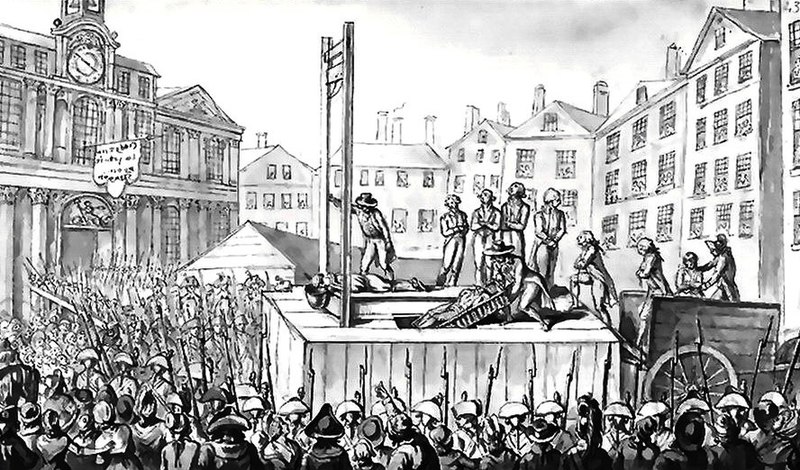
Reign of Terror
1793–94 period of political violence during the French Revolution

Candide
' ( , ) is a French satire written by Voltaire, a philosopher of the Age of Enlightenment, first published in 1759. The novella has been widely translated, with English versions titled Candide: or, All for the Best (1759); Candide: or, The Optimist (1762); and Candide: Optimism''''' (1947). A young man, Candide, lives a sheltered life in an Edenic paradise, being indoctrinated with Leibnizian optimism by his mentor, Professor Pangloss. This lifestyle is abruptly ended, followed by Candide's slow and painful disillusionment as he witnesses and experiences great hardships in the world. Voltaire

War in the Vendée
1793–1796 set of battles between the French revolutionaries and the royalists

sans-culottes
The '''''' (; ) were the common people of the lower classes in late 18th-century France, a great many of whom became radical and militant partisans of the French Revolution in response to their poor quality of life under the . The word , which is opposed to "aristocrat", seems to have been used for the first time on 28 February 1791 by Jean-Bernard Gauthier de Murnan in a derogatory sense, speaking about a " army". The word came into vogue during the demonstration of 20 June 1792.

Carbonari
The Carbonari () was an informal network of secret revolutionary societies active in Italy from about 1800 to 1831. The Carbonari may have further influenced other revolutionary groups in France, Portugal, Spain, Brazil, Uruguay, the Ottoman Empire, and Russia. Although their goals often had a patriotic and liberal basis, they lacked a clear immediate political agenda. They were a focus for those unhappy with the repressive political situation in Italy following 1815, especially in the south of the Italian peninsula. Members of the Carbonari, and those influenced by them, took part in importan
September Massacres
Wave of killings in France in 2–7 Sept. 1792 during the French Revolution, in which half the prison population of Paris (that is, approximately 1200–1400 people) were summarily executed
Cult of the Supreme Being
state religion during the French Revolution
Roger Peyrefitte
French diplomat and writer (1907–2000)
2020 Nice attack
terrorist attack in France on 29 October 2020
Civil Constitution of the Clergy
French revolutionary law, making the Catholic Church in France subordinate to the government, Not in Union with the Holy See
Cult of Reason
state religion during the French Revolution
2016 Saint-Étienne-du-Rouvray church attack
terrorist attack in July 2016
Dechristianisation of France during the French Revolution
Anti-Christian policy during the French Revolution

Michelade
right|400px|thumbnail|Michelade of Nîmes.
Biens nationaux
properties confiscated during the French Revolution
Affaire Des Fiches
1904-1905 French political scandal

Massacre de la rue Haxo
Massacre of priests and gendarmes during the Paris Commune, 1871
Decadary Cult
semi-official religion of France during the Directory period
Fédération Nationale Catholique
organization