Category
page 1Archaeological sites in the Southeastern Anatolia region
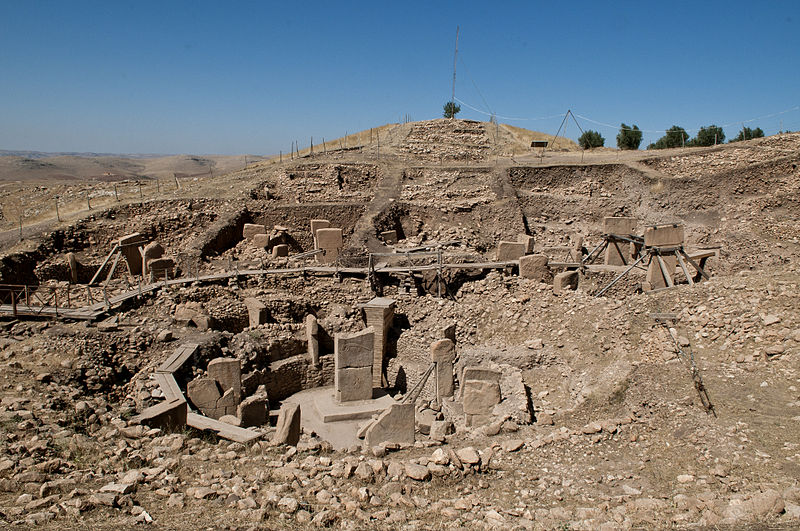
Göbekli Tepe
neolithic archaeological site in Turkey

Harran
Harran is a municipality and district of Şanlıurfa Province, Turkey. Its area is 904 km2, and its population is 96,072 (2022). It is approximately southeast of Urfa and from the Syrian border crossing at Akçakale.

Mount Nemrut
mountain and UNESCO World Heritage Site in Turkey

Nusaybin
Nusaybin (, ) is a municipality and district of Mardin Province, Turkey. Its area is 1,079 km2, and its population is 115,586 (2022). The city is populated by Kurds of different tribal affiliation.
.jpg)
Carchemish
Carchemish ( or ), also spelled Karkemish (), was an important ancient capital in the northern part of the region of Syria. At times during its history the city was independent, but it was also part of the Mitanni, Hittite and Neo-Assyrian Empires. Today it is on the frontier between Turkey and Syria.

Edessa
thumb|400px|Upper Mesopotamia and surrounding regions during the [[Early Christian period, with Edessa in the upper left quadrant]]
Edessa (; ) was an ancient city (polis) in Upper Mesopotamia, in what is now Urfa or Şanlıurfa, Turkey. It was founded during the Hellenistic period by Macedonian general and self proclaimed king Seleucus I Nicator (), founder of the Seleucid Empire. He named it after an ancient Macedonian capital. The Greek name (Édessa) means "tower in the water". It later became capital of the Kingdom of Osroene, and continued as capital of the Roman province of Osroene. In Lat

Hasankeyf
Hasankeyf is a town located along the Tigris, in the Hasankeyf District, Batman Province, Turkey. It was declared a natural conservation area by Turkey in 1981.

Çayönü
Çayönü Tepesi is a Pre-Pottery Neolithic B settlement in southeastern Turkey which prospered from circa 8,630 to 6,800 BC. It is located in Diyarbakır Province forty kilometres north-west of Diyarbakır, one hundred and forty kilometres north-east of Şanlıurfa, at the foot of the Taurus mountains. It lies near the Boğazçay, a tributary of the upper Tigris River and the Bestakot, an intermittent stream. It is an early example of agriculture.
Zeugma
ancient city of Commagene, in modern-day Turkey
Nevalı Çori
Early Neolithic settlement and archaeological site
Karahan Tepe
archeological site in Turkey

Zincirli Höyük
Zincirli Höyük is an archaeological site located in the Anti-Taurus Mountains of modern Turkey's Gaziantep Province. During its time under the control of the Neo-Assyrian Empire (c. 700 BC) it was called, by them, '''Sam'al'''. It was founded at least as far back as the Early Bronze Age and thrived between 3000 and 2000 BC, and on the highest part of the upper mound was found a walled citadel of the Middle Bronze Age (ca. 2000–1600 BC).
Zerzevan Castle
archaeological site in Diyarbakır province, Turkey
Yesemek Quarry and Sculpture Workshop
Turkish archaeological site

Hallan Çemi
archeological site in Turkey
Tigris tunnel
cave in Turkey
Taş Tepeler
cluster of 12 archaeologic sites in Şanlıurfa
Sultantepe
Sultantepe (Huzirina?), a tell with a temple complex from the Late Assyrian, an archeological site at the edge of the Neo-Assyrian Empire, now in Şanlıurfa Province, Turkey. Sultantepe is about south of Urfa on the road to Harran. The modern village of Sultantepe Köyü lies at the base of the tell.
Tushhan
Tushhan (alternatively spelled as Tushan or Tušḫan) was a Neo-Assyrian provincial capital in the upper Tigris region. It was rebuilt by the ruler Ashurnasirpal II (883–859 BC) and survived until the end of the Neo-Assyrian period around 611 BC.
Boncuklu Tarla
Neolithic archaeological site in Turkey
Asmacık
Tilhalit, also spelled Tell Khalid () and officially recognized as Asmacık, is a neighbourhood in the municipality and district of Oğuzeli, Gaziantep Province, Turkey. Its population is 195 (2022). It was a fortress during the 12th century, contested at times by the Crusaders, Zengids and Ayyubids.
Hassuni Caves
caves in Silvan, Diyarbakır, Turkey
Perrhe
thumb|Necropolis of Perrhe
Perrhe (Ancient Greek: ) was an ancient city in the kingdom of Commagene. The remains of the city are located in the modern suburb of Örenli (previously the village of Pirin or Pirun) in the northern section of Adıyaman, Turkey. Some authors identify it with Antiochia ad Taurum.
Gürcütepe
Gürcütepe is a Neolithic site on the southeastern outskirts of Şanlıurfa in Turkey, consisting of four very shallow tells along Sirrin Stream that flows from Şanlıurfa. All four hills are now covered by modern buildings, so they are no longer recognizable. In the late 1990s a German archaeological team under the direction of Klaus Schmidt carried out soundings on all four hills and made extensive excavations on the second hill seen from the east.
Tilmen Höyük
İslahiye, Türkiye'de tepe