Category
page 1Buddhist pilgrimage sites in India

Varanasi
Varanasi (, also Benares, Banaras ), or Kashi, is a city on the Ganges river in northern India that has a central place in the traditions of pilgrimage, death, and mourning in the Hindu world. Located in the middle-Ganges valley in the southeastern part of the state of Uttar Pradesh, Varanasi lies on the left bank of the river. It is to the southeast of India's capital New Delhi and to the southeast of the state capital, Lucknow. It lies downstream of Prayagraj, where the confluence with the Yamuna river is another major Hindu pilgrimage site.

Gangtok
Gangtok (, ) is the capital and the most populous city of the Indian state of Sikkim. The seat of eponymous district, Gangtok is in the eastern Himalayan range, at an elevation of . The city's population of 100,000 consists of the three Sikkimese ethnicities: the Bhutias, Lepchas, Indian Gorkhas as well as plainsmen from other states of India. Within the higher peaks of the Himalayas and with a year-round mild temperate climate, Gangtok is at the centre of Sikkim's tourism industry.

Vijayawada
Vijayawada ( ), also called as Bezawada, is the second largest city and a major commercial hub in the Indian state of Andhra Pradesh. The city forms an integral part of the Andhra Pradesh Capital Region and is situated on the banks of the Krishna River, flanked by the Eastern Ghats and the Indrakeeladri Hills.
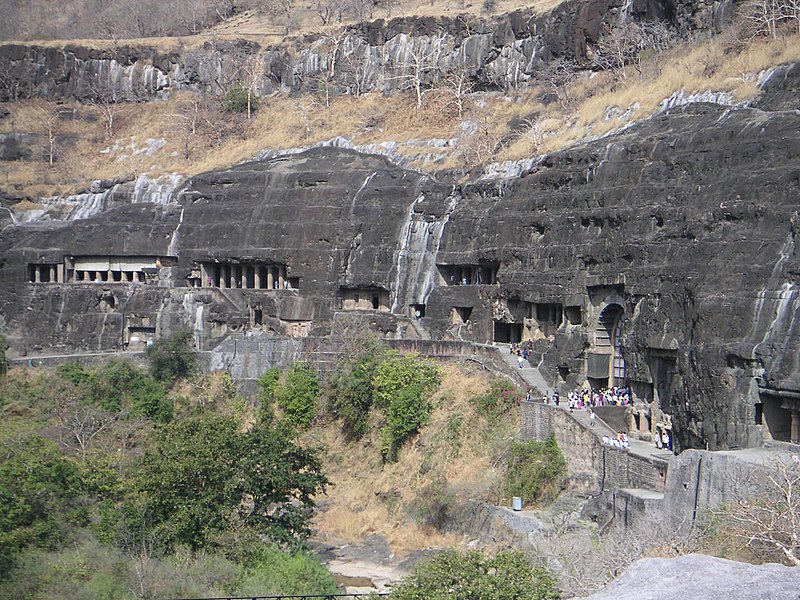
Ajanta Caves
2nd century BCE to 1st century CE Buddhist cave monuments located in Maharashtra, India

Mathura
Mathura () is a city and the administrative headquarters of Mathura district in the Indian state of Uttar Pradesh. It is located south-east of Delhi; and about from the town of Vrindavan. In ancient times, Mathura was an economic hub, located at the junction of important caravan routes. The 2011 Census of India estimated the population of Mathura at 441,894.

Ellora Caves
ancient cave temples of Hinduism, Buddhism and Jainism in Maharashtra, India

Nalanda Mahavihara
ancient Hindu-Buddhist monastery in present-day Bihar, India

Gaya
Holy City in Bihar, India

Bodh Gaya
town

Kushinagar

Rajgir
Rajgir (old name Rajagriha, meaning "The City of Kings") is an ancient city and university town in the Nalanda district of Bihar, India. Also a Cultural capital of Magadh. It was the capital of the Haryanka dynasty, the Pradyota dynasty, the Brihadratha dynasty, the Mauryan Empire, and it was the retreat center for the Buddha and his sangha. Other historical figures such as Mahavira and king Bimbisara lived there, and due to its religious significance, the city holds a place of prominence in Buddhist, Jain and Hindu scriptures.

Sarnath
Sarnath (also known as Deer Park, Sarangnath, Isipatana Deer Park, Rishipattana, Migadaya, or Mrigadava) is a town northeast of Varanasi, in Uttar Pradesh, India. As the Lalitavistara sutra states, the Gautama Buddha chose "Deer Park by the Hill of the Fallen Sages, outside of Varanasi" for his first teaching after he attained enlightenment in Bodh Gaya. The teaching is entitled Dhammacakkappavattana sutra. Sarnath is one of the eight most important pilgrimage sites for Buddhists, and has been nominated to become a UNESCO World Heritage Site.

Sanchi
Buddhist complex, famous for its Great Stupa, in Madhya Pradesh, India

Pataliputra
Pataliputra (IAST: ), adjacent to modern-day Patna, Bihar, was a city in ancient India, originally built by Magadha ruler Ajatashatru in 490 BCE, as a small fort () near the Ganges river. Udayin laid the foundation of the city of Pataliputra at the confluence of two rivers, the Son and the Ganges. He shifted his capital from Rajgriha to Pataliputra due to the latter's central location in the empire.

Bodhi Tree
sacred fig tree under which Buddha is said to have achieved enlightenment
Vaishali
ancient Buddhist pilgrimage and archaeological site (Ashoka pillar, Stupa and Swastika Monastery) associated with significant events in Lord Buddha's life; in Bihar in India

Shravasti
Shravasti (, ; ) is a town in Shravasti district in Indian state of Uttar Pradesh. It was the capital of the ancient Indian kingdom of Kosala where the Buddha lived most after his enlightenment. It is near the Rapti river in the northeastern part of Uttar Pradesh India, close to the Nepalese border.
Amaravathi
village in Amaravathi mandal, Palnadu district, Andhra Pradesh, India

Vikramaśīla University
Vikramashila (IAST: ) was a Buddhist monastic university situated in what is now modern-day Bihar in India. It was founded by King Dharmapala between the late eighth and early ninth century.

Deekshabhoomi
thumb|right|22 vows given by Ambedkar at Deekshabhoomi|alt=The Bodhi Tree at Deekshabhoomi
thumb|Ambedkar and Deekshabhoomi on a 2017 postage stamp of India
thumb|Bust of Babasaheb Ambedkar at Deekshabhoomi
Pithapuram
Pithapuram (also spelled as Pitapuram) is a city and municipality in the Kakinada district of Andhra Pradesh, India. With a history spanning over 1,500 years, it is one of the oldest towns in the state. Pitapuram served as the capital for various kingdoms of Andhra, dating back to the 4th century CE, and continues to be an important pilgrimage destination.
Barabar Caves
rock-cut caves in Bihar, India
Karla Caves
cave complex in Karla, India
.jpg)
Kosambi
Kosambi (Pali) or Kaushambi (Sanskrit) was an ancient city in India, characterized by its importance as a trading center along the Ganges Plain and its status as the capital of the Vatsa Kingdom, one of the sixteen mahajanapadas. It was located on the Yamuna River about southwest of its confluence with the Ganges at Prayaga (modern Prayagraj), which made it a powerful center for trade and beneficial for the Vatsa Kingdom.
.jpg)
Vinukonda
alt=Photo showing a busy road in Vinukonda|thumb|Vinukonda Junction
Vinukonda is a town in Palnadu district of the Indian state of Andhra Pradesh. It is a municipality and the headquarters of Vinukonda mandal and administered under Narasaraopet revenue division.
Assandh
Assandh, historically known as Āsandīvat, is a town and municipal committee in the Karnal district of the Indian state of Haryana. Assandh is located in 45 km south-west of Karnal. The town is surrounded by four districts - Karnal, Kaithal, Jind and Panipat.

Bharhut
Bharhut is a village in the Satna district of Madhya Pradesh, central India. It is known for a Buddhist stupa, unique in that each panel is explicitly labelled in Brahmi characters saying what the panel depicts. The major donor for the Bharhut stupa was King Dhanabhuti.

Jetavana
thumb|300px|Mulagandhakuti. The remains of the Buddha's hut at Jetavana.

Piprahwa
Piprahwa is a village near Siddharthnagar city in Siddharthnagar district of the Indian state of Uttar Pradesh. Kalanamak rice, a scented and spicy variety, is grown in this area. It lies in the heart of the historical Buddha's homeland and is 9 miles from the world heritage site of Lumbini that is believed to be the place of Gautama Buddha's birth.

Sankassa
Sankissa (also Sankasia, Sankassa and Sankasya) is an ancient city in India renown for the descent of Gautama Buddha from the Tushita heavens where he taught his mother before landing at Sankissa. Considered among the eight great pilgrimage sites, it was thirty leagues from Sravasti. Around 300 years after the Gautama Buddha's Mahaparinirvana, king Ashoka visited and built a Pillar of Ashoka of which the elephant capital survives. He also built a stupa and a temple commemorating the Buddha's descent from the heavens. The ruins of the stupa are still present, as is a temple of Vishari Devi and

Bhattiprolu
thumb|255px|Bhattiprolu is one of the Holy relic sites of Andhra Pradesh
Ratnagiri
Buddhist monastery in Odisha
Bagh Caves
Buddhist caves in southwest Madhya Pradesh
Bhaja Caves
cave complex in Maharashtra, India
Pushpagiri
Budhist site in Odisha, India
Bedse Caves
cave in India

Lalitgiri
Lalitagiri () (also known as Nalitagiri) is a major Buddhist complex in the Cuttack district in the Indian state of Odisha. The complex is home to stupas, 'esoteric' Buddha images, and monasteries (viharas), which is the oldest site in the region. Significant finds at this complex include Buddha's relics. Tantric Buddhism was practiced at this site.
Nasik Caves
ancient Buddhist cave complex in Nashik, India
Udayagiri
Buddhist complex in Odisha
Mahakali Caves
Caves in Maharashtra state of India
.jpg)
Nagarjunakonda
thumb|Drum panel depicting a stupa with the Buddha's descent from Trāyastriṃśa heaven, second half 3rd century.
Kondana Caves
cave in India (Maharashtra)
Kesaria stupa
Buddhist stupa in Bihar, India

Lenyadri
Lenyadri, sometimes called Ganesa Lena, Ganesh Pahar Caves, are a series of about 30 rock-cut Buddhist "caves", located about north of Junnar in Pune district in the Indian state of Maharashtra. They are cut into a natural cliff or steep slope. Other caves surrounding the city of Junnar are: Manmodi Caves, Shivneri Caves and Tulja Caves. The Lenyadri caves date between the 1st and 3rd century AD. Some have later been adapted to Hindu use.

Kesaria
Kesaria, also known as Kesariya is a town in the district of East Champaran, in the Indian state of Bihar. It is the site of a stupa built by the Mauryan king Ashoka.
Kolvi Caves
cave in India
Mandapeshwar Caves
cave in Mumbai, India

Pava
thumb|325px|A stupa built at the place where Cunda Kammāraputta|Cunda's house used to be, in ancient Pava (present-day [[Fazilnagar)]]
Shivneri Caves
caves in Maharashtra, India
Kuda Caves
caves in Raigad district, Maharashtra, India
Parinirvana Stupa
Buddhist temple in Kushinagar, India
Saptaparni Cave
Buddhist cave in Bihar, India
Junagadh Buddhist Cave Groups
cave in India
Ghantasala
village in Ghantasala mandal, Krishna district, Andhra Pradesh, India
Rajgir hills
hill in India
Guntupalli Group of Buddhist Monuments
village in Andhra Pradesh, India
Sana Caves
caves in India
Saru Maru caves and stupas
Buddhist archaeological site in India
Erravaram Caves
cave in India
Bava Pyara caves
Caves in Gujarat, India