Category
page 1Coins of the Byzantine Empire
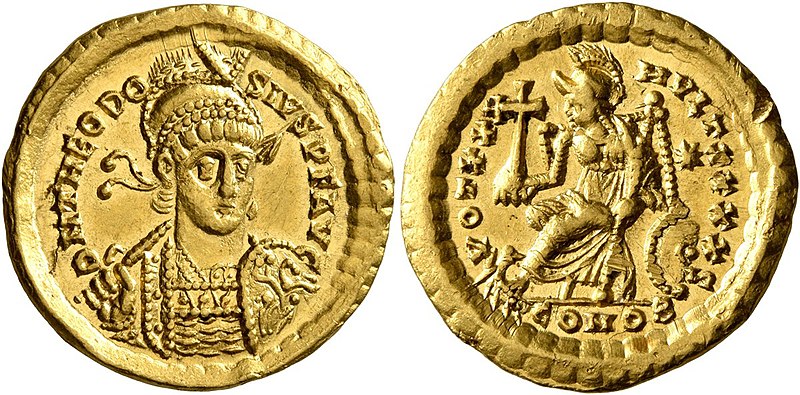
solidus
gold coin issued in the Late Roman Empire

hyperpyron
thumb|250px|right|Hyperpyron of Emperor Manuel I Komnenos (r. 1143–1180), showing its typical [[scyphate (cup-shaped) form.]]The hyperpyron (, nómisma hypérpyron ) was a Byzantine coin in use during the late Middle Ages, replacing the solidus as the Byzantine Empire's standard gold coinage in the 11th century. It was introduced by emperor Alexios I Komnenos.

follis
thumb|An AE1 follis of Diocletian, 27 mm

bezant
thumb|upright=1.6|Crusader coins of the Kingdom of Jerusalem: Denier in European style with [[Holy Sepulchre (1162–1175); Kufic gold bezant, imitation of the Fatimid dinar (1140–1180); gold bezant with Christian symbol (1250s) (British Museum). Gold coins were first copied dinars and bore Kufic script, but after 1250 Christian symbols were added following Papal complaints.]]
thumb|upright=1.6|County of Tripoli gold bezant in Arabic (1270–1300), and Tripoli silver gros (1275–1287). [[British Museum.]]

Tremissis
thumb|Tremissis from Constantinople in the second reign of Zeno (emperor)|Zeno
upright|thumb|Merovingian dynasty|Frankish gold Tremissis with Christian cross, issued by minter , [[Dorestad, Netherlands, mid-600s]]

nummus
thumb|right|150px|Nummi coins of the late reign of Anastasius I (emperor)|Anastasius I: on the left a 40-nummi coin ([[follis) and on the right a 5-nummi coin (pentanummium).]]
Byzantine coinage

Histamenon
thumb|right|260px|Histamenon of Emperor Constantine VIII ()

miliarense
thumb|alt=Silver coin showing a man standing with a standard and a round shield behind his legs. There is writing round the edge including "TRPR" below the figure.|Reverse of a miliarense from the Hoxne Hoard. TRPS indicates the mint of [[Treveri (modern Trier, Germany).]]
scyphate
Scyphate is a term frequently used in numismatics to refer to the concave or "cup-shaped" Byzantine coins of the 11th–14th centuries.

Tetarteron
The tetarteron (, "quarter [coin]") was a Byzantine term applied to two different coins, one gold circulating from the 960s to 1092 in parallel to the histamenon, and one copper used from 1092 to the second half of the 13th century.
Hexagram
Byzantine silver coin

miliaresion
thumb|right|215px|Example of the first miliaresia, struck by Leo III the Isaurian|Leo III () to celebrate the coronation of his son, [[Constantine V (), as co-emperor. Notice the lack of any imagery except the cross.]]

Aspron
thumb|Aspron minted by Manuel I of Trebizond
The aspron (), from Latin asper, was a late Byzantine name for silver or silver-alloy coins.

Stavraton
The stavraton or stauraton () was a type of silver coin used during the last century of the Byzantine Empire.

basilikon
thumb|right|200px|One of the first basilika issued, with a seated Christ and the standing figures of Andronikos II and Michael IX holding a labarum between them. The legend reads ΘΕΕ ΒΟΗΘΕΙ AYTOKPATOPEC PWMAIWN ("God aid the emperors of the Romans").
trachy
currency
Byzantine mints
Wikimedia list article
Template:Byzantine coinage
Wikimedia template
Politikon
thumb|250px|right|Example of the politikon coinage.