Category
page 1Cold War history of China

Cultural Revolution
1966–1976 Maoist sociopolitical movement in China
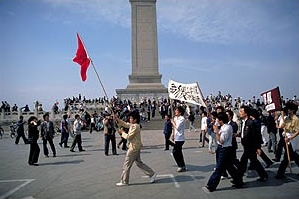
1989 Tiananmen Square protests and massacre
Protests led by students and workers, known in China as the June Fourth Incident, were held in Tiananmen Square in Beijing, China, from 15 April to 4 June 1989. After weeks of unsuccessful attempts between the demonstrators and the Chinese government to find a peaceful resolution, the Chinese government initiated martial law in late May and deployed troops to occupy the square on the night of 3 June in what is referred to as the Tiananmen Square massacre. The events are sometimes called the '89 Democracy Movement, the Tiananmen Square Incident, or the Tiananmen uprising.

one-child policy
population control policy which was used by the People's Republic of China

Sino-Soviet split
the breaking of political relations between the People's Republic of China (PRC) and the Union of Soviet Socialist Republics (USSR)

Gang of Four
Chinese political faction
Chinese economic reform
reforms allowing more free markets in China since Deng Xiaoping
bamboo curtain
political demarcation
peaceful coexistence
theory that the Socialist Bloc could peacefully coexist with the capitalist bloc
Anti-Rightist Campaign
Chinese political campaign under Mao Zedong
people's war
Maoist military strategy
New Democracy
Maoist concept that democracy in China would take a path that was decisively distinct from that in any other country
Beijing Spring
late 1970's liberalization period in the history of the People's Republic of China
Democracy Wall of Xidan
former wall in Beijing, PR China
Boluan Fanzheng
transition period in modern Chinese history in the aftermath of the Cultural Revolution, aiming at correcting the wrongs incurred during the previous political turmoils
land reform in China
Chinese campaign led by Mao Zedong
Socialist Education Movement
Chinese reform movement led by Mao Zedong
Hai Rui Dismissed from Office
literary work
Capitalist roader
Maoist term for people or groups within socialist revolutionary circles who would attempt to return to capitalism

scar literature
Chinese literature portraying damage caused by the Cultural Revolution
Seven Thousand Cadres Conference
work conference of the Chinese Communist Party
Sufan movement
Chinese political campaign under Mao Zedong
Bombard the Headquarters
suppressionary document by Mao Zedong
history of the People's Republic of China (1949-1976)
Mao era
rusticated youth of China
youth forced to work in the countryside during China's cultural revolution; urban Chinese youth who were relocated to the countryside for reeducation during the Cultural Revolution (1966-1976) and who developed a shared group identity
history of the People's Republic of China (1976–1989)
China under Deng Xiaoping
Beijing Students' Autonomous Federation
political party in People's Republic of China
nuclear weapons of China

Anita Parkhurst Willcox
American pacifist and artist (1892–1984)
Three Rules of Discipline and Eight Points for Attention
1928 military doctrine of Mao Zedong