Category
page 1Conditions of the skin appendages

bald head
state where most or all of hair from the head has been lost or intentionally removed
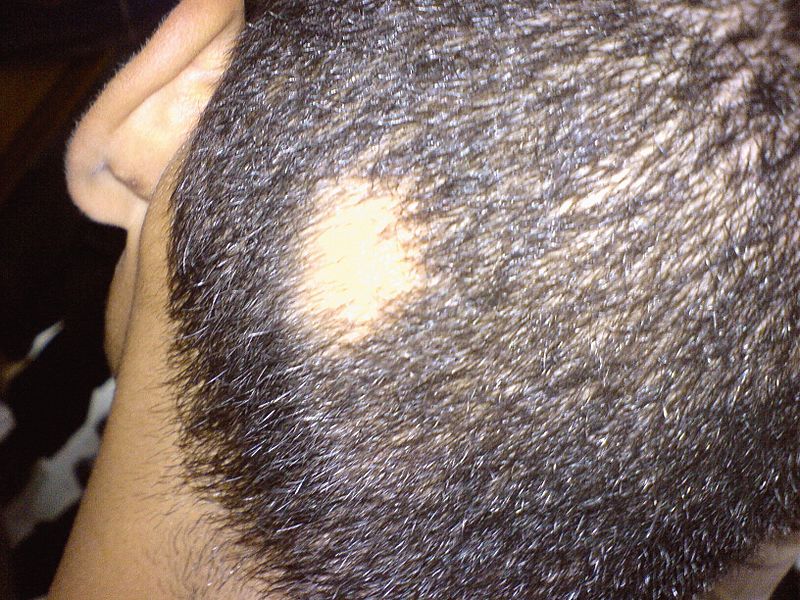
alopecia areata
condition in which hair is lost from some or all areas of the body
hyperhidrosis
Hyperhidrosis is a medical condition in which a person exhibits excessive sweating, more than is required for the regulation of body temperature. Although it is primarily a physical burden, hyperhidrosis can deteriorate the quality of life of the people who are affected, frequently leading to psychological, physical, and social consequences. Hyperhidrosis can lead to difficulties in professional fields, with more than 80% of patients experiencing moderate to severe emotional effects from the disease.
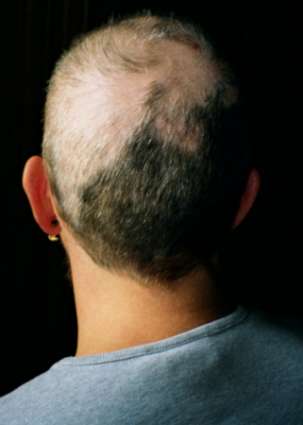
trichotillomania

onychomycosis
Onychomycosis, also known as tinea unguium, is a fungal infection of the nail. Symptoms may include white or yellow nail discoloration, thickening of the nail, and separation of the nail from the nail bed. Fingernails may be affected, but it is more common for toenails. Complications may include cellulitis of the lower leg.
A number of different types of fungus can cause onychomycosis, including dermatophytes and Fusarium. Risk factors include athlete's foot, other nail diseases, exposure to someone with the condition, peripheral vascular disease, and poor immune function. The diagnosis is ge

hypertrichosis
Hypertrichosis (sometimes known as werewolf syndrome or Ambras syndrome) is an abnormal amount of hair growth over the body. The two distinct types of hypertrichosis are generalized hypertrichosis, which occurs over the entire body, and localized hypertrichosis, which is restricted to a certain area. Hypertrichosis can be either congenital (present at birth) or acquired later in life. The excess growth of hair occurs in areas of the skin with the exception of androgen-dependent hair of the pubic area, face, and axillary regions.
hirsutism
Hirsutism is excessive body hair on parts of the body where hair is normally absent or minimal. The word is from the early 17th century: from Latin hirsutus meaning "hairy". It usually refers to a male pattern of hair growth in a female that may be a sign of a more serious medical condition, especially if it develops well after puberty. Cultural stigma against hirsutism can cause much psychological distress and social difficulty. Discrimination based on facial hirsutism often leads to the avoidance of social situations and to symptoms of anxiety and depression.

paronychia
Paronychia is an inflammation of the skin around the nail, often due to bacteria or fungi.
ingrown nail
common nail disease

folliculitis
Folliculitis is the infection and inflammation of one or more hair follicles. The condition may occur anywhere on hair-covered skin. The rash may appear as pimples that come to white tips on the face, chest, back, arms, legs, buttocks, or head.
nail biting
oral compulsive habit
nail clubbing
deformity found in nails
excoriation disorder
mental disorder involving compulsive skin-picking
androgenic alopecia
hair loss due to susceptibility of hair follicles to androgenic miniaturization
whitlow
A whitlow or felon is an infection of the tip of the finger. Herpetic whitlow and melanotic whitlow (subungual melanoma) are subtypes that are not synonymous with the term felon. A felon is an "extremely painful abscess on the palmar aspect of the fingertip". Whitlow usually refers to herpetic whitlow, though it can also refer to melanotic whitlow (subungual melanoma), which somewhat resembles acral lentiginous melanoma. The terms whitlow and felon are also sometimes misapplied to paronychia, which is an infection of the tissue at the side or base of the nail. Felon presents clinically with a
Menkes disease
Human disease
Rubinstein-Taybi syndrome
rare disease
hangnail
A hangnail is a small piece of skin or nail next to a fingernail or toenail. Hangnails are typically caused by having dry skin, trauma to the fingers, or ingrown nails.
epidermoid cyst
human disease
yellow nail syndrome
Human disease
Subungual hematoma
medical condition
keratosis follicularis
inherited skin disorder

Milium
thumb|290px|Relative incidence of cutaneous cysts. Milia is labeled at bottom right.
A milium (: milia), also called a milk spot or an oil seed, is a clog of the eccrine sweat gland. It is a keratin-filled cyst that may appear just under the epidermis or on the roof of the mouth. Milia are commonly associated with newborn babies, but may appear on people of any age. They are usually found around the nose and eyes, and sometimes on the genitalia, often mistaken by those affected as warts or other sexually transmitted diseases. Milia can also be confused with stubborn whiteheads.
hidradenitis
Hidradenitis is any disease in which the histologic abnormality is primarily an inflammatory infiltrate around the eccrine glands. This group includes neutrophilic eccrine hidradenitis and recurrent palmoplantar hidradenitis.
uncombable hair syndrome
rare scalp hair shaft dysplasia
onycholysis
Onycholysis is a common medical condition characterized by the painless detachment of the nail from the nail bed, usually starting at the tip and/or sides. On the hands, it occurs particularly on the ring finger but can occur on any of the fingernails. It may also happen to toenails.
Beau's lines
deep horizontal ridges on fingernails or toenails

dermatophagia
Dermatophagia () or dermatodaxia () is a compulsion disorder of gnawing or biting one's own skin, most commonly at the fingers. This action can either be conscious or unconscious and it is considered to be a type of pica. Those affected with dermatophagia typically bite the skin around the nails, leading to bleeding and discoloration over time. Some people also bite on their skin on their finger knuckles which can lead to pain and bleeding just by moving their fingers.
nail-patella syndrome
Human disease
ingrown hair
hair condition

leukonychia
Leukonychia (or leuconychia) is a medical term for white discoloration appearing on nails. It is derived from the Greek words leuko 'white' and onyx 'nail'. The most common cause is injury to the base of the nail (the matrix) where the nail is formed.
Mees' lines
medical condition
.jpg)
onychogryphosis
Onychogryphosis is a hypertrophy that may produce nails resembling claws or a ram's horn.
telogen effluvium
Human disease
monilethrix
Monilethrix (also referred to as beaded hair) is a rare autosomal dominant hair disease that results in short, fragile, broken hair that appears beaded. It comes from the Latin word for necklace (monile) and the Greek word for hair (thrix). Hair becomes brittle, and breaks off at the thinner parts between the beads. It appears as a thinning or baldness of hair and was first described in 1897 by Walter Smith
nail disease
integumentary system disease that is located in nail
pachyonychia congenita
rare group of autosomal dominant skin disorders that are caused by a mutation in one of five different keratin genes
body-focused repetitive behavior disorders
mental and behaviour disorders including skin picking and hair pulling
alopecia universalis
human disease
Marie Antoinette syndrome
alleged condition of hair suddenly turning white
Fox-Fordyce disease
chronic blockage of the sweat gland ducts with a secondary, non-bacterial inflammatory response to the secretions and cellular debris in the cysts
Koilonychia
Koilonychia, also known as spoon nails, is a nail disease that can be a sign of hypochromic anemia, especially iron-deficiency anemia. It refers to abnormally thin nails (usually of the hand) which have lost their convexity, becoming flat or even concave in shape. In early stages nails may be brittle and chip or break
easily.
pseudofolliculitis barbae
human skin condition
Terry's nails
physical condition
onychotillomania
Onychotillomania is a compulsive behavior in which a person picks constantly at the nails or tries to tear them off. It is not the same as onychophagia, where the nails are bitten or chewed, or dermatillomania, where skin is bitten or scratched. Onychotillomania can be categorized as a body-focused repetitive behavior in the DSM-5 and is a form of skin picking, also known as excoriation disorder.
alopecia totalis
Alopecia totalis is a form of alopecia areata, an inflammatory disease of the hair follicle, characterized by a complete loss of hair of the entire scalp which becomes glabrous
onychorrhexis
Onychorrhexis (from the Greek words ὄνυχο- ónycho-, "nail" and ῥῆξις rhexis, "bursting"), is a brittleness with breakage of finger or toenails that may result from hypothyroidism, anemia, anorexia nervosa or bulimia, or after oral retinoid therapy. It can also be seen in melanoma that involves the nail and onychomycosis.

Muehrcke's nails
Dark horizontal lines on fingernails
cicatricial alopecia
medical condition
chromhidrosis
Chromhidrosis is a rare condition characterized by the secretion of colored sweat. It is caused by the deposition of lipofuscin in the sweat glands. Cases of red, blue, green, yellow, pink, and black sweat have been reported.
onychauxis
Onychauxis presents with thickened nails without deformity, and this simple thickening may be the result of trauma, acromegaly, Darier's disease, psoriasis, or pityriasis rubra pilaris, or, in some cases, hereditary.
trichobacteriosis axillaris
medical condition
Trichomegaly
Trichomegaly is a condition in which the eyelashes are abnormally long, objectively defined as 12mm or greater in the central area and 8mm in the peripheral. The term was first used by H. Gray in 1944 in a publication in the Stanford Medical Bulletin, though he was only the third person to characterize the disorder; the first two reports were published in German in 1926 and 1931 by Reiter and Bab, respectively. Gray suggested the use of the term "movie lashes" to describe this condition, for long lashes were at the time being portrayed in film as a desirable characteristic in women.
Splinter hemorrhage
medical condition
Ophiasis
Ophiasis is a form of alopecia areata characterized by the loss of hair in the shape of a wave at the circumference of the head.
frontal fibrosing alopecia
Frontal fibrosing alopecia (FFA) is a rare variant of lichen planopilaris (see this term) characterized by symmetrical, progressive, band-like anterior hair loss of the scalp
anonychia
Anonychia is the failure to form fingernails or toenails.
acroosteolysis
thumb|Early changes of acroosteolysis can be detected by x-ray. In this radiograph there is dissolution and fragmentation of the bone in several of the terminal phalanges.~CDC