Category
page 1Culture of India

Mahāyāna
thumb|260px|An illustration in a manuscript of the Aṣṭasāhasrikā Prajñāpāramitā Sūtra from [[Nalanda, depicting the bodhisattva Maitreya, an important figure in Mahāyāna]]

guru
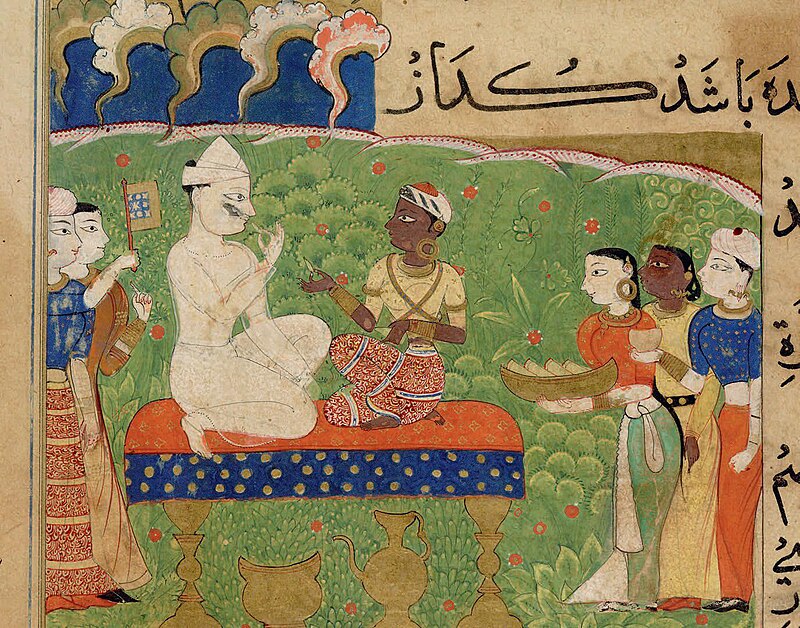
thumb|The guru-smiti relationship. Watercolour, Punjab Hills, India, 1740.
Guru ( ; IAST: guru) is a Sanskrit term for a "mentor, guide, expert, or master" of certain knowledge or field. In pan-Indian traditions, a guru is more than a teacher: traditionally, the guru is a reverential figure to the disciple (or shisya in Sanskrit, literally seeker [of knowledge or truth]) or student, with the guru serving as a "counsellor, who helps mould values, shares experiential knowledge as much as literal knowledge, an exemplar in life, an inspirational source and who helps in the spiritual evolution of a

Indian national calendar
Indian National calander format

culture of India
pattern of human activity and symbolism associated with India and its people

cinema of India
filmmaking industry in India

dharmacakra
thumb|The ancient Dharmachakra symbol used by Emperor Ashoka.
Paan
Hindi word for betel used for a stimulating and psychoactive preparation combined with areca nut and/or cured tobacco

bindi
upright|thumb|Hindu woman in Kullu, Himachal Pradesh wearing a stick-on bindi
sky lantern
flying lantern used during celebrations
Din-e Ilahi
syncretic religion propounded by Mughal emperor Akbar in 1582
shalwar kameez
costume for men and women consisting of trousers and a tunic, worn in South and Central Asia
Om Namah Shivaya
Hindu mantra

Swami
thumb|Swami Saradananda
Swami (; ; sometimes abbreviated sw.) in Hinduism is an honorific title given to an ascetic who has chosen the path of renunciation (sanyāsa). It is used either before or after the subject's name (usually an adopted religious name). An alternative form, swamini (), is sometimes used by female renunciates.
banana leaf
leaf of the banana plant

chillum
thumb|right|An Italian-made chillum
thumb|Traditional earthen chillum displayed for sale at Chawk Bazaar Jorhat, [[Assam]]
.png)
howdah
thumb|right|Elephant with howdah

mushaira
thumb|Depiction of Ghalib at a Mushaira
Mushaira () is a traditional Urdu poetry gathering in which poets publicly recite their work, often engaging in forms of improvisation and competitive performance. Mushairas, also known as mehfil or mushairi, have been a defining institution of Urdu literary culture in North India, Pakistan, and the Deccan, particularly among Hyderabadi Muslims. It is often regarded as a forum for free self-expression.
durbar
Persian-derived term for a formal meeting where the ruler held discussions regarding the state

mangalsutra
thumb|Indian Mangalsutra with black beads
thumb|A mangala sutra before being tied around a bride's neck.|268x268px
A mangala sutra (), or tali (ISO: tāḷi), is a necklace worn by married Hindu women. During a Hindu wedding, the mangalasutra is tied around the neck of the bride by the groom. The ceremony is known as the .

manjaa
thumb|Traditional Indian charpai. At the near end, the lacing for re-tensioning the bias weave.
thumb|One of many charpai patterns
Charpai (also, kaithu kattil, rope cot, charpaya, charpoy, khat, khatla, manja, or manji) is a traditional woven bed used across South Asia. The name charpai is a compound of char "four" and pay "footed". Regional variations are found in Afghanistan and Pakistan, North and Central India, Bihar and Myanmar.
feminism in India
set of movements for women's rights in India
name of India
various names used for India
snake charming
practice of appearing to hypnotise a snake
National Pledge
oath of allegiance to the Republic of India

kulhar
thumb|upright=1.35|Tea served in a kulhar
A kulhar (Hindi: कुल्हड़ and Urdu: کلہڑ) or kulhad, matir bhar () or simply bhar (), sometimes called a shikora, is a traditional handleless pottery cup from South Asia that is typically undecorated and unglazed, and is meant to be disposable. Kulhars are almost never reused.
Saare Jahan se Achcha
Urdu poem
water lantern
type of lamp that floats
prostitution in India
overview of the legality and practice of prostitution in India
Punjabi ghagra
outfit worn by Women in Punjab, India
item number
musical performance in Indian cinema

Dalit feminism
Feminism that questions caste and gender roles
%20yang%20dijual%20di%20dataran%20puncak%20Jabal%20Rahmah%2C%20Mekah.jpg)
Attar
thumb|Attar being sold at the top of Mount Arafat|Jabale Rahmah, [[Mecca.]]
Ministry of Culture
ministry of India

Rabindra Sangeet
songs composed by Rabindranath Tagore
Indo-Persian culture
Persian aspects integrated into or absorbed into the cultures of the Indian subcontinent
Alta
red dye to adorn hands and feet especially of women for weddings and festivals in the Indian subcontinent
Manipuri pony
traditional breed of horse originated from Manipur (Kangleipalk) State

Sringara
thumb|Expression of Sringāra in BharatanatyamSringara (, ) is one of the nine rasas, usually translated as erotic love, romantic love, or as attraction or beauty. Rasa means "flavour", and the theory of rasa is the primary concept behind classical Indian arts including theatre, music, dance, poetry, and sculpture. Much of the content of traditional Indian arts revolves around the relationship between a man and a woman. The primary emotion thus generated is Sringara. The romantic relationship between lover and beloved is a metaphor for the relationship between the individual and the divine.
Indian martial arts
fighting systems of the Indian subcontinent

Indomania
Indomania or Indophilia refer to the special interest that India, Indians and their cultures and traditions have generated across the world, more specifically among the cultures and civilisations of the Indian subcontinent, as well those of the Arab and Western world. The initial British interest in governing their newly absorbed territories awoke the interest in India, in particular its culture and ancient history. Later the people with interests in Indian aspects came to be known as Indologists and their subject as Indology. The opposite of Indomania is Indophobia.
gamosa
thumb|350px|A Gamusa made from Assam silk|Pat silk with intricate designs.
Indian red
color
Tradition of removing shoes in home
cultural practices
Vedic mythology
mythology of brahmanism
Gamcha
thumb|right|Bangladesh|Bangladeshi Rickshaw Puller wearing traditional Gamcha
thumb|Milk salesman wearing Gamchha in Nepal
Gamcha (or Gamchhā, Gāmchhā, Gāmuchhā (Odia), Gamusā (Assamese) and Angochha) is a rectangular piece of traditional coarse cotton cloth, sometimes with a checked design, worn as traditional scarf by men in the Indian subcontinent, mainly in Eastern India (including Assam), Bangladesh, as well as in eastern Terai of Nepal. It also became bit popular in other cultures of India and now in what is known as Pakistan after the Indian partition, as well as various parts of South
Kitty Party
women's savings club
Izzat
the concept of honour
Mela
200px|thumb|right|A procession of Akharas marching .....over a temporary bridge over the [[Ganges river, Kumbh Mela at Allahabad, 2001]]
theatre of India
dramatic tradition of India
Cultural Zones of India
zones defined by the Ministry of Culture of the Government of India
superstition in India
widespread social issue in India
Ganga-Jamuni tehzeeb
syncretic fusion of Hindu-Muslim cultures in Northern India
Meitei mythology
mythology of the Meitei people which is sometimes intertwined with historical facts

Kundan
Kundan, meaning pure gold, is a traditional form of Indian gemstone jewellery involving a gem set with a gold foil between the stones and its mount, usually for elaborate necklaces and other jewellery.
North Indian culture
overview of the culture in North India
Bagh prints
a traditional wood block printing an Indian handicraft originating in Bagh, Dhar district of Madhya Pradesh, India.
Jharokha Darshan
practice of addressing the public at the balcony at forts and palaces of medieval kings in India
Kothi
type of transgender in India
Indian tea culture
culture in India
Kashmiriyat
thumb|300px|The Jwala Ji Temple|Jwala Mukhi Mandir in [[Khrew, located in the Indian-administered union territory of Jammu and Kashmir, hosts the Jwalamukhi Mela annually that is celebrated by both Kashmiri Hindus and Kashmiri Muslims. The joint celebration of religious festivals by both Kashmiri Hindus and Kashmiri Muslims in the Kashmir Valley is said to be an emblem of the spirit of Kashmiriyat.]]