Category
page 1Culture of the Soviet Union

Russian
East Slavic language
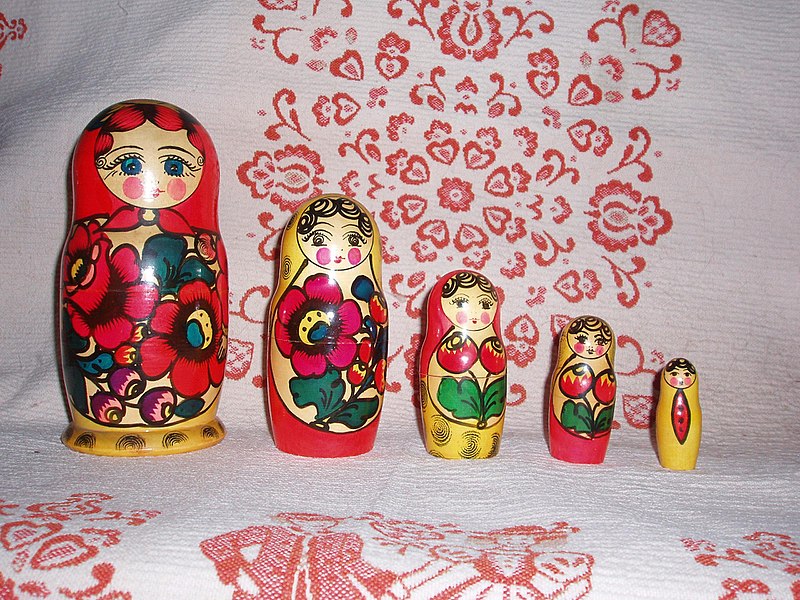
matryoshka doll
Japanese-created Russian cultural icon: set of wooden dolls of decreasing size placed one inside another

sambo
martial art sport developed in the USSR

samizdat
Samizdat (, , ), also Samvydav () was a form of dissident activity across the Eastern Bloc in which individuals reproduced censored and underground makeshift publications, often by hand, and passed the documents from reader to reader. The practice of manual reproduction was widespread, because printed texts could be traced back to the source. This was a grassroots practice used to evade official Soviet censorship.

dacha
right|300px|thumb|Soviet-era dacha with hammer and sickle in Yekaterinburg
A dacha () is a seasonal or year-round second home, often located in the exurbs of post-Soviet countries, including Russia. A cottage (, '''') or shack serving as a family's main or only home, or an outbuilding, is not considered a dacha, although some dachas recently have been converted to year-round residences and vice versa.
Gopnik
A gopnik, (feminine: gopnitsa) is a member of a juvenile delinquent urban subculture in Russia, Ukraine, Belarus, and some other former Soviet republics. In the 21st century the image of "gopnik" is mostly preserved as an imitation of the stereotype, e.g., as an artistic image in Russian pop-culture and some other countries.
National Academy of Sciences of Ukraine
academy of sciences
Palace of the Soviets
unfinished Soviet architecture project

Misha
Misha (), also known as Mishka () or The Olympic Mishka (), is the name of the Russian Bear mascot of the 1980 Moscow Olympic Games (the XXII Summer Olympics). He was designed by children's books illustrator Victor Chizhikov.
Homo Sovieticus
phrase

Proletkult
Proletkult (), a portmanteau of the Russian words "proletarskaya kultura" (proletarian culture), was an experimental Soviet artistic institution that arose in conjunction with the Russian Revolution of 1917. This organization, a federation of local cultural societies and avant-garde artists, was most prominent in the visual, literary, and dramatic fields. Proletkult aspired to radically modify existing artistic forms by creating a new, revolutionary working-class aesthetic, which drew its inspiration from the construction of modern industrial society in agrarian Russia.
National Academy of Sciences of Belarus
national academy of Belarus
Zhdanov Doctrine
Soviet cultural doctrine developed by Central Committee secretary Andrei Zhdanov in 1946 that proposed the world was divided into two camps: the "imperialistic", headed by the United States; and "democratic", headed by the Soviet Union
overtone singing
singing technique
naukograd
Naukograd (, also technopole), meaning "science city", is a formal term for towns with high concentrations of research and development facilities in Russia and the Soviet Union, some specifically built by the Soviet Union for these purposes. Some of the towns were secret and were part of a larger system of closed cities in the USSR, many built by forced labour from the Soviet Gulag. In the Russian Federation in post-Soviet times, the term is used generally for about seventy towns that have concentrations of scientific research and production, and specifically, refers to a small number of towns
latinisation in the Soviet Union
1920s–1930s campaign to develop Latin alphabets for the languages of the Soviet Union

Likbez
thumb|"- Woman, learn to read and write! - Oh, mother! If you were literate, you could help me!" A poster by Elizaveta Kruglikova advocating female literacy, 1923.
Moscow State Circus
architectural structure
communal apartment
type of living in Soviet Union and Russia
religion in the Soviet Union
religion in the country
string bag
type of reuseable shopping bag

telnyashka
A telnyashka (, ) or telnik () is a type of undershirt worn with military uniforms of the Russian Armed Forces. They traditionally feature blue and white horizontal stripes, and can come in varying thicknesses and may be sleeved or sleeveless. Other variations of telnyashka with different colour schemes have been adopted based on a unit's affiliation.
Russian Telegraph Agency
state news agency in Soviet Russia

UNOVIS
thumb|280px|The seal of UNOVIS; Kazimir Malevich's Black square
culture of the Soviet Union
Moscow Nikulin Circus on Tsvetnoy Boulevard
circus and circus building in Moscow, Russia
Komarovo
municipal settlement in St. Petersburg, Russia
Soviet cuisine
culinary traditions of the Soviet Union
palace of culture
large house of culture, major club-house (thus named especially in socialist societies)
Small Soviet Encyclopedia
Russian-language encyclopedia, first published in 1928
Uzbek Soviet Encyclopedia
Galiaskar Kamal Tatar Academic Theatre
leading Tatar theater in Kazan, Russia
Tajik Soviet Encyclopedia
first universal encyclopedia in the Tajik language
People's Commissariat for Education
Soviet ministry responsible for education
National Opera and Ballet Theatre of Moldova
opera and ballet theatre, former monument of art of national importance in Moldova
languages of the Soviet Union
languages of a geographic region

Moral Code of the Builder of Communism
set of twelve codified moral rules in the Soviet Union
New Soviet man
Archetype of the ideal Soviet citizen

Song of the Year
Russian annual music festival held before New Year
Moldavian Soviet Encyclopedia
defunct multi-purpose Encyclopedia of Moldavia, issued in the USSR
Kazakh Soviet Encyclopedia
encyclopedia
Artists' Union of the USSR
organization
Stilyagi
Stilyagi (, , "stylish, style hunters") were members of a Soviet youth counterculture movement from the late 1940s until the early 1960s. A stilyaga () was primarily distinguished by snappy clothing—preferably foreign-label clothing acquired from fartsovshchiks (black market sellers)—that contrasted with the communist realities of the time, and a fascination with zagranitsa, modern Western music and fashions corresponding to those of the Beat Generation. English writings on Soviet culture variously translated the term as "dandies", "fashionistas", "beatniks", "hipsters", or "zoot suiters".
Russian Association of Proletarian Musicians
former association of Soviet musicians
elektrichka
thumb|ER9 elektrichka in Murom|alt=Green-and-orange electrified train
thumb|"Ivolga" (EG2T) on Moscow Central Diameters
Ministry of Culture
former government office of the Soviet Union
Programme One
Soviet television channel
nonconformist art
Soviet art outside of the rubric of Socialist Realism
N.N. Miklukho-Maklai Institute of Anthropology and Ethnography RAS
research institute in Moscow, Russia
magnitizdat
thumb|right|Tape recorder "Tembr" (1964) without casing (From museum of political history of Russia)
Magnitizdat () was the process of copying and distributing audio tape recordings that were not commercially available in the Soviet Union. It is analogous to samizdat, the method of disseminating written works that could not be officially published under Soviet political censorship. It is technically similar to bootleg recordings, except it has a political dimension not usually present in the latter term.
agit-train
thumb|right|350px|Section of a painted car of a Soviet "agit-train" from a 1921 newsreel.
An agit-train (Russian: агитпоезд) was a locomotive engine with special auxiliary cars outfitted for propaganda purposes by the Bolshevik government of Soviet Russia during the time of the Russian Civil War, War Communism, and the New Economic Policy. Brightly painted and carrying on board a printing press, government complaint office, printed political leaflets and pamphlets, library books, and a mobile movie theater, agit-trains traveled the rails of Russia, Siberia, and Ukraine in an attempt to introdu
cyrillisation in the Soviet Union
move from Latin scripts to Cyrillic
Joc dance ensemble
Moldavian folk dance company
Table-glass
type of drinkware made from especially hard and thick glass

Octobering
thumb|250px|Octobering in 1927.
Octobering was a naming ceremony which occurred during the early era of the Soviet Union, which involved giving a name to a newborn, introduced by the state on the official basis of Marxist–Leninist atheism as an attempt to replace the religious tradition of christening. The term serves as a translation of two synonymous Soviet neologisms: Oktyabryenie, coined in an analogy to Kreshcheniye, literally, the sacrament of "baptism", and Oktyabriny instead of '''', the latter being a family celebration on the occasion of baptism.
Names of Soviet origin
named created in the USSR
Workers' Youth Theatre
Soviet theatre type
Turkmen State Circus
circus building in Ashgabat, Turkmenistan
Programme Two
television channel of SCTV
sovok
Sovok () is a pejorative term related to the Soviet Union: the state itself, the mindset and way of life of average Soviet people, and vestiges of the Soviet Union in the psychology of people in modern Russia.