Category
page 1Currencies of Germany

Deutsche Mark
official currency of West Germany and later Germany from 1948 to 2002

thaler
thumb|300px|Four thalers and one double thaler, compared to a U.S. Quarter (United States coin)|quarter (bottom center):
Clockwise from top left:
Saxe-Altenburg 1616 (reverse),
Saxony 1592,
Austria 1701 (obverse),
Saxony 1592 (obverse),
Center: double thaler, Austria 1635 (obverse).
A thaler, or taler ( ; , previously spelled ), is one of the large silver coins minted in the states and territories of the Holy Roman Empire and the Habsburg monarchy during the Early Modern period. A thaler size silver coin has a diameter of about and a weight of about 25 to 30 grams (roughly 1 ounce). The word

Reichsmark
The ' (; sign: ℛ︁ℳ︁; abbreviation: RM') was the currency of Germany from 1924 until the fall of Nazi Germany in 1945, and in the American, British and French occupied zones of Germany, until 20 June 1948. The was then replaced by the , to become the currency of West Germany and then all of Germany after the 1990 reunification. The was used in the Soviet occupation zone in Germany until 23 June 1948, where it was replaced by the East German mark. The was subdivided into 100 (Rpf or ℛ︁₰). The mark is an ancient Germanic weight measure, traditionally a half pound, later used for several coins; ()
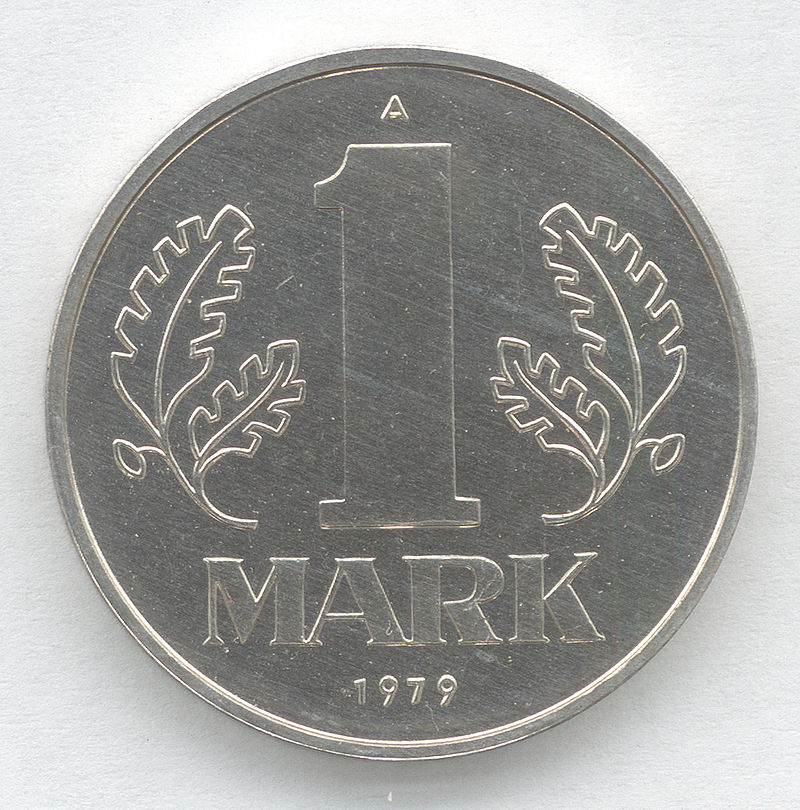
East German mark
currency

groschen
thumb|upright=1.4|Barile (large groschen), Florence, 1506

pfennig
thumb|right|[[Kingdom of Prussia|Prussia: 1 pfenning 1852. The obverse reads: 360 [make up] one thaler.]]
thumb|right|German Empire: 10 pfennig iron coin 1917

kreuzer
thumb|250px|1690 Kreuzer of Friedrich Karl, administrator
thumb|250px|1776 Kreuzer of Bern
The Kreuzer (), in English also spelled kreutzer ( ), was a coin and unit of currency in the southern German states prior to the introduction of the German gold mark in 1871–1873, and in Austria and Switzerland. After 1760 it was made of copper. In south Germany the kreuzer was typically worth 4 Pfennige and there were 60 Kreuzer to a gulden. Kreuzer was abbreviated as Kr, kr, K or Xr.
German mark
German currency from 1871–1923

Papiermark
The Papiermark (; 'paper mark') was a derisive term for the Mark (sign: ℳ︁) after it went off the gold standard, and most specifically with the era of hyperinflation in Germany of 1922 and 1923. Formally, the same German mark was used from 1871 to 1923. Like many countries, Germany departed the gold standard due to the outbreak of World War I, and stopped issuing gold coins backed in marks in August 1914. Precious metals rapidly disappeared from circulation, and inflation occurred as paper money was used to cover war debts in 1914 to 1918. Still, the papiermark is more associated with the earl

Rentenmark
The Rentenmark (; RM) was a currency issued on 15 November 1923 to stop the hyperinflation of 1922 and 1923 in Weimar Germany, after the previously used Papiermark had become almost worthless. It was subdivided into 100 Rentenpfennig and was replaced in 1924 by the Reichsmark.
heller
originally a German coin later used elsewhere in Central Europe
mark
currency or unit of account in many nations
Danzig gulden
currency of the Free City of Danzig between 1923 and 1939
German East African rupie
currency

Conventionsthaler
thumb|upright=1.2|: Francis I, Emperor of Austria, 1822; [[Frederick Augustus I, King of Saxony, 1813, Dresden Mint]]

Vereinsthaler
thumb|right|250px|Austrian Vereinstaler of 1866The Vereinsthaler (, union thaler) was a standard silver coin of German Confederation, used in most German states and the Austrian Empire in the years before German unification.
Saar franc
currency of the Saar Protectorate in 1948-1956
Prussian thaler
currency of Prussia, used until 1857
German ostruble
Occupation currency of World War I
Saar mark
currency

Reichsthaler
thumb|Electorate of Saxony, Reichstaler from 1575 from the Dresden mint, Mmz. HB
The Reichsthaler (; modern spelling Reichstaler), or more specifically the Reichsthaler specie, was a standard thaler silver coin introduced by the Holy Roman Empire in 1566 for use in all German states, minted in various versions for the next 300 years, and containing 25–26 grams fine silver.
German ostmark
short-lived currency used in eastern areas occupied by Germany in 1918

notgeld
upright=1.35|thumb|Different examples of German notes, 1917–19
'''''' (German for 'emergency money' or 'necessity money') is money issued by an institution in a time of economic or political crisis. The issuing institution is usually one without official sanction from the central government. This usually occurs when not enough state-produced money is available from the central bank. In particular, generally refers to money produced in Germany and Austria during World War I and the Interwar period. Issuing institutions could be a town's savings banks, municipalities and private or state-owned f
Chiemgauer
The Chiemgauer is a regional currency in Prien am Chiemsee, Bavaria, Germany.
It was created by Christian Gelleri in 2003 and named after the Chiemgau, a region around the Chiemsee lake.
Gelleri was inspired by the economist Silvio Gesell.
The Chiemgauer is intended to increase local employment, support local culture, promote sustainability, and stimulate the local economy.
It is one of the longest sustained and most successful implementations of demurrage currency since 1900.
New Guinean mark
currency of German New Guinea between 1884 and 1911

South German gulden
currency of the states of southern Germany between 1754 and 1873
Silbergroschen
The Silbergroschen was a coin used in Prussia and several other German Confederation states in northern Germany during the 19th century, worth one thirtieth of a Thaler.
Foreign exchange certificate
tool of foreign exchange control
Bremen thaler
currency of the Free Hanseatic City of Bremen
Forum check
form of hard currency in East Germany
list of commemorative coins of the Federal Republic of Germany
Wikimedia list article
German South West African mark
currency of German South West Africa between 1885 and 1915
Hamburg mark
hamburger currencies
North German thaler
currency used from 1690 to 1873
Saxon thaler
currency
Westphalian frank
currency of the Kingdom of Westphalia