Category
page 1Economy of the Soviet Union

perestroika
Perestroika ( ; ) was a political reform movement within the Communist Party of the Soviet Union (CPSU) during the late 1980s, widely associated with CPSU general secretary Mikhail Gorbachev and his ("transparency") policy reform. literally means "restructuring", referring to the restructuring of the political economy of the Soviet Union in an attempt to end the Era of Stagnation.

Stalinism
thumb|Official portrait of Joseph Stalin from 1945
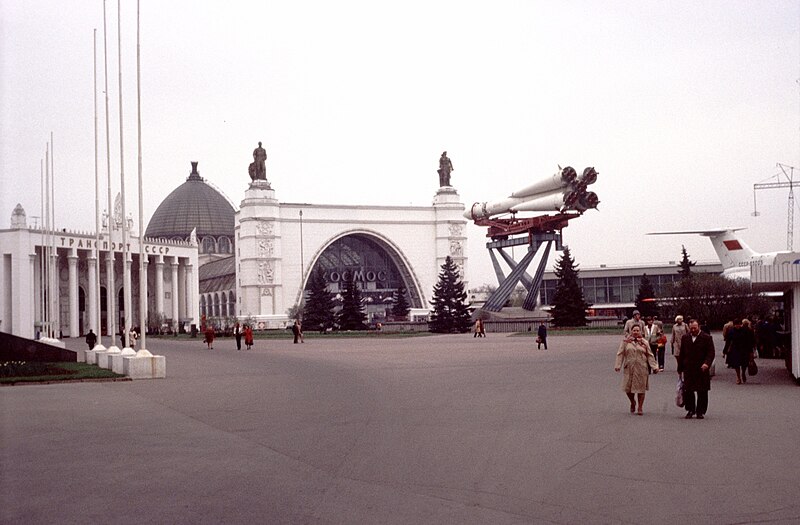
Exhibition of achievements of national economy
trade show in Moscow, Russia

Khrushchyovka
thumb|Panel khrushchevka in Tomsk
%2C%20Scientist%20and%20Co-worker%20with%20Lenin%20(Birth%20Centenary)).jpg)
Gosplan
The State Planning Committee, commonly known as Gosplan ( ), was the agency responsible for central economic planning in the Soviet Union. Established in 1921 and remaining in existence until the dissolution of the Soviet Union in 1991, Gosplan had as its main task the creation and administration of a series of five-year plans governing the economy of the USSR.
economy of the Soviet Union
economy of the country
Federal State Statistics Service
Russia's principal government institution in charge of statistics and census data
real socialism
Soviet-type economic planning enforced by the ruling communist parties
Artel
An artel () was any of several types of cooperative associations of workers in pre-revolutionary Russia. In the Soviet Union, the term was applied to production cooperatives. They began centuries ago but were especially prevalent from the time of the emancipation of the Russian serfs (1861) through the 1950s. In the later Soviet period (1960s–1980s), the term was mostly phased out with the complete monopolization of the Soviet economy by the state.
industrialization in the Soviet Union
overview article

udarnik
thumb|right|Agitprop poster by [[Vladimir Mayakovsky: "Hurry to join shock brigades!"
– Do you want it? Then join.
1. Want to defeat cold?
2. Want to defeat hunger?
3. Want to eat?
4. Want to drink?
Hurry, join the advanced exemplary labour group. ]]
In the terminology of the Soviet Union, the Eastern Bloc, and other communist countries, an udarnik (, plural udarniks or udarniki; ), also known in English as a shock worker or strike worker (collectively known as shock brigades or a shock labor team) is a high productivity worker. It derived from the expression "udarny trud" for "superproducti
State quality mark of the USSR
certification mark

monotown
thumb|Novotroitsk, a monotown in [[Orenburg Oblast, Russia]]
500 Days
1990 Soviet economic plan
Northern river reversal
socialist emulation
form of competition that was practiced in the Soviet Union

Goznak
thumb|300px|One thousand rubles of 2000-2004
Gossnab
State Supplies of the USSR, known as the Gossnab of USSR () was active from 1948 to 1953, and 1965 to 1991. Its full name was the State Committee for Material and
Technical Supply of the USSR. Its primary responsibility was the wholesale allocation of material and technical goods to state enterprises, a critical state function in the absence of markets.
Sovznak
Sovznaks () were promissory notes issued in Soviet Russia in 1919 and used during 1919–1924. The name is an abbreviation of the expression "Sovetskiye znaki" (Советские знаки, Soviet tokens), which in its turn was an abbreviation of the official terms (советские казначейские знаки, расчётные знаки РСФСР, денежные знаки РСФСР (СССР) ) used during different periods. They were the de facto money of the time. The term "token" was a euphemism for "money", since communism was supposed to abolish money, and sovznaks were considered to be a temporary, transitional instrument.
NEPman
REDIRECT New Economic Policy#NEPmen
Stalinka
thumb|Stalin's Empire style in [[Nikopol, Ukraine]]
Stalinka, Stalinist apartment buildings or Stalin-era buildings, are a common colloquial term for apartment buildings constructed in the USSR from 1933 to 1961, primarily during the rule of Joseph Stalin. They were predominantly built in the neoclassical style (Stalinist Classical). Stalinkas are solidly constructed multi-apartment buildings with full utilities, featuring non-combustible materials and typically at least two stories high.
The term Stalinka does not include other types of residential buildings from Stalin's era, such as barrack
Nuclear Explosions for the National Economy
Soviet program investigating peaceful use of nuclear bombs
Kerenka
thumb
khozraschyot
Khozraschyot (; short for , 'economic accounting') was an attempt to introduce capitalist concepts of profit and profit center into the planned economy of the Soviet Union. Khozraschyot introduced a certain degree of independence of enterprises (which continued to be state-owned and subject to state control) and allowed for self-management and self-financing within the framework of prices set by the Soviet government.
Department against Misappropriation of Socialist Property
The Department Against Misappropriation of Socialist Property (abbreviation: OBKhSS, ) functioned as the Soviet financial police. It administered economic laws combating theft of property in the organizations and institutions of state commerce, consumer, industrial and individual co-operatives, savings-banks and procurement agencies; it also acted against bribery and speculation.
Foreign exchange certificate
tool of foreign exchange control
Soviet-type economic planning
centralized investment and economic input decision-making model under Leninist states
Partmaximum
Partmaximum () was a limit on the salary of a member of the Communist Party in the Soviet Union, a maximum wage. Partmaximum was introduced in 1920 by a decree of the All-Russian Central Executive Committee (ВЦИК) for all communists that held executive positions in Party, industry, government and Soviet trade unions. Their salary was not supposed to exceed that of a highly qualified industrial worker. If a communist had other incomes, e.g., honoraria or royalties, he had to transfer a specified percentage from the amount above the partmaximum into the Party funds.

Net material product
statistical index used in the USSR as a susbstitute to GDP
Shturmovshchina
Shturmovshchina (, storming) was a common Soviet work practice of frantic and overtime work at the end of a planning period in order to fulfill the planned production target. The practice usually gave rise to products of poor quality at the end of a planning cycle.
Soviet combat vehicle production during World War II
Soviet military vehicle production during World War II

Kuzbass Autonomous Industrial Colony
Soviet experiment in workers' control
Blackboards
soviet Union monetary penalty
Perestroika in Kazakhstan
Unpromising villages
Soviet term for uneconomic settlements
Shock construction project
Central Economic Mathematical Institute
economic theory and econometrics research center in Moscow
production association
group of companies working together to manufacture a product