Category
page 1Endemic birds of Hawaii

Nene
species of bird

Hawaiian Crow
species of bird

Hawaiian duck
species of bird

Laysan Duck
species of bird

Iiwi
The ʻiʻiwi (pronounced , ) or scarlet honeycreeper (Drepanis coccinea), is a species of Hawaiian honeycreeper. The iiwi is a highly recognizable symbol of Hawaii.

Hawaiian honeycreeper
subfamily of birds

ʻAkohekohe
The ākohekohe (Palmeria dolei), or crested honeycreeper, is a species of Hawaiian honeycreeper. It is endemic to the island of Maui in Hawaii. The ākohekohe is susceptible to mosquito‐transmitted avian malaria (Plasmodium relictum) and only breeds in high‐elevation wet forests (> ).

Hawaiian Hawk
species of bird

Hawaiian Coot
species of bird

Laysan Finch
species of bird

Palila
The palila (Loxioides bailleui) is a critically endangered finch-billed species of Hawaiian honeycreeper. It has a golden-yellow head and breast, with a light belly, gray back, and greenish wings and tail. The bird has a close ecological relationship with the māmane tree (Sophora chrysophylla), and became endangered due to destruction of the trees and accompanying dry forests. The first specimen of the palila was collected in 1876 at the Greenwell Ranch on the Big Island by Pierre Étienne Théodore Ballieu (1828–1885), who was French consul in Hawaiʻi from 1869 to 1878. The type specimen (No. 1
ʻAnianiau
The anianiau (pronounced ) (Magumma parva) is a species of Hawaiian honeycreeper that is endemic to upper elevation forests on the island of Kauai.
.jpg)
Apapane
The apapane ( ;) (Himatione sanguinea) is a small, crimson species of Hawaiian honeycreeper endemic to the Hawaiian Islands. They are the most abundant and widely distributed honeycreeper and are found on the islands of Hawaii, Maui, Lānai, Kauai, Molokai and Oahu.
Psittirostra psittacea
The ʻōʻū (pronounced ) (Psittirostra psittacea) is an extinct species of Hawaiian honeycreeper that was endemic to the Hawaiian islands. It had a dark green back and olive green underparts; males had a yellow head while females had a green head. Its unusual beak seems to have been adapted to feeding on the fruits of Freycinetia arborea. It had a strong flight which it used to fly considerable distances in search of this vine, but it also ate other fruits, buds, flowers and insects.

Maui Parrotbill
Hawaiian Bird Species
Chasiempis sandwichensis
species of bird

Nihoa Finch
species of bird

ʻAkikiki
The akikiki (pronounced ) (Oreomystis bairdi), also called the Kauai creeper, is a critically endangered Hawaiian honeycreeper endemic to Kauai, Hawaii. It is the only member of the genus Oreomystis. Of the Hawaiian birds known to be extant, it is thought to be the most endangered, with only 454 wild individuals reported as of 2018. A survey report in 2021 estimated the population at 45 with a 5 percent annual decrease, in July 2023 the remaining number of wild birds was estimated to be just 5 individuals.

Olomaʻo
The olomao (Myadestes lanaiensis) is a small, dark solitaire endemic to Maui, Lānai and Molokai in the Hawaiian Islands. It is currently listed as Critically Endangered under the IUCN Red List of Threatened Species.

Loxops caeruleirostris
The akekee (Loxops caeruleirostris) or Kauai ākepa is a bird species in the family Fringillidae, where it is placed in the Hawaiian honeycreeper genus Loxops. It is endemic to the island of Kauai where it is found in small numbers in higher elevations. Because of their similar size, shape, and unusual bill, the akekee and the ākepa (Loxops coccineus) were for some time classified as a single species. This was eventually changed, because of differences in their color, nesting behavior, and calls. The akekee is extremely threatened and is predicted to face imminent extinction if mosquito control

Bryan's Shearwater
species of bird

Chlorodrepanis virens
species of bird

Maui Alauahio
species of bird

Hawaiian Petrel
species of bird

Myadestes obscurus
The ōmao (Myadestes obscurus), also called the Hawaiian thrush, is an endemic species of robin-like bird found only on the island of Hawaii. Ōmao are closely related to the other endemic thrushes of the Hawaiian Islands, the kāmao, the olomao, and the puaiohi. Ōmao are found primarily in rainforests in the eastern and southeastern regions of the Big Island. Population estimates approximate 170,000 birds, making it the most common of the Hawaiian thrushes. It appears to have a stable population, but because the entire population exists on a small range and is endemic to a single island, it is c

‘Elepaio
thumb|Illustration by Joseph Smit
The elepaio are three species of monarch flycatcher in the genus Chasiempis. They are endemic to the Hawaiian Islands, and were formerly considered conspecific. They measure 14 cm long and weigh 12–18 g. One species inhabits the Big Island, another Oahu and the third Kauai. Being one of the most adaptable native birds of Hawaii, no subspecies have yet become extinct, though two have become quite rare.

Chlorodrepanis stejnegeri
species of bird
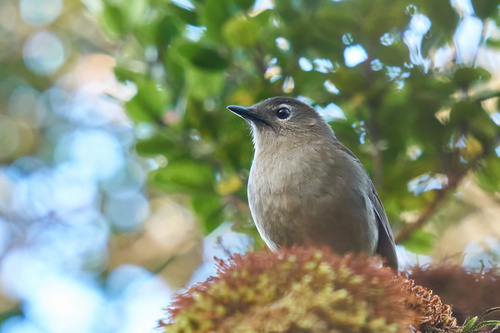
Puaiohi
The puaiohi (Myadestes palmeri) or small Kauai thrush is a rare species of songbird in the thrush family, Turdidae, that is endemic to the Hawaiian island of Kauai. It is closely related to the other three endemic Hawaiian thrushes, the kāmao, olomao, and ōmao. It was first collected by Henry Palmer in 1891 at Halemanu around the entrance to the Kōkee State Park.

Chlorodrepanis flava
species of bird

Kauaʻi ‘Elepaio
species of bird

Newell's Shearwater
species of bird

O'ahu ‘Elepaio
species of bird
Loxops ochraceus
species of bird
Pueo
The pueo (Asio flammeus sandwichensis) is a subspecies of the short-eared owl and is endemic to Hawaii. The pueo is one of the more famous of the various physical forms assumed by aumākua (ancestor spirits) in Hawaiian culture.
Nihoa Millerbird
subspecies of bird
Hawaiian stilt
subspecies of bird