Category
page 1Extinct birds of Hawaii
Kauaʻi ʻŌʻō
extinct species of Moho songbird
Kioea
The kioea or kiowea (Chaetoptila angustipluma) is an extinct species of Hawaiian honeyeater that was endemic to the islands of Hawaii before going extinct around the mid-19th century.
Bishop's ʻŌʻō
species of bird
Hawaiʻi ʻŌʻō
species of bird

Laysan Rail
species of bird

Poʻouli
The poo-uli (Melamprosops phaeosoma) or Hawaiian black-faced honeycreeper is an extinct species of passerine bird that was endemic to the island of Maui in Hawaiʻi. It is considered to be a member of the Hawaiian honeycreepers, and is the only member of its genus Melamprosops. It had a black head, brown upper parts and pale gray underparts. This bird inhabited only the wetter, easternmost side of Maui, where it had rapidly decreased in numbers. With extinction threatening, efforts were made to capture birds to enable them to breed in captivity. These efforts were unsuccessful; in 2004, only tw
Mohoidae
Mohoidae, also known as the Hawaiian honeyeaters, is a family of Hawaiian species of now recently extinct, nectarivorous songbirds in the genera Moho (ōō) and Chaetoptila (kioea). These now extinct birds form their own family, representing the only complete extinction of an entire avian family in modern times, when the disputed family Turnagridae is regarded as invalid. The last surviving species in the family, the Kauaʻi ʻōʻō (Moho braccatus), became extinct after 1987.
Hawai'i Mamo
species of bird
Oʻahu ʻŌʻō
species of bird
%20-%20Kamao%20or%20Large%20Kauai%20Thrush%20-%20specimen%20-%20lateral%20view.jpeg)
Kāmaʻo
thumb
The kāmao or large Kauai thrush (Myadestes myadestinus) is an extinct species of small, dark solitaire that was endemic to Kauai in the Hawaiian Islands.
Moho
genus of birds
Kona Grosbeak
species of bird
black mamo
species of bird

ʻUla-ʻai-Hawane
The ula-ai-hāwane (Ciridops anna) is an extinct species of small Hawaiian honeycreeper. The term ula-ai-hāwane is a Hawaiian phrase translating to "red [bird] that eats hāwane". It was only ever reported from the forested mountains of the Kohala, Hilo and Kona districts on the island of Hawaii. Fossil remains reveal that it (and at least one closely related species, Ciridops tenax) also existed at one time on other Hawaiian islands. The species is named after Anna Dole, wife of Sanford B. Dole.
Hawaiian Rail
species of bird
Lesser Koa Finch
species of bird
Greater Koa Finch
species of bird
Viridonia sagittirostris
species of bird
Lāna'i Hookbill
species of bird

Oahu Akialoa
species of bird
Kākāwahie
The kākāwahie or Molokai creeper (Paroreomyza flammea) is an extinct species of Hawaiian honeycreeper. It was found on the Hawaiian island of Molokai in Hawaii.

Akialoa obscura
species of bird
Rhodacanthis
'''Rhodacanthis, commonly known as the koa finches,''' is an extinct genus of Hawaiian honeycreeper in the subfamily Carduelinae of the family Fringillidae. All four species were endemic to Hawaii.
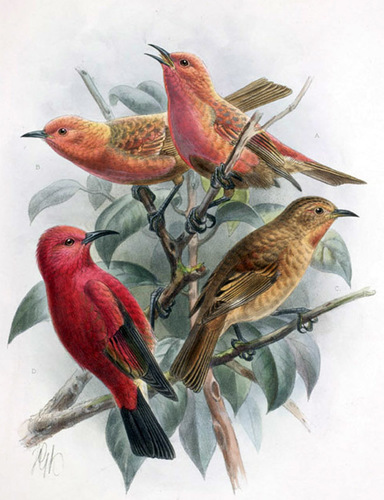
Himatione fraithii
species of bird
Akialoa
Akialoa is an extinct genus of Hawaiian honeycreeper in the subfamily Carduelinae of the family Fringillidae. The ʻakialoa species are all extinct, but they formerly occurred throughout Hawaii.
ʻĀmaui
The ʻāmaui (Myadestes woahensis) or Oahu thrush is an extinct species of thrush in the family Turdidae that was endemic to the island of Oahu. It was the first member of its genus to become extinct, c. 1850. It has sometimes been considered a subspecies of the olomaʻo (Myadestes lanaiensis).
Loxops wolstenholmei
species of bird
Chloridops
Chloridops is an extinct genus of Hawaiian honeycreeper in the subfamily Carduelinae of the family Fringillidae.

Lanai Akialoa
species of bird

Kauai Akialoa
species of bird
Ciridops
Ciridops is an extinct genus of Hawaiian honeycreeper species that occurred in prehistoric and historic times on the Hawaiian islands of Hawaii, Molokai, Kauai and Oahu. This genus was created in 1892 by Alfred Newton in an article published by the journal Nature on the basis of the ʻula-ʻai-hawane, which was named Fringilla anna by Sanford B. Dole in 1879.

Hemignathus affinis
species of bird

Moa-nalo
The moa-nalo are a group of extinct aberrant, goose-like ducks that lived on the larger Hawaiian Islands, except Hawaii itself, in the Pacific. They were the major herbivores on most of these islands until they became extinct after human settlement.
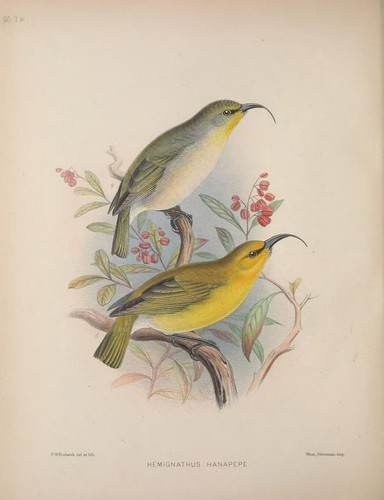
Hemignathus hanapepe
species of bird
Apteribis
Apteribis is an extinct genus of flightless birds in the ibis subfamily that was endemic to the Hawaiian Islands in the Pacific Ocean.
Laysan Millerbird
subspecies of bird
High-billed Crow
species of bird
Thambetochen
Thambetochen is an extinct genus of moa-nalo duck. It contains two species, the Maui Nui moa-nalo (T. chauliodous) and the smaller O'ahu moa-nalo (T. xanion).
thumb|upright|left|Restoration of T. xanion
thumb|upright|left|Restoration of T. chauliodous and Ptaiochen pau
The former was found on Maui and Molokai on Hawaii, the latter was found on Oahu. These birds were large, flightless ducks, with robust legs but small wings, which had evolved in isolation, on islands without terrestrial mammals. Their beaks had tooth-like lamellae and their diet was plants which they digested throug
Nēnē-nui
The nēnē-nui (Hawaiian: "great nēnē") or wood-walking goose (translation of scientific name Branta hylobadistes) is an extinct species of goose that once inhabited Maui and possibly (or closely related species) Kauai, Oahu and perhaps Molokai in the Hawaiian Islands. It is known from a large number of subfossil bones (several thousand bones from many dozens of individuals) found in Holocene cave sediments.
Small-billed Moa-nalo
species of bird (fossil)
Stilt-owl
The stilt-owls (Grallistrix) is an extinct genus of true owls which contains four species, all of which lived on the Hawaiian Islands.
Kauai Palila
species of bird
Wood Harrier
species of bird (fossil)

Corvus viriosus
species of bird
King Kong Grosbeak
species of bird
Turtle-jawed Moa-nalo
species of bird (fossil)
Giant Nukupu‘u
species of bird (fossil)
Maui Nui Large-billed Moa-nalo
species of bird (fossil)
O'ahu Petrel
species of bird (fossil)
Xestospiza fastigialis
species of bird
Talpanas
Talpanas lippa, the Kauaʻi mole duck, is an extinct species of duck. It was first described by Andrew N. Iwaniuk, Storrs L. Olson, and Helen F. James in the journal Zootaxa in November 2009. It is the only known member of the genus Talpanas. It was endemic to the Hawaiian island of Kauaʻi where the fossil remains were unearthed in the Makauwahi Cave, Maha‘ulepu. The archaeological association of the bones is about 6000 years BP (around 4050 BCE).
Xestospiza conica
species of bird
O'ahu Moa-nalo
species of bird (fossil)