Category
page 1Geology of Russia

Ural Mountains
mountain range in Russia

chernozem
Chernozem ( ), also called black soil, black earth, dark earth, regur soil or black cotton soil, is a black-colored soil containing a high percentage of humus (4% to 16%) and high percentages of phosphorus and ammonia compounds. Chernozem is very fertile and can produce high agricultural yields with its high moisture-storage capacity. However, prolonged agricultural use of chernozems still require replenishment with fertilizers because they easily can get depleted of nutrients through continuous decrease in humus content. Chernozems are a Reference Soil Group of the World Reference Base for So
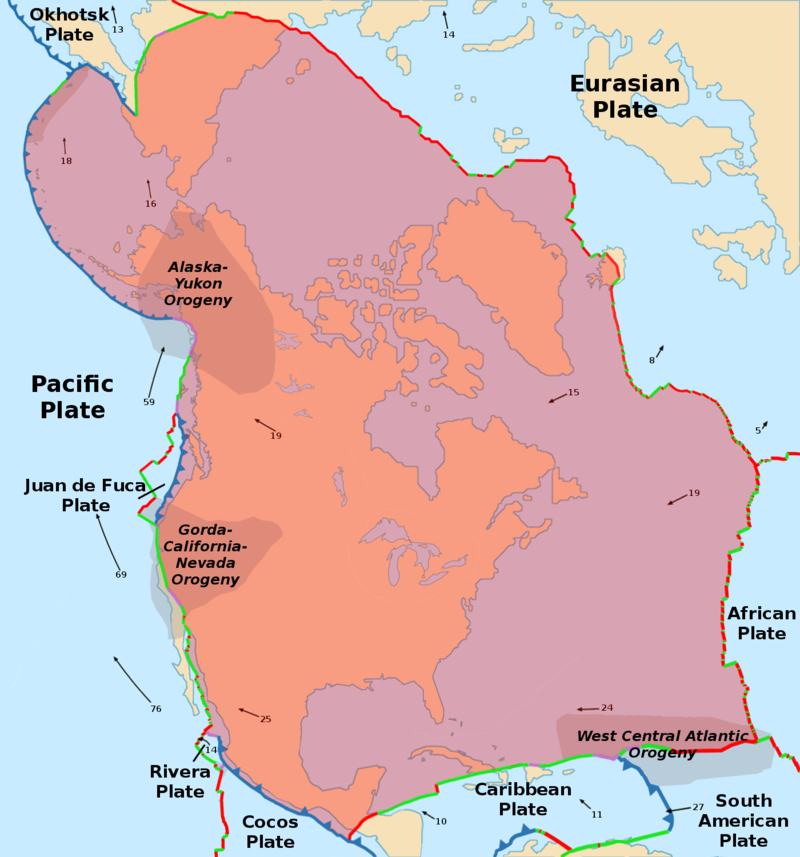
North American Plate
tectonic plate
Lena Pillars
protected area of Russia
Siberia
ancient continent
Okhotsk Plate
tectonic plate
Kuznetsk Basin
coal deposit in the Kemerovo Oblast of Russia
Suntar-Khayata Range
mountain range
Kondyor massif
mountain
Turgai Sea
large shallow body of salt water of the Mesozoic and Cenozoic Eras
Baikal Rift Zone
a series of continental rifts centered beneath Lake Baikal in southeastern Russia
zakharovite
Zakharovite is a mineral, a silicate of sodium and manganese; formula Na4Mn5Si10O24(OH)6·6H2O. It has a yellow colour with a pearly lustre. Discovered in 1982 in the Kola peninsula of Northern Russia, it is named after Evgeny Evgenevich Zakharov (1902–1980), the director of the Moscow Institute of Geological Exploration.
Uralian orogeny
the long series of linear deformation and mountain building events that raised the Ural Mountains
alarsite
Alarsite (AlAsO4) is an aluminium arsenate mineral with its name derived from its composition: aluminium and arsenate. It occurs as brittle subhedral grains which exhibit trigonal symmetry. It has a Mohs hardness of 5-5.5 and a specific gravity of 3.32. It is semitransparent, colorless with pale yellow tints and shows a vitreous luster. It is optically uniaxial (+) with refractive indices of nω = 1.596 and nε = 1.608.
icosahedrite
Icosahedrite is the first known naturally occurring quasicrystal phase. It has the composition Al63Cu24Fe13 and is a mineral approved by the International Mineralogical Association in 2010. Its discovery followed a 10-year-long systematic search by an international team of scientists led by Luca Bindi and Paul J. Steinhardt to find the first natural quasicrystal.
kalininite
Kalininite (ZnCr2S4) is a thiospinel mineral found in Russia in 1985 in the Pereval Marble Quarry, Slyudyanka (Sludyanka), Lake Baikal area, Irkutskaya Oblast', Prebaikalia (Pribaikal'e), Eastern-Siberian Region. It was named for P. V. Kalinin, Russian mineralogist and petrologist, investigator of the southern Baikal region.
calciborite
Calciborite, CaB2O4, is a rare calcium borate mineral.
kukersite
thumb|Outcrop of Ordovician kukersite oil shale, northern Estonia
Kukersite is a light-brown marine type oil shale of Ordovician age. It is found in the Baltic Oil Shale Basin in Estonia and North-West Russia. It is of the lowest Upper Ordovician formation, formed some 460 million years ago. It was named after the German name of the Kukruse Manor in the north-east of Estonia by the Russian paleobotanist Mikhail Zalessky in 1917.

Balagan-Tas
Balagan-Tas (, ) is a cinder cone volcano in Russia. It was discovered by V.A. Zimin in 1939 and is one of the main features of Moma Natural Park.
oil reserves in Russia
oil reserves located in Russia
khatyrkite
Khatyrkite ( ) is a rare mineral which is mostly composed of copper and aluminium, but may contain up to about 15% of zinc or iron. Its chemical structure is described by an approximate formula or . It was discovered in 1985 in a placer in association with another rare mineral cupalite (). These two minerals have only been found at in the area of the Iomrautvaam, a tributary of the Khatyrka river, in the Koryak Mountains, in Anadyrsky District (former Beringovsky District), Chukotka, Russia. Analysis of one of the samples containing khatyrkite showed that the small rock was from a meteorite. A
cupalite
Cupalite is a rare mineral which is mostly composed of copper and aluminium, but might contain up to several percent of zinc or iron; its chemical structure is therefore described by an approximate formula or . It was discovered in 1985 in placers derived from serpentine, in association with another rare mineral khatyrkite (CuAl2). Both minerals are thus far restricted to the area of the Iomrautvaam, in the Khatyrka ultramafic (silicon-poor) zone of the Koryak–Kamchatka fold area, Koryak Mountains, Anadyrsky District, Chukotka Autonomous Okrug, Far Eastern Federal District, Russia. The mineral
Geological Committee
Russian geological organization (1882-1930)
Eastern margin of the Sea of Japan
Geological feature in Japan
Geology of Russia
regional geology of Russia