Category
page 1Hebrew words and phrases in the Hebrew Bible

amen
thumb|upright=0.9|A man in Jewish hat says "Amen" to ' in the margin of ' f. 86v. Abraham, c. 1300.
Amen is an Abrahamic declaration of affirmation which is first found in the Hebrew Bible, and subsequently found in the New Testament. It is used in Jewish, Christian, and Islamic practices as a concluding word, or as a response to a prayer. Common English translations of the word amen include "verily", "truly", "it is true", and "let it be so". It is also used colloquially to express strong agreement.

Sukkot
thumb|Sukkot's Four species|4 Holy Species from left to right: [[Hadass (myrtle), Lulav (palm frond), Aravah (willow branch), Etrog (citron) carrier, Etrog (citron) outside its carrier]]
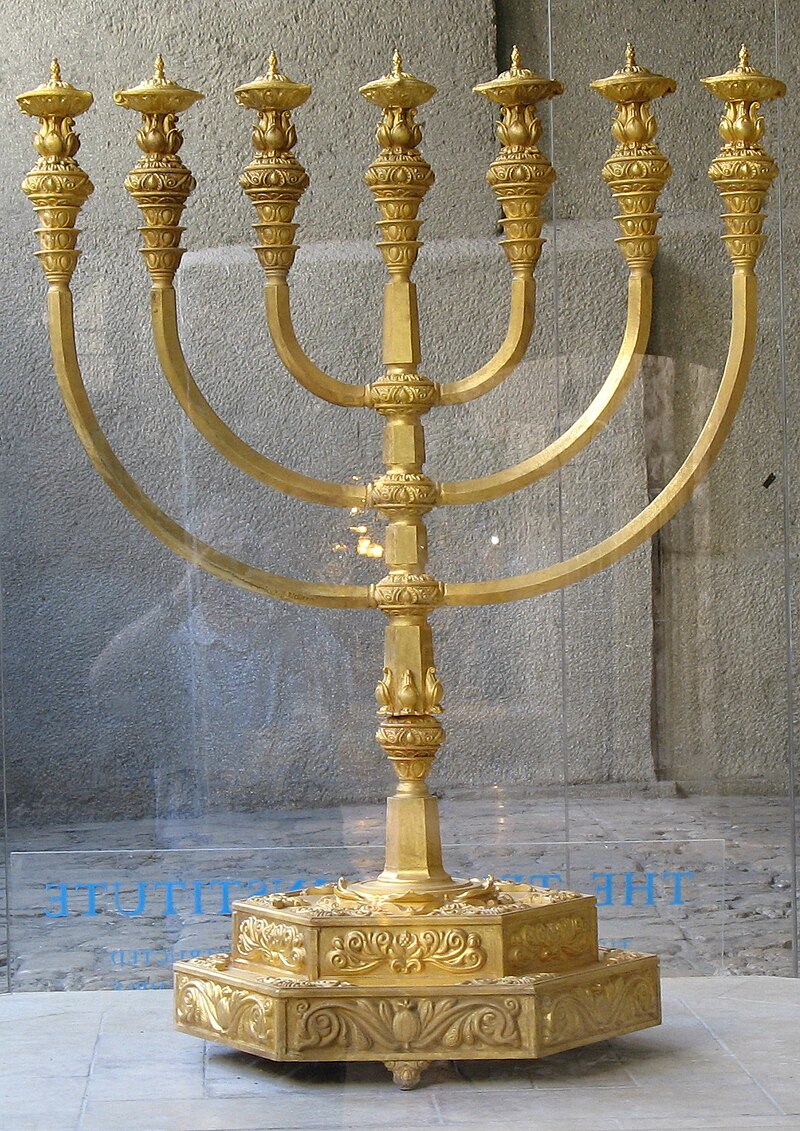
menorah
ancient Hebrew lampstand

hallelujah
thumb|900px|Hallelujah written in Modern Hebrew
Hallelujah (; , Modern ) is an interjection from the Hebrew language, used as an expression of gratitude to God. The term is used 24 times in the Tanakh (in the book of Psalms), twice in deuterocanonical books, and four times in the Christian Book of Revelation.

cherub
thumb|A tetramorph cherub, in [[Eastern Orthodox iconography]]
A cherub (; : cherubim; kərūḇ, pl. kərūḇīm) is one type of supernatural being in the Abrahamic religions. The numerous depictions of cherubim assign to them many different roles, such as protecting the entrance of the Garden of Eden.

Leviathan
thumb|upright=1.1|The Destruction of Leviathan by Gustave Doré (1865)
thumb|upright=1.4|The circular salt sea Tiamat (green) and sphere of cosmic freshwater ocean [[Abzu are pre-existent deities in Sumerian myths, from whose mating Earth was created, so the sketch's side view shows the same as Babylon's map. Referring to the Atra-Hasis epic, Abzu is the celestial reservoir from which an organisation of younger gods triggers the Flood in order to consume humanity – also a source for the dangerous cosmic sea monster Leviathan.]]

Shema Yisrael
thumb|Indian Jews praying "Shema Yisrael", illustration on a book cover
.jpg)
seraph
thumb|upright=1|Bas relief of a seraph Isaiah 6|carrying a hot coal on the walls of the [[Jerusalem International YMCA.]]
Ketuvim
The '''''' (; ) is the third and final section of the Hebrew Bible, after the ("instruction") and the "Prophets". In English translations of the Hebrew Bible, this section is usually titled "Writings" or "Hagiographa".

Elohim
thumb|Elohim in Hebrew script. The letters are, right-to-left: aleph-lamed-he-yud-[[mem.]]

Mezuzah
thumb|upright|Ashkenazi Jews|Ashkenazi mezuzah. The case is tilted and features the Hebrew letter (Shin).
thumb|upright|A Sephardi Jews|Sephardic mezuzah. The mezuzah case is vertical and features the Hebrew letter (Shin).
Behemoth
thumb|Behemoth as depicted in the Dictionnaire Infernal by Collin de Plancy
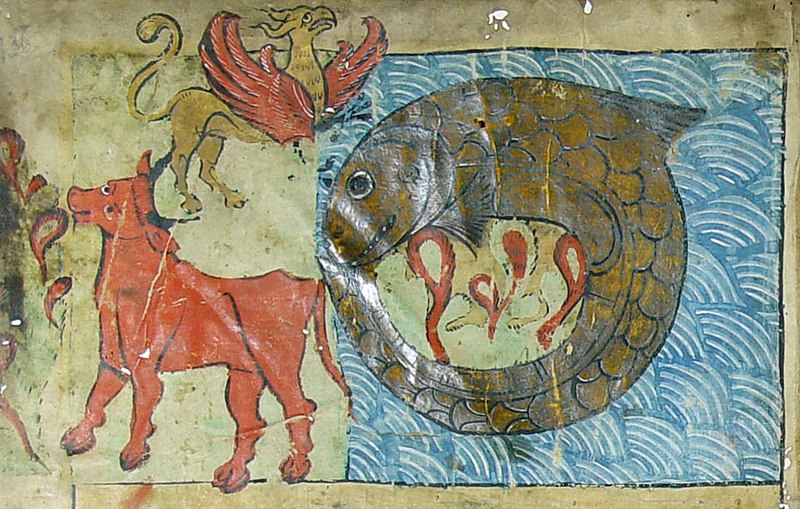
Behemoth (; , bəhēmōṯ) is a beast from the biblical Book of Job, and is a form of the primeval chaos-monster created by God at the beginning of creation. Metaphorically, the name has come to be used for any extremely large or powerful entity.

El
Northwest Semitic word for "god"

tefillin
Tefillin ( or ; ), or phylacteries, are sets of small black leather boxes with leather straps containing scrolls of parchment inscribed with verses from the Torah. Tefillin are traditionally worn by male adult Jews during Shacharit on weekdays.

shofar
thumbnail|Shofar
thumbnail|Shofar
thumbnail|Blowing the shofar
A shofar ( ; from , ) is an ancient musical horn, typically a ram's horn, used for Jewish ritual purposes. Like the modern bugle, the shofar lacks pitch-altering devices, with all pitch control done by the player's varying their embouchure. The shofar is blown in synagogue services on Rosh Hashanah and at the end of Yom Kippur; it is also blown every weekday morning in the month of Elul running up to Rosh Hashanah. Shofars come in a variety of sizes and shapes, depending on the choice of animal and level of finish.

Nevi'im
The '''''' (; ) is the second major division of the Tanakh (the Hebrew Bible), lying between the first division, the () and the third division, (). The Nevi'im are divided into two groups. The Former Prophets ( ) consists of the narrative books of Joshua, Judges, Samuel and Kings; while the Latter Prophets ( ) include the books of Isaiah, Jeremiah, Ezekiel, and the Twelve Minor Prophets.

goy
Goy (pl: goyim or goys) is a term for a gentile, a non-Jew, sometimes in a pejorative sense. The word, of Hebrew origin, was adopted into English from Yiddish. It carries a similar meaning in Modern Hebrew.

shibboleth
thumb|upright=1.3|A New Orleans resident challenges out-of-towners who had come to protest against the 2017 removal of the Robert E. Lee Monument. The out-of-towners' inability to pronounce "[[Tchoupitoulas Street" according to the local fashion would be a shibboleth marking them as outsiders.]]
.jpg)
Azazel
thumb|"And Aaron shall cast lots over the two goats, one lot for the LORD and the other lot for Azazel." Lincoln Cathedral
thumb|The Scapegoat (painting)|The Scapegoat, by [[William Holman Hunt, 1854]]
thumb|Illustration of Azazel in Dictionnaire infernal by Collin de Plancy (1863)
In the Hebrew Bible, the name Azazel (; ʿĂzāʾzēl) represents a desolate place where a scapegoat bearing the sins of the Jews was sent during Yom Kippur. During the late Second Temple period (after the closure of the Hebrew Bible canon), Azazel came to be viewed as a fallen angel responsible for introducing humans to
Nazirite
In the Hebrew Bible, a nazirite or a nazarite ( Nāzīr) is an Israelite man or woman who voluntarily took a vow which is described in . This vow required the nazirite to:

Tzitzit
Tzitzit ( ṣīṣīṯ, ; plural ṣīṣiyyōṯ, Ashkenazi: '; and Samaritan: ') are specially knotted ritual fringes, or tassels, worn in antiquity by Israelites and also modern observant Jews and Samaritans. are usually attached to the four corners of the tallit gadol (prayer shawl), usually referred to simply as a or ; and tallit katan (everyday undershirt). Through synecdoche, a may be referred to as .
%20box%2C%20Charleston%2C%201820%2C%20silver%2C%20National%20Museum%20of%20American%20Jewish%20History.JPG)
Tzedakah
thumb|Tzedakah box (Pushke), Charleston, 1820, silver, [[National Museum of American Jewish History]]
Tzedakah ( ṣədāqā, ) is a Hebrew word meaning "righteousness", but commonly used to signify charity. This concept of "charity" differs from the modern Western understanding of "charity". The latter is typically understood as a spontaneous act of goodwill and a marker of generosity; tzedakah is an ethical obligation, and it is not properly "charity", like in Christendom, but a way to empower poor people to support themselves, helping them in developing their talents and skills. The Medieval Jew
Urim and Thummim
elements of the breastplate worn by the Jewish High Priest

Shmita
thumb|Shmita placard in an agricultural field (in the year 5782)
The sabbath year or sabbatical year (), also called the shmita () or "sabbath of the Land", is the seventh year of the seven-year agricultural cycle mandated by the Torah in the Land of Israel and is observed in Judaism.
jubilee
year at the end of seven cycles of shmita (Sabbatical years)
Hallel
Hallel (, 'Praise') is a Jewish prayer, a verbatim recitation from Psalms which is recited by observant Jews on Jewish holidays as an act of praise and thanksgiving.

ephod
thumb|High Priest of Israel wearing the sacred vestments. The ephod is depicted here in yellow.
Pidyon haben
Jewish ceremony
proselyte
Proselyte is the anglicized form of the Greek word ( or 'newcomer'). In the Septuagint, the classical Greek translation of the Tanakh, the term refers to someone born outside of the Jewish community who relocates to the Land of Israel and adopts, either fully or partially, the observance of ()
and practice of Judaism. The term is itself a translation of (), a rabbinic designation found in the Mishnah and Talmud for a non‑Jewish resident who accepts certain commandments and protections of the Jewish community; it is distinct from a full convert (). The term also has the more general meaning in

Teraphim
thumb|Teraphim depicted in the Oedipus Aegyptiacus ([[Athanasius Kircher, 1652)]]
Teraphim () is a word from the Hebrew Bible, found only in the plural, and of uncertain etymology. Despite being plural, teraphim may refer to singular objects. Teraphim is defined in classical rabbinical literature as "disgraceful things", but this is dismissed by modern etymologists. Many Bible translations into English translate it as idols or household god(s); its exact meaning in ancient times is unknown.
Tohu wa-bohu
("waste and void," "formless and empty," or "chaos and desolation") Biblical Hebrew phrase in Genesis 1:2 describing the condition of the earth before God said, "Let there be light" (Gen. 1:3)

tekhelet
thumb|right|300px|Tzitzit produced from a blue dye derived from [[Hexaplex trunculus and tied according to the opinion of the Sefer ha-Chinuch, resting atop volumes of the Shulchan Aruch.]]
thumb|upright|The flag of Israel, which emulates the tekhelet color for the [[Star of David and the two tallit-like stripes.]]
thumb|upright|A contemporary tekhelet thread tied according to the method of the 18th-century rabbi Vilna Gaon.
thumb|A Jew wearing blue tzitzit, 15th-century
omer
antique unit of measurement

Ophanim
thumb|upright=1.3|A traditional depiction of the Merkabah|chariot vision, based on the description in Ezekiel, with an opan on the left side
The ophanim ( , ; singular: ), alternatively spelled auphanim or ofanim, and also called galgalim ( , ; singular: ), refer to the wheels seen in Ezekiel's vision of the chariot (Hebrew ) in . One of the Dead Sea Scrolls (4Q405) construes them as angels; late sections of the Book of Enoch (61:10, 71:7) portray them as a class of celestial beings who (along with the Cherubim and Seraphim) never sleep, but guard the throne of God. In some systems of Christia
.jpg)
Tehom
thumb|Illustration by Wenceslas Hollar: the spirit of God (with [[Tetragrammaton) moves over the face of the deep.]]
Tehom ( təhôm) is a Northwest Semitic and Biblical Hebrew word meaning "the deep" or "abyss" (literally "the deeps"). It is used to describe the primeval ocean and the post-creation waters of the earth. It is a cognate of the Akkadian words tiāmtum and tâmtum as well as Ugaritic t-h-m which have similar meanings. According to a theological dictionary, tehom derives from a Semitic root which denoted the sea as a non-personified entity with mythological import.
Terumot
Terumot (, lit. "Priestly dues" and often, "heave-offering") is the sixth tractate of Seder Zeraim ("Order of Seeds") of the Mishnah and of the Jerusalem Talmud. This tractate discusses the laws of teruma, a gift of produce that an Israelite farmer was required to set aside and give to a kohen (priest). There were two kinds of terumot given to the priest: the regular heave-offering, known also as the terumah gedolah ("great heave-offering"), which the Israelites were required to give to the priest from the produce of their fields; the other was the ''terumat ma'aser'' ("tithe of the heave-offe
Am Yisrael Chai
Jewish solidarity anthem

Bechukotai
Bechukotai, Bechukosai, or Bəḥuqothai (Biblical) ( bəḥuqqōṯay—Hebrew for "by my decrees," the second word, and the first distinctive word, in the parashah) is the 33rd weekly Torah portion (, parashah) in the annual Jewish cycle of Torah reading and the 10th and last in the Book of Leviticus. It constitutes Leviticus 26:3–27:34. The parashah addresses blessings for obeying the law, curses for disobeying it, and vows. The parashah is made up of 3,992 Hebrew letters, 1,013 Hebrew words, 78 verses, and 131 lines in a Torah Scroll (, Sefer Torah).
Oholah and Oholibah
pejorative personifications given by the prophet Ezekiel to Samaria and Jerusalem in respectively
Kiddush Hashem
sanctification of the Name
Kareth
The Hebrew term kareth ("cutting off" , ), or extirpation, is a form of punishment for sin, mentioned in the Hebrew Bible and later Jewish writings. The typical Biblical phrase used is "that soul shall be cut off from its people" or a slight variation of this. Several different suggestions have been made for the understanding of this punishment in the Bible and in rabbinic thought.
Yetzer hara
In Judaism, yetzer hara is the congenital inclination to do evil
Nephesh
Nephesh (), also spelled nefesh, is a term in the Hebrew Bible used to refer to the aspects of sentience, and human beings and other animals are both described as being nephesh. Not all living organisms are referred to as "nefesh": arthropods ("bugs") and plants, for example, are not described in the Hebrew Bible as nephesh. The English corresponding term to nephesh is the Christian term "soul," which has very similar connotations, and is customarily used to translate it.
Hasid
Ḥasīd (, "pious", "saintly", "godly man"; plural "Hasidim") is a Jewish honorific, frequently used as a term of exceptional respect in the Talmudic and early medieval periods. It denotes a person who is scrupulous in his observance of Jewish law, and often one who goes beyond the legal requirements of ritual and ethical Jewish observance in daily life. In the Mishnah, the term is used thirteen times, the majority of which being in the Tractate Pirkei Avot.
Bikkurim
sacrificial gift brought up to the altar
Hakhel
thumb
Hakhel () is a biblical commandment to assemble all Israelite men, women and children and converts, to hear the reading of the Torah by the king of Israel once every seven years to strengthen their fear of God.
Shiloh
figure mentioned in Genesis 49:10 in Jacob's benediction to Judah: “the sceptre will not depart from Judah […] until Shiloh comes […]”; sometimes interpreted as a Messianic prophecy
Gid hanasheh
term for sciatic nerve in Judaism
Messiah ben Joseph
Messiah in Jewish eschatology
terefah
Terefah (, lit. "torn by a beast of prey"; plural treifot) refers to either:
Herem
Hebrew-language word used in the Tanakh
Am ha'aretz
people of the Land
Kil'ayim
Prohibitions of certain types of forbidden mixtures in Jewish law
Chadash
In Judaism, Chadash () is a concept within Kashrut (the Jewish dietary regulations), based on the Biblical requirement not to eat any grain of the new year (or products made from it) prior to the annual Omer offering on the 16th day of Nisan.
Jehovah-jireh
thumb|350px| The Sacrifice of Isaac by Paolo Veronese, which simultaneously depicts the angel and the ram at Jehovah-jireh.

Yom
Yom () is a Biblical Hebrew word which occurs in the Hebrew Bible. The word is a generic term meaning "a period of time". In both Modern and Biblical Hebrew it is usually translated as a specific period of time (such as "day", "evening", "lifetime", or "year") based on context.
Almah
thumb|Rebecca (biblical figure)|Rebecca at the well, by [[Giovanni Antonio Pellegrini. Rebecca is described as an almah (Genesis 24:43)]]
Orlah
The prohibition on orlah fruit (lit. "uncircumcised" fruit) is a command found in the Bible not to eat fruit produced by a tree during the first three years after planting.
Jeshurun
Jeshurun ( Yəšurūn) is a poetic name for Israel used in the Hebrew Bible.
Chelev
Chelev (, ḥēleḇ), "suet", is the animal fats that the Torah prohibits Jews and Israelites from eating. Only the chelev of animals that are of the sort from which offerings can be brought in the Tabernacle or Temple are prohibited (). The prohibition of eating chelev is also, in addition to the Torah, one of the 613 commandments that, according to the Talmud, were given to Moses on Mount Sinai.