Category
page 1Historic Sites of Japan

Hōryū-ji Temple
is a Buddhist temple that was once one of the powerful Seven Great Temples, located in Ikaruga, Nara Prefecture, Japan. Built shortly after Buddhism was introduced to Japan, it is also one of the oldest Buddhist sites in the country. Its full name is , or Learning Temple of the Flourishing Law, with the complex serving as both a seminary and monastery.

Battle of Sekigahara
1600 battle preceding Tokugawa shogunate in Japan

Tōdai-ji Temple
is a Buddhist temple complex that was once one of the powerful Seven Great Temples, located in the city of Nara, Japan. The construction of the temple was an attempt to imitate Chinese temples from the much-admired Tang dynasty. Though it was originally founded in the year 738 CE, Tōdai-ji was not opened until the year 752 CE. The temple has undergone several reconstructions, including one initiated by Minamoto Yoritomo in 1181 (entrusted to Chogen, a monk of the Jodo sect) which included the standardization of existing buildings and the strengthening of visible pillars. Since then, one of the

Shuri Castle
Ryukyuan gusuku castle
Matsumoto Castle
building in Matsumoto, Nagano Prefecture, Japan

Byōdō-in Temple
is a Buddhist temple in the city of Uji in Kyoto Prefecture, Japan, built in the late Heian period. It is jointly a temple of the Jōdo-shū (Pure Land) and Tendai-shū (Heavenly Level) sects.

Arashiyama
thumb|Aerial perspective of Arashiyama Park Nakanoshima Area 嵐山公園 中之島地区
thumb|Aerial panorama of Arashiyama (嵐山)
thumbnail|right|Mount Arashi (Arashiyama) across the Ōi River
thumbnail|right|Iwatayama Monkey Park
thumb|Bamboo forest in Arashiyama
Iwami Ginzan Silver Mine
mine
Matsue Castle
castle

Ryōan-ji Temple
Ryōan-ji (, , The Temple of the Dragon at Peace) is a Zen temple located in northwest Kyoto, Japan. It belongs to the Myōshin-ji school of the Rinzai branch of Zen Buddhism. The Ryōan-ji garden is considered one of the finest surviving examples of kare-sansui ("dry landscape"), a refined type of Japanese Zen temple garden design generally featuring distinctive larger rock formations arranged amidst a sweep of smooth pebbles (small, carefully selected polished river rocks) raked into linear patterns that facilitate meditation. The temple and its gardens are listed as one of the Historic Monumen
Hiroshima Castle
castle
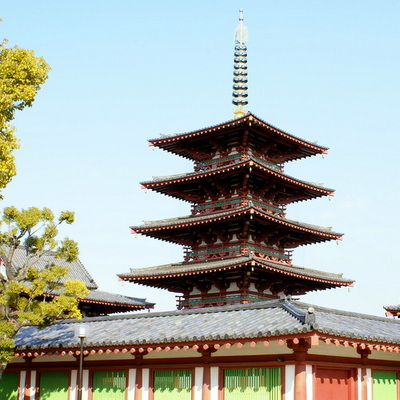
Shitennō-ji Temple
thumb|240px|Shitennō-ji seen from above (center) in the middle of Ōsaka, 2025

Enryaku-ji Temple
is a Tendai monastery located on Mount Hiei in Ōtsu, overlooking Kyoto. It was first founded in 788 during the early Heian period (794–1185) by Saichō (767–822), also known as Dengyō Daishi, who introduced the Tendai sect of Mahayana Buddhism to Japan from China. The temple complex has undergone several reconstruction efforts since then, with the most significant (that of the main hall) taking place in 1642 under Tokugawa Iemitsu. Enryaku-ji is the headquarters of the Tendai sect and one of the most significant monasteries in Japanese history. As such, it is part of the UNESCO World Heri

Tō-ji Temple
, a.k.a. the is a Shingon Buddhist temple in the Minami-ku ward of Kyoto, Japan.
Nijō Castle
castle in Kyoto, Japan

Kōfuku-ji Temple
is a Buddhist temple in Japan that was once one of the powerful Nanto Shichi Daiji 'Seven Great Temples' in the city of Nara. The temple is the national headquarters of the East Asian Yogācāra school. It is part of the Historic Monuments of Ancient Nara, a World Heritage Site.
Battle of Okehazama
1560 battle

Kasuga-taisha
is a Shinto shrine in Nara, Nara Prefecture, Japan. It is the shrine of the Fujiwara family, established in 768 CE and rebuilt several times over the centuries. The interior is famous for its many bronze lanterns, as well as the many stone lanterns that lead up to the shrine.
Tomioka Silk Mill
silk reeling factory in Tomioka, Gunma prefecture, Japan
Inuyama Castle
one of the 12 Japanese castles still in existence which were built before the Edo period
Kamigamo Shrine
Shinto shrine in Kita-ku, Kyōto, Japan
Heian Palace
Imperial palace in the capital of Japan

Ninna-ji Temple
thumb|250px|Shinden's North Garden
thumb|250px|Shinden's South Garden
is the head temple of the Omuro school of the Shingon Sect of Buddhism. Located in western Kyoto, Japan, it was first founded in AD 888 by Emperor Uda, and was later reconstructed in the 17th century. It is part of the Historic Monuments of Ancient Kyoto, a UNESCO World Heritage Site.
Ō no Yasumaro
Japanese noble

Nagaoka-kyō
thumb|right|Chōdō-in () of Nagaoka-kyō (restoration model)
Gifu Castle
fortification

Daigo-ji Temple
right|thumb|from the picture album "Kannon Reigen ki"
.jpg)
Kakiemon
thumb|Kakiemon Imari ware hexagonal jar, flowering plant and phoenix design in overglaze enamel. Edo period, 17th century
thumb|Kakiemon square bottle with plums and stylized flowers in glaze and gilding. Edo period, 1670–1690
is a style of Japanese porcelain, with overglaze decoration called "enameled" ceramics. It was originally produced at the kilns around Arita, in Japan's Hizen province (today, Saga Prefecture) from the Edo period's mid-17th century onwards. The quality of its decoration was highly prized in the West and widely imitated by major European porcelain manufacturers during th
Odawara Castle
castle in Kanagawa Prefecture, Japan
Okayama Castle
Japanese castle in Kita-ku, Okayama, Japan
Shimogamo Shrine
Shinto shrine in Sakyō-ku, Kyōto, Japan

Nanzen-ji Temple
, or Zuiryusan Nanzen-ji, formerly , is a Zen Buddhist temple in Kyoto, Japan. Emperor Kameyama established it in 1291 on the site of his previous detached palace. It is also the headquarters of the Nanzen-ji branch of Rinzai Zen. The precincts of Nanzen-ji are a nationally designated Historic Site and the Hōjō gardens a Place of Scenic Beauty. The temple was destroyed in a fire in 1895 and rebuilt in 1909.
Saihō-ji Temple
Rinzai Zen Buddhist temple located in Matsuo, Japan
Ōura Church
Roman Catholic church in Nagasaki, Japan
Heijō Palace
imperial residence in the Japanese capital city Heijō-kyō (today's Nara), during most of the Nara period

Kōchi Castle
Japanese castle in Kōchi city
Hirosaki Castle
castle in Hirosaki, Aomori prefecture, Japan
Mount Chōkai
volcano in Akita and Yamagata Prefectures, Japan
Kanazawa Castle
castle in Kanazawa, Ishikawa prefecture, Japan
Mount Yoshino
mountain in Nara Prefecture, Japan
Nakijin Castle
fortification

Kōzan-ji Temple
, officially , is a Buddhist temple of the Omuro sect of Shingon Buddhism in Umegahata Toganōchō, Ukyō Ward, Kyoto, Japan. Kōzan-ji is also known as Kōsan-ji and Toganō-dera. The temple was founded by the Shingon scholar and monk Myōe (1173–1232) and is renowned for its numerous national treasures and important cultural properties. The Chōjū-jinbutsu-giga, a group of ink paintings from the 12th and 13th centuries, are among the most important treasures of Kōzan-ji. The temple celebrates Biyakkōshin, Zenmyōshin and Kasuga Myōjin, as well as the temple's tutelary Shintō deity. In 1994, it was re

Tenryū-ji Temple
, formally known as , is the head temple of the Tenryū-ji branch of the Rinzai sect of Zen Buddhism, located in Susukinobaba-chō, Ukyō Ward, Kyoto, Japan. The temple was founded by Ashikaga Takauji in 1339, primarily to venerate Gautama Buddha, and its first chief priest was Musō Soseki. Construction was completed in 1345. As a temple related to both the Ashikaga family and Emperor Go-Daigo, the temple is held in high esteem, and is ranked number one among Kyoto's so-called Five Mountains. In 1994, it was registered as a UNESCO World Heritage Site as part of the "Historic Monuments of Ancient
Daitoku-ji Temple
is a Rinzai school Zen Buddhist temple in the Murasakino neighborhood of Kita-ku in the city of Kyoto Japan. Its (sangō) is . The Daitoku-ji temple complex is one of the largest Zen temples in Kyoto, covering more than . In addition to the main temple complex including the Buddha Hall and the lecture hall, there are more than 20 sub-temples on the grounds. Daitokuji has produced many famous monks and has a deep connection with the tea ceremony culture, making it a temple that has had a great influence on Japanese culture. The main temple and sub-temples have many cultural assets, including bui
Kongōbu-ji Temple
is the ecclesiastic head temple of Kōyasan Shingon Buddhism, located on , Wakayama Prefecture, Japan. Its name means Temple of the Diamond Mountain Peak. It is part of the "Sacred Sites and Pilgrimage Routes in the Kii Mountain Range" UNESCO World Heritage Site.
Mount Kongō
mountain in Osaka and Nara Prefecture, Japan

Mii-dera Temple
thumb|upright=1.5|Golden Hall (National Treasure of Japan)
thumb|The or "Four-Legged Gate"
thumb|
thumb|Rāgarāja
thumb|Video
Matsuyama Castle
castle in Iyo province (now Matsuyama, Ehime prefecture), Japan

Inō Tadataka
Japanese surveyor and cartographer (1745-1818)
Aizuwakamatsu Castle
castle in Fukushima pref., Japan
Tōshōdai-ji Temple
thumb|250px|Lecture Hall
is a Buddhist temple of the Risshū sect in the city of Nara, in Nara Prefecture, Japan. The Classic Golden Hall, also known as the kondō, has a single story, hipped tiled roof with a seven bay wide facade. It is considered the archetype of "classical style".
Hirata Atsutane
conventionally ranked as one of the four great men of kokugaku studies, and one of the most significant theologians of the Shintō religion

Gangō-ji Temple
right|thumb|290px|Model of Gangō-ji in the Nara period; the temple at the top of the photo is Kofuku-ji
thumb|right|Gangō-ji Gokurakubo zenshitsu (National Treasure)
thumb|upright|Gangō-ji miniature pagoda (National Treasure)
right|thumb|290px|Site of the Five-story Pagoda
was one of the first Buddhist temples in Japan, and was ranked as one of the powerful Seven Great Temples, in Nara, Japan. It was mostly destroyed in the Muromachi period and the old town of Naramachi occupies most of what was once the temple's precincts. Three small portions of the temple have survived to the present day,
Kairaku-en
is a Japanese garden located in Mito, Ibaraki Prefecture, Japan. Along with Kenroku-en and Koraku-en, it is considered one of the Three Great Gardens of Japan.
Nakagusuku Castle
castle
Zakimi Castle
castle
Hagi Castle
Japanese castle in Hagi, Yamaguchi prefecture
Iwashimizu Hachimangū
Shinto shrine in Kyoto Prefecture, Japan
Futarasan Shrine
Shinto shrine in Tochigi Prefecture, Japan

Myōshin-ji Temple
is a temple complex in Kyoto, Japan, which serves as the head temple of the associated branch of Rinzai Zen Buddhism. The Myōshin-ji School is by far the largest school in Rinzai Zen, approximately as big as the other thirteen branches combined: it contains within it about 3,400 temples throughout Japan, together with a handful overseas, of the approximately six thousand total Rinzai temples, and also has nineteen associated monasteries, of the total of forty Rinzai monasteries and one nunnery.