Category
page 1Historical regions of Anatolia

Lydia
Lydia (; ) was an Iron Age kingdom situated in western Anatolia, in modern-day Turkey. Later, it became an important province of the Achaemenid Empire and then the Roman Empire. Its capital was Sardis.

Phrygia
In classical antiquity, Phrygia ( ; , Phrygía) was a kingdom in the west-central part of Anatolia, in what is now Asian Turkey, centered on the Sangarios River.

Cilicia
Cilicia (, ) is a geographical region of southern Anatolia in West Asia, extending inland from the northeastern coasts of the Mediterranean Sea. Cilicia borders Pamphylia to the west, Lycaonia and Cappadocia to the north, Commagene to the north-east, Syria to the east and the Mediterranean Sea to the south. Cilicia has a population ranging over six million, concentrated mostly at the Cilician plain (). The region includes the provinces of Mersin, Adana, Osmaniye and Hatay.

Bithynia
thumb|300px|Bithynia and Pontus as a province of the Roman Empire, 125 AD
Bithynia (; ) is a geographical region of northwestern Asia Minor (in present-day Turkey), adjoining the Sea of Marmara, the Bosporus, and the Black Sea. It borders Mysia to the southwest, Paphlagonia to the northeast along the Black Sea coast, and Phrygia to the southeast towards the interior of Asia Minor.
.jpg)
Lycia
thumb|350px

Galatia
Galatia (; , Galatía, ) was an ancient area in the highlands of central Anatolia, roughly corresponding to the provinces of Ankara and Eskişehir in modern Turkey. Galatia was named after the Gauls from Thrace (cf. Tylis), who settled here and became a small transient foreign tribe in the 3rd century BC, following the Gallic invasion of the Balkans in 279 BC.

Pontus
region in the eastern Black Sea Region of Turkey

Caria
Caria (; from Greek: Καρία, Karia; ) was a region of western Anatolia extending along the coast from mid-Ionia (Mycale) south to Lycia and east to Phrygia. The Carians were described by Herodotus as being Anatolian mainlanders and they called themselves Caria because of the name of their king. He reports the Carians themselves maintained that they were Anatolian mainlanders intensely engaged in seafaring and were akin to the Mysians and the Lydians. The Carians spoke Carian, a native Anatolian language closely related to Luwian. Also closely associated with the Carians were the Leleges, which
%2002.jpg)
Pamphylia
Pamphylia (; , Pamphylía ) was a region in the south of Asia Minor in Western Asia, between Lycia and Cilicia, extending from the Mediterranean to Mount Taurus (all in modern-day Antalya province, Turkey). It was bounded on the north by Pisidia and was therefore a country of small extent, having a coast-line of only about 120 km (75 miles) with a breadth of about 50 km (30 miles). Under the Roman administration the term Pamphylia was extended so as to include Pisidia and the whole tract up to the frontiers of Phrygia and Lycaonia, and in this wider sense it is employed by Ptolemy.
.jpg)
Troad
thumb|340px|A map of the Troad (Troas)
thumb|350px|Troas among the classical regions of Anatolia. Troas is at upper left, south of Thracia, west of Mysia.
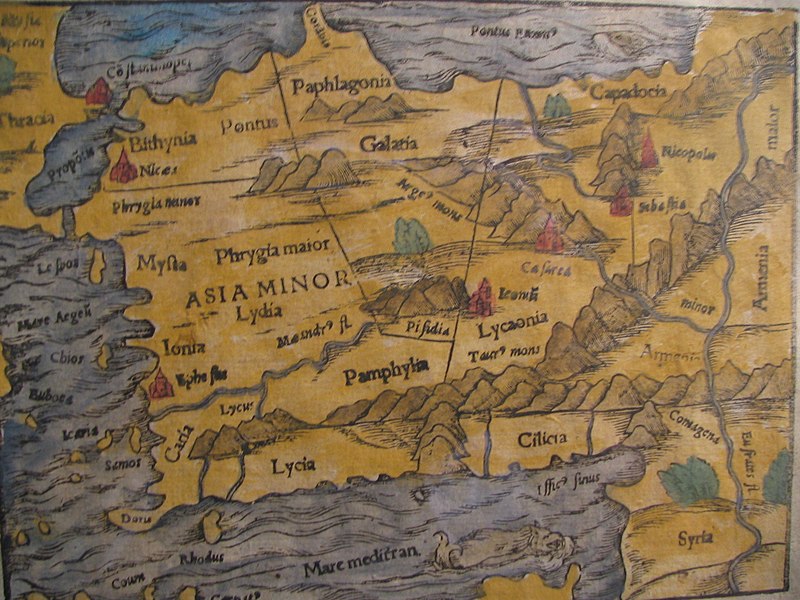
Paphlagonia
Paphlagonia (; , modern translit. Paflagonía; ) was an ancient region on the Black Sea coast of north-central Anatolia, situated between Bithynia to the west and Pontus to the east, and separated from Phrygia (later, Galatia) by a prolongation to the east of the Bithynian Olympus. According to Strabo, the region was bounded by the river Parthenius to the west and the Halys River to the east.
Paphlagonia was said to be named after Paphlagon, a son of the mythical Phineus.

Pisidia
thumb|300px|Greco-Roman Asia Minor, including Pisidia.
.jpg)
Mysia
Mysia (UK , US or ; ; ; ) was a region in the northwest of ancient Asia Minor (Anatolia, Asian part of modern Turkey). It was located on the south coast of the Sea of Marmara. It was bounded by Bithynia on the east, Phrygia on the southeast, Lydia on the south, Aeolis on the southwest, Troad on the west, and the Propontis on the north. In ancient times it was inhabited by the Mysians, Phrygians, Aeolian Greeks and other groups.
Lycaonia
thumb|320px|Heinrich Kiepert. Asia citerior. Lycaonia, 1903
Lycaonia (; , Lykaonia; ) was a large region in the interior of Asia Minor (modern-day Turkey), north of the Taurus Mountains. It was bounded on the east by Cappadocia, on the north by Galatia, on the west by Phrygia and Pisidia, while to the south it extended to the chain of Mount Taurus, where it bordered on the country popularly called in earlier times Cilicia and in the Byzantine period Isauria; but its boundaries varied greatly at different times. The name is not found in Herodotus, but Lycaonia is mentioned by Xenophon as traver

Arzawa
Chaldia
Chaldia (, Khaldia) was a historical region located in the mountainous interior of the eastern Black Sea, northeast Anatolia (modern Turkey) in Western Asia. Its name was derived from a people called the Chaldoi (or Chalybes) that inhabited the region in antiquity. Chaldia was used throughout the Byzantine period and was established as a formal theme, known as the Theme of Chaldia (Greek: θέμα Χαλδίας), by 840. During the Late Middle Ages, it formed the core of the Empire of Trebizond until its fall to the Ottoman Empire in 1461.

Lazistan
Lazistan or Lazeti (; , or ჭანეთი, ''ch'aneti''; ) is a historical and cultural region of the Caucasus and Anatolia; the term was primarily used during Ottoman rule in the region. Traditionally inhabited by the Laz people and located mostly in Turkey, with small parts in Georgia, its area is about 7,000 km2 (2,703 sq mi) with a modern-day population of around 500,000 (including groups outside of the Laz peoples).
Milyas
Milyas () was a mountainous country in ancient south-west Anatolia (modern Turkey). However, it is generally described as being mostly in the northern part of the successor kingdom of Lycia, as well as southern Pisidia, and part of eastern Phrygia. According to Herodotus, the boundaries of Milyas were never fixed.
Caramania
In the 18th and 19th centuries, Karamania (or Caramania) was an exonym used by Europeans for the southern (Mediterranean) coast of Anatolia, then part of the Ottoman Empire (current Turkey). It can also refer to the general south central Anatolian region, whose name is reflected on the modern town of Karaman. It is also the namesake of the larger Karaman Province of Turkey, the historical Karaman Eyalet of the Ottoman Empire, the medieval Turkish Karamanids dynasty and state from the region, and the Karamanlides, a Turkish-speaking Orthodox Christian group originally from the area.