Category
page 1History of climate variability and change
climate change
human-caused changes to climate on Earth

ice age
period of long-term reduction in temperature of Earth's surface and atmosphere
Kyoto Protocol
international treaty to reduce greenhouse gas emissions

Little Ice Age
period of cooling that occurred after the Medieval Warm Period, usually defined as between the 14th (or the 16th) to the 19th centuries

extinction event
widespread and rapid decrease in the amount of life on earth
Medieval Warm Period
time of warm climate in the North Atlantic region lasting from c. 950 to c. 1250
Ordovician–Silurian extinction event
mass extinction event at the end of the Ordovician period and the beginning of the Silurian period in the Paleozoic era, around 444 million years ago
Triassic-Jurassic mass extinction
mass extinction at the end of the Triassic
climate variability
all the variations in the climate that last longer than individual weather events
Maunder Minimum
The period starting about 1645 and continuing to about 1715 when sunspots were exceedingly rare
Paleocene–Eocene Thermal Maximum
rapid (in geological terms) global warming, profound changes in ecosystems, and major perturbations in the carbon cycle which started about 55.0 million years ago
retreat of glaciers since 1850
Shortening of glaciers by melting of their ice in warmer locations
Late Devonian extinction
mass extinction event, starting at the end of the Frasnian age of Upper Devonian around 372 million years ago
8.2 kiloyear event
sudden decrease in global temperatures that occurred c. 6200 BCE; defines the end of the Greenlandian age and start of the Northgrippian age in the Holocene epoch
Boreal
first of the Blytt-Sernander sequence of north European climatic phases
Dalton Minimum
Period of low solar activity from 1790 to 1830
Bond event
North Atlantic ice rafting events
Holocene climatic optimum
warm period during roughly the interval 9,000 to 5,000 years BP
causes of climate change
effort to scientifically ascertain mechanisms responsible for recent global warming and related climate changes on Earth
100,000-year problem
discrepancy between past temperatures and the amount of incoming solar radiation
Spörer Minimum
Hypothesized period of low solar activity from 1460 to 1550
Dansgaard–Oeschger event
rapid climate fluctuation in the last glacial period
Roman Warm Period
warm weather period, 250 BC to AD 400
clathrate gun hypothesis
hypothesis that climate change can trigger a release of methane buried in seabeds which leads to runaway warming
African humid period
Holocene climate period during which Africa was wetter than today
Cambrian–Ordovician extinction event
mass extinction event; occurred approximately 488 million years ago
stadial
phase dividing the Quaternary period
carbonate–silicate cycle
term in chemistry: long-term transformation of silicate rocks to carbonate rocks by weathering and sedimentation, and the transformation of carbonate rocks back into silicate rocks by metamorphism and volcanism
Carboniferous rainforest collapse
extinction event; occurred ca. 305 Ma at the end of the Moscovian in the Carboniferous; altered the vast coal forests that covered the equatorial region of Euramerica, fragmenting them into ‘islands’, causing dwarfism and extinction of many species
Piora Oscillation
period
pluvial
In geology and climatology, a pluvial is either a modern climate characterized by relatively high precipitation or an interval of time of variable length, decades to thousands of years, during which a climate is characterized by relatively high precipitation or humidity. Subdivisions of a pluvial, which are characterized by relatively high precipitation, are known as a subpluvials. Formally, pluvials were equated with glacial stages of the Quaternary. However, pluvials, as in equatorial regions, can also occur during interglacial stages. No lower latitudes have experienced major pluvials in ea
2024 in climate change
overview of the events of 2024 in climate change
greenhouse and icehouse Earth
opposing climate states on Earth
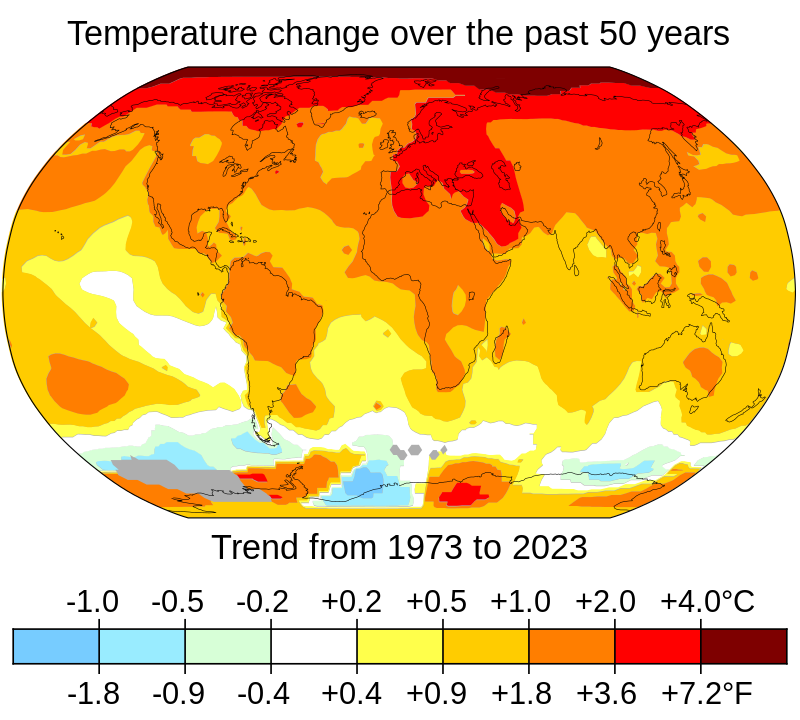
global surface temperature
average temperature of the Earth's surface
Iron Age Cold Epoch
period
Antarctic Cold Reversal
episode of cooling in the climate history of the Earth
Mousterian Pluvial
neoglaciation
alt=|thumb|Greenland ice sheet temperatures interpreted with 18O isotope from 6 ice cores (Vinther, B., et al., 2009)
The neoglaciation ("renewed glaciation") describes the documented cooling trend in the Earth's climate during the Holocene, following the retreat of the Wisconsin glaciation, the most recent glacial period. Neoglaciation has followed the Hypsithermal or Holocene Climatic Optimum, the warmest point in the Earth's climate during the current interglacial stage, excluding the global warming-induced temperature increase starting in the 20th century. The neoglaciation has no well-mar
Late Glacial Maximum
glacial period
Eocene Thermal Maximum 2
period of global warming that occurred around 54 Ma
2023 in climate change
overview of the events of 2023 in climate change
2021 in climate change
overview of the events of 2021 in climate change
Neopluvial
The Neopluvial was a phase of wetter and colder climate that occurred during the late Holocene in the Western United States. During the Neopluvial, water levels in a number of now-dry lakes and closed lakes such as the Great Salt Lake rose and vegetation changed in response to increased precipitation. The event was not exactly synchronous everywhere, with neopluvial lake-level rises occurring between 6,000 and 2,000 years ago. It is correlative to the Neoglacial period.
Pliocene climate
part of the Pliocene Epoch
2019 in climate change
overview of the events of 2019 in climate change