Category
page 1History of Nubia

Nubia
Nubia ( ; Nobiin: Nⲟ̅ⲩ̅ⲃⲁ; ) is a region along the Nile river encompassing the area between the confluence of the Blue and White Niles (near Khartoum in central Sudan) and the First Cataract (south of Aswan in southern Egypt). It was the seat of one of the earliest civilizations of ancient Africa, the Kerma culture, which lasted from around 2500 BC until its conquest by the New Kingdom of Egypt under Pharaoh Thutmose I around 1500 BC. Egyptian heirs subsequently ruled much of Nubia for the next four centuries.
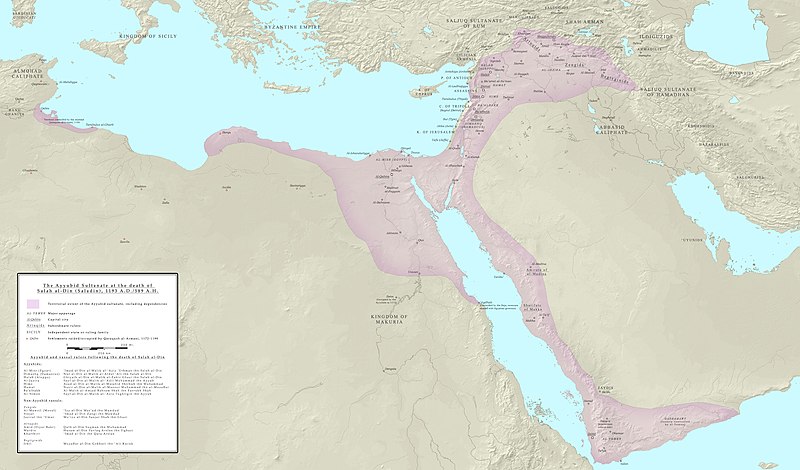
Ayyubid dynasty
Kurdish dynasty from 1171 to 1341
Jebel Barkal
mountain
Twenty-fifth Dynasty of Egypt
Kushite rule in Egypt during the third intermediate period

Kingdom of Makuria
Makuria (Old Nubian: , Dotawo; ; ) was a medieval Nubian kingdom in what is today northern Sudan and southern Egypt. Its capital was Dongola (Old Nubian: , Touggoul) in the fertile Dongola Reach, about halfway between the 3rd and 4th Nile cataract.

Alodia
Alodia, also known as Alwa (Greek: Ἀρούα, Aroua; , ʿAlwa), was a medieval kingdom in what is now central Sudan. Its capital was the city of Soba, located near modern-day Khartoum at the confluence of the Blue and White Nile rivers.

Nobatia
Nobatia or Nobadia (; Greek: Νοβαδία, Nobadia; Old Nubian: ⲙⲓⲅⲛ̅ Migin or ⲙⲓⲅⲓⲧⲛ︦ ⲅⲟⲩⲗ, Migitin Goul lit. "''of Nobadia's land''") was a late antique kingdom in Lower Nubia, modern day southern Egypt. Together with the two other Coptic-Nubian kingdoms, Makuria and Alodia, it succeeded the kingdom of Kush. After its establishment in around 400, Nobadia gradually expanded by defeating the Blemmyes in the north and incorporating the territory between the second and third Nile cataract in the south. In 543, it converted to Coptic Christianity. It would then be annexed by Makuria, under unknown cir

Aethiopia
thumb|1747 map with all the oceans surrounding the African continent
Buhen
Buhen, alternatively known as Βοὥν (Bohón) in Ancient Greek, stands as a significant ancient Egyptian settlement on the western bank of the Nile, just below the Second Cataract in present-day Northern State, Sudan. Its origins trace back to the Old Kingdom period (about 2686–2181BCE), where it served as an Egyptian colonial town, particularly recognized for copper smelting. In 1962, archaeological discoveries brought to light an ancient copper manufacturing facility encircled by an imposing stone barrier, indicating its origin during the rule of Sneferu in the 4th Dynasty. Inscriptions and gra
Nubian pyramids
pyramids that were built by the rulers of the ancient Kushite kingdoms
Tierpark Hagenbeck
zoo
Sehel Island
Island in the Nile

Old Dongola
human settlement
Kerma kingdom
Ancient Sudanese kingdom
Old Nubian
ancient variety of the Nubian language

Blemmyes
thumb|Location of the Blemmyes in Late Antiquity
The Blemmyes ( or Βλέμυες, Blémues , Latin: Blemmyae) were an Eastern Desert people who appeared in written sources from the 7th century BC until the 8th century AD. By the late 4th century, they had occupied Lower Nubia and established a kingdom. From inscriptions in the temple of Isis at Philae, a considerable amount is known about the structure of the Blemmyan state.
Qasr Ibrim
Archaeological site in Egypt
National Museum of Sudan
Museum for the history of Sudan

Medjay
Medjay (Egyptian mḏꜣ.j, a nisba of mḏꜣ) was a demonym used in various ways throughout ancient Egyptian history to refer initially to a nomadic group from Nubia and later as a generic term for desert-ranger police.
They were sometimes confused with the Pan-Grave culture.
Viceroy of Kush
ancient Egyptian administrative title
Temple of Isis in Philae
Temple of Isis in Philae now located on Agilkia island
.jpg)
Catoblepas
thumb|The Catoblepas as depicted by Jan Jonston, Historia naturalis de quadrupedibus, Amsterdam, 1657
The catoblepas (from Latin catōblepas, ultimately from Greek καταβλέπω (katablépō) "to look downwards") is a legendary creature from Aethiopia, first described by Pliny the Elder and later by Claudius Aelianus.
Bigeh
Bigeh (; Ancient Egyptian znmwt) is an island and archaeological site situated along the Nile River in historic Nubia and within the Aswan Governorate of southern Egypt. The island has been situated in the reservoir of the Old Aswan Dam since the dam's initial completion in 1902.

Soleb
Soleb is an ancient town in Nubia, in present-day Sudan. The site is located north of the third cataract of the Nile, on the western side of the Nile. It was discovered and described by
Karl Richard Lepsius in 1844. The temple was built during the reign of Amenhotep III and dedicated to Amun, but after Akhenaten assumed power, it was rededicated to Aten.

Turan-Shah
'''Shams ad-Din Turanshah ibn Ayyub al-Malik al-Mu'azzam Shams ad-Dawla Fakhr ad-Din known simply as Turanshah''' () (died 27 June 1180) was the Ayyubid emir (prince) of Yemen (1174–1176), Damascus (1176–1179), Baalbek (1178–1179) and finally Alexandria where he died in 1180. He is noted for strengthening the position of his younger brother, Sultan Saladin, in Egypt and playing the leading role in the Ayyubid conquests of both Nubia and Arabia.
Soba
human settlement
International Museum of Nubia
museum in Aswan, Egypt

Qustul
Qustul () is an archaeological cemetery located on the eastern bank of the Nile in Lower Nubia, just opposite of Ballana near the Sudan frontier. The site has archaeological records from the A-Group culture, the New Kingdom of Egypt and the X-Group culture.The site is currently submerged under Lake Nasser.
Semna
ancient Egyptian archaeological site in Sudan
Lower Nubia
northernmost part of Nubia

Triakontaschoinos
thumb|Map of the Lower Nile valley; the Triakontaschoinos is the area between the first cataract (1) and the second (2). Note that Lake Nasser did not exist until the construction of the [[Aswan Dam in the 1960s–1970s.]]
The Triakontaschoinos (, "Land of the Thirty Schoinoi"), Latinized as Triacontaschoenus, was a geographical and administrative term used in the Greco-Roman world for the part of Lower Nubia between the First and Second Cataracts of the Nile, which formed a buffer zone between Egypt and later Rome on the one hand and Meroë on the other hand. The northern part of this area, stre
A-Group culture
archaeological culture
Ballana
Ballana () was a cemetery in Lower Nubia. It, along with nearby Qustul, were excavated by Walter Bryan Emery between 1928 and 1931 as a rescue project before a second rising of the Aswan Low Dam. A total of 122 tombs were found under huge artificial mounds. They date to the time after the collapse of the Meroitic state but before the founding of the Christian Nubian kingdoms, around AD 350 to 600. They usually featured one or several underground chambers, with one main burial chamber. Some tombs were found unlooted, but even the robbed burials still proved to contain many burial goods.

Walter Bryan Emery
British egyptologist (1903–1971)
Kumma
building in Africa
Faras Cathedral
cathedral in the Lower Nubian city of Faras (Sudan)

Nubiology
thumb|170px|Kazimierz Michałowski, who coined the term Nubiology.
Nubiology is the scientific study of ancient Nubia, which existed in parts of modern-day Egypt and Sudan, predominantly in the Middle Nile region from Aswan to Khartoum. The term was coined by archaeologist Kazimierz Michałowski.
Kingdom of al-Abwab
former country
Jebel Dosha
archaeological site in Sudan
Uronarti
Uronarti is an island and archaeological site in the Nile just south of the Second Cataract in the north of Sudan. The site features a massive ancient fortress that still stands on its northern end. This fortress is one of many constructed along the Nile in Lower Nubia during the Middle Kingdom, beginning under the reign of Senusret I.
Dendur
archaeological site in Egypt
Tombos
island
Michel Baud
French egyptologist (1963-2012)
Sesebi
Sesebi or Sesibi was a New Kingdom Egyptian town on the west bank of the Nile, across from Delgo, Sudan. A temple was built there by Akhenaten, who appointed a viceroy to maintain the structure, govern the local settlement, and secure traffic on the Nile.
Debeira
Debeira is an archaeological site in Sudan situated on the eastern bank of the Nile some 20 kilometres north of Wadi Halfa.
Nubian vault
type of vaulted structure
X-Group culture
Nubian cultural period from the C.E.1st millennium
Upper Nubia
southernmost part of Nubia
Nubian architecture
overview about the Nubian architecture
Temple of Mut, Jebel Barkal
temple at Jebel Barkal in Northern State, Sudan
Kushite religion
mythological beliefs of the Nubians
Monastery in Ghazali
monastery in the Bayuda Desert, Sudan
Noba
Noba is a term found in a number of historical sources discussing ancient and Medieval Nubia. Its exact meaning is uncertain, with ancient sources themselves seeming confused about the region south of Egypt. Most likely it refers to two separate groups: the Nuba, a people from southeast of Nubia, and a people later known as the Nobatae (Nubians), a group of unknown origin who invaded Nubia during the decline of Meroe, conquered the Kingdom of Kush, most likely founded the kingdoms of Nobatia and Makuria, and gave their name to Nubia itself as well as the Nubian languages. There are mentions of
Statues of Amun in the form of a ram protecting King Taharqa