Category
page 1History of the Serbs

history of Montenegro
chronicle about the country of Montenegro

Hilandar
The Hilandar Monastery (, , , ) is one of the twenty Eastern Orthodox monasteries in Mount Athos in Greece and the only Serbian Orthodox monastery there. It is ranked fourth in the Athonite hierarchy of 20 sovereign monasteries.
list of Serbian monarchs
Wikimedia list article

Magyarization
thumb|324x324px|Distribution of nationalities within the Kingdom of Hungary (without [[Kingdom of Croatia-Slavonia) according to the Hungarian census in 1910. ]]
Magyarization ( , also Hungarianization; ), after "Magyar"—the Hungarian autonym—was an assimilation or acculturation process by which non-Hungarian nationals living in the Kingdom of Hungary, then part of the Austro-Hungarian Empire, adopted the Hungarian national identity and language in the period between the Compromise of 1867 and Austria-Hungary's dissolution in 1918. Magyarization occurred both voluntarily and as a result of soc
White Serbia
Historical region of the White Serbs
Serbian cross
ordinary cross
Memorandum of the Serbian Academy of Sciences and Arts
draft document produced by a 16-member committee of the Serbian Academy of Sciences and Art
New Serbia
historical region in center of todays Ukraine
Serbian-Hungarian Baranya-Baja Republic
former country

Slavo-Serbia
Slavo-Serbia or Slaveno-Serbia was a territory of Imperial Russia from 1753 to 1764. It was located to the south of the Donets River, between the Bakhmutka River and Luhan River. This area today is located within present-day Luhansk Oblast and Donetsk Oblast of Ukraine. The administrative centre of Slavo-Serbia was Bakhmut.
Unknown Archon
Serbian leader
Kosovo Myth
Serbian nation-building myth based on legends about events related to the Battle of Kosovo (1389)
Old Serbia
historical heartland of the Serbian Empire (1346-71)
Only Unity Saves the Serbs
unofficial national motto of Serbia
Seimeni
Seimeni (plural of Seimen) designates the group of flintlock-armed infantry mercenaries charged with guarding the hospodar (ruler) and his court in 17th and 18th century Wallachia and Moldavia. They were mostly of Serb and other Balkan origin. The term is of Turkish origin: seğmen means "young armed man", it itself derives from Persian سگبان (sagbān). In modern transcriptions of Slavonic, it may also appear as simén (plural: siméni) or siimén (siiméni).
Podgorica Assembly
1918 meeting of Montenegrin officials to discuss unification with Serbia
National symbols of Serbia
emblematic, representative or otherwise characteristic of Serbia and the Serbian people or Serbian culture

Rascians
Rascians ( / Raši, Rašani; ) was a historical term for Serbs. The term was derived from the Latinized name for the central Serbian region of Raška (; ). In medieval and early modern Western sources, exonym Rascia was often used as a designation for Serbian lands in general, and consequently the term Rasciani became one of the most common designations for Serbs. Because of the increasing migratory concentration of Serbs in the southern Pannonian Plain, since the late 15th century, those regions also became referred to as Rascia, since they were largely inhabited by Rasciani (Rascians). Among th
Serbian national identity
history of a distinct Serbian national identity
Serbs in Romania
ethnic group in Romania
Prečani Serbs
Serbian blanket term
Gordoservon
thumb|Bithynia marked in radium green
Gordoservon or Gordoserbon or Gordoserba (; ) was an early medieval Byzantine city, and a bishopric, suffragan of the Metropolis of Nicaea, in the region of Bithynia, Asia Minor. It is mentioned in several ecclesiastical sources from the period between the 7th and the 9th century. Most notably, the city is mentioned in the acts of the Council of Trullo (691-692), as a seat of bishop Isidore, who attended the council.
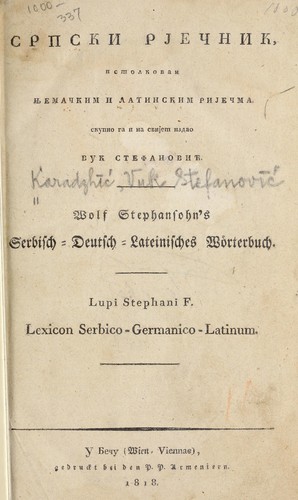
Srpski rječnik
book
Pomorišje
thumb|250px|Frontiersman from Pomorišje, first half of the 18th century.
Pomorišje () is a historical geographical region on the banks of the river Mureș () that in the past has had a sizable ethnic Serb population. The region is mostly divided between Romania and Hungary, with small part of it in northern Serbia. Today, a Serb minority is present in parts of the region that are part of Romania and Hungary.
Origin of the Serbs
article on the Serbs
Serb Democratic League
Serbian political party in the Ottoman Empire
Serboi
thumb|"Serbi" located near the mouth of the Volga in a map depicting Sarmatia Asiatica, 1770
The Serboi or Serbi () and Sirbi () was a tribe mentioned in Greco-Roman geography as living in the North Caucasus, believed by scholars to have been Sarmatian.
Serbian Revival
Banovina of Serbia
proposed banovina