Category
page 1Hypothetical bodies of the Solar System
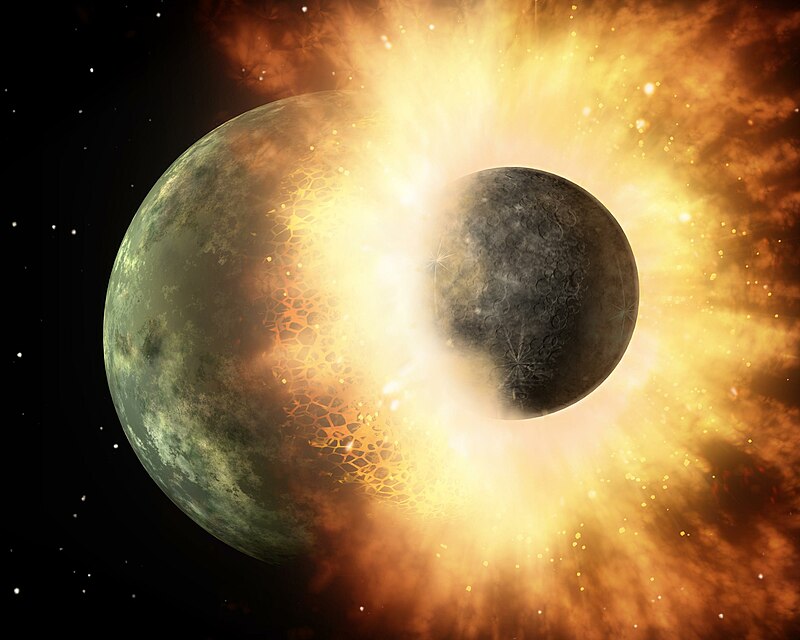
Theia
planet that is hypothesized to have impacted Earth and created the Moon
Vulcan
hypothetical planet between the Sun and Mercury

Nemesis
hypothetical star orbiting the Sun, responsible of extinction events

Vulcanoid asteroid
right|thumb|270px|The zone, represented by the orange region, in which vulcanoids may exist, compared with the orbits of Mercury (planet)|Mercury, [[Venus and Earth]]
The vulcanoids are a hypothetical population of asteroids that orbit the Sun in a dynamically stable zone inside the orbit of the planet Mercury. They are named after the hypothetical planet Vulcan, which was proposed on the basis of irregularities in Mercury's orbit that were later found to be explained by general relativity. So far, no vulcanoids have been discovered, and it is not yet clear whether any exist.
planet beyond Neptune
any Solar System planet that might orbit the Sun beyond Neptune
Tyche
Öpik–Oort Comet Cloud hypothetical planet
Phaeton
hypothetical former Solar System planet
Neith
hypothetical natural satellite of Venus
claimed moons of Earth
claims that Earth may have other natural satellites
Themis
hypothetical moon of Saturn

Counter-Earth
thumb|250px|right|Philolaus believed there was a "Counter-Earth" (Antichthon) orbiting the "Central Fire" (not labeled) that was not visible from Earth. The upper illustration depicts Earth at night while the lower one depicts Earth in the day.
The Counter-Earth is a hypothetical body of the Solar System that orbits on the other side of the Solar System from Earth, e.g. at the L3 Lagrange point of the Sun–Earth system. A Counter-Earth, or Antichthon (), was hypothesized by the pre-Socratic Greek philosopher Philolaus () to support his non-geocentric cosmology, in which all objects in the unive
Mercury's moon
supposed natural satellite orbiting Mercury
Chiron
hypothetical natural satellite of Saturn
list of hypothetical Solar System objects
Wikimedia list article
Planet V
scientific proposal in 2002 for a destroyed fifth planet

Synestia
thumb|Artistic impression
A synestia is a hypothesized structure for the debris field generated by the collision of planets: a rapidly spinning doughnut-shaped mass of vaporized rock. The term was coined in 2017 by Sarah T. Stewart-Mukhopadhyay, taken from Hestia, goddess of the hearth, combined with syn- meaning together. In computer simulations of giant impacts of rotating objects, a synestia can form if the total angular momentum is greater than the co-rotational limit. Beyond the co-rotational limit, the velocity at the equator of a body would exceed the orbital velocity.
Fifth planet
any of various hypothetical planets thought to have existed