Category
page 1Kings in Greek mythology

Zeus
Zeus (, ) is the chief deity of the Greek pantheon. He is a sky and thunder god in ancient Greek religion and mythology, who rules as king of the gods on Mount Olympus.

Poseidon
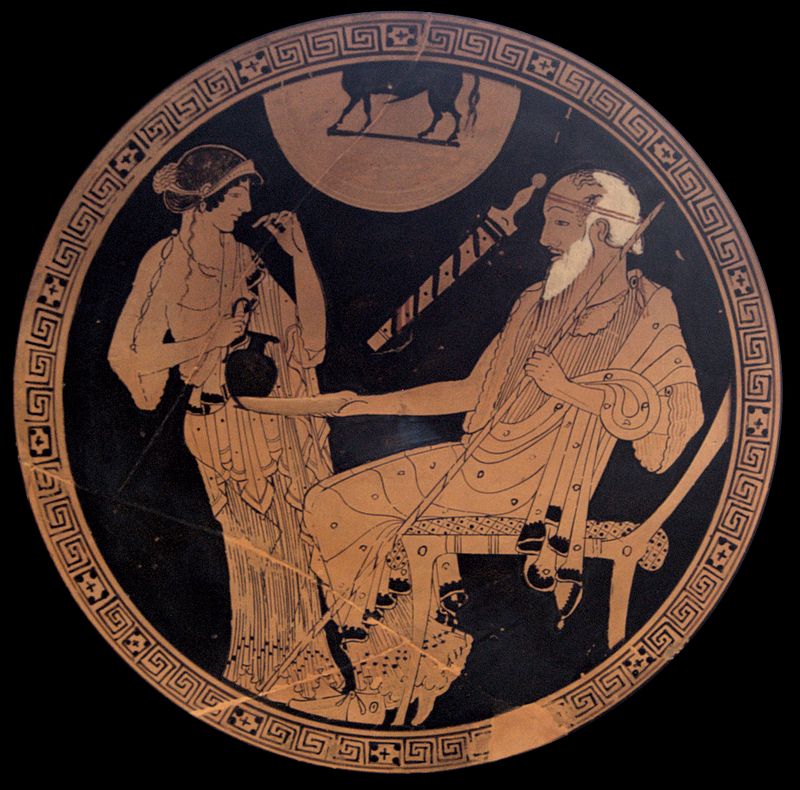
thumb|right|280px|Poseidon greeting Theseus (on the right). Detail, Attic red-figured calyx-krater by Syriscos Painter, 450-500BC from Agrigento. BnF Museum (Cabinet des médailles), Paris

Hades
Hades (; , , later ), in the ancient Greek religion and mythology, is the god of the dead and riches and the King of the underworld, with which his name became synonymous. Hades was the eldest son of Cronus and Rhea, although this also made him the last son to be regurgitated by his father. He and his brothers, Zeus and Poseidon, defeated, overthrew, and replaced their father's generation of gods, the Titans, and claimed joint sovereignty over the cosmos. Hades received the underworld, Zeus the sky, and Poseidon the sea, with the solid earth, which was long the domain of Gaia, available to all

Odysseus
In Greek and Roman mythology, Odysseus (; , ), also known by the Latin variant Ulysses (, ; ), is a legendary Greek king of Ithaca and the hero of Homer's epic poem, the Odyssey. Odysseus also plays a key role in Homer's Iliad and other works in that same epic cycle.

Cronus
In ancient Greek religion and mythology, Cronus, Cronos, or Kronos ( or ; ) was the leader and youngest of the Titans, the children of Gaia (Earth) and Uranus (Sky). He overthrew his father and ruled during the mythological Golden Age until he was overthrown by his son Zeus and imprisoned in Tartarus. According to Plato, however, the deities Phorcys, Cronus, and Rhea were the eldest children of Oceanus and Tethys.

Uranus
primordial Greek deity, god of the Sky; one of the Greek primordial deities

Sisyphus
thumb|alt=Sisyphus depicted on a black-figure amphora vase |Persephone supervising Sisyphus in the Underworld, Attic [[black-figure amphora, BC, Staatliche Antikensammlungen]]
thumb|Sisyphus and Amphiaraus, copy of a mural in the [[François Tomb, Vulci, made in 4th century BC]]

Oedipus
Oedipus (, ; , ) was a mythical Greek king of Thebes. A tragic hero in Greek mythology, Oedipus unwittingly fulfilled a prophecy that he would end up killing his father and marrying his mother, thereby bringing disaster to his city and family.

Minos
250 px|thumb|Gustave Doré's illustration of King Minos for [[Dante Alighieri's Inferno]]
thumb|Mural of Minos at the National and Kapodistrain University of Athens

Priam
In Greek mythology, Priam (; , ) was the legendary and last king of Troy during the Trojan War. He was the son of Laomedon. His many children included notable characters such as Hector, Paris, and Cassandra.

Midas
thumb|King Midas on a red-figure stamnos from Chiusi around 440 BC, British Museum

Cadmus
In Greek mythology, Cadmus (; ) was the legendary Phoenician founder of Boeotian Thebes. He was, alongside Perseus and Bellerophon, the greatest hero and slayer of monsters before the days of Heracles. Commonly stated to be a prince of Phoenicia, the son of king Agenor and queen Telephassa of Tyre, the brother of Phoenix, Cilix and Europa, Cadmus traced his origins back to Poseidon and Libya.
.jpg)
Peleus
thumb|upright|Detail of Greek mosaic with Peleus and Clotho, [[Paphos Archaeological Park]]

Bellerophon
Bellerophon or Bellerophontes () or Hipponous (), was a divine Corinthian hero of Greek mythology, the son of Poseidon and Eurynome, and the foster son of Glaukos. He was "the greatest hero and slayer of monsters, alongside Cadmus and Perseus, before the days of Heracles". Among his greatest feats was killing the Chimera of the Iliad, a monster that Homer depicted with a lion's head, a goat's body, and a serpent's tail: "her breath came out in terrible blasts of burning flame."
thumb|Bellerophon, Pegasus, and [[Athena, a Roman fresco in Pompeii, first half of the 1st century]]
.jpg)
Rhadamanthus
thumb|315x315px|Depiction of Rhadamanthys in the Tomb of Judgement, Lefkadia, c.300–250 BC

Tantalus
thumb|300px|Tantalus on an Apulian red-figure volute krater, 330-320 BC, Staatliche Antikensammlungen.

Aeacus
Aeacus (; also spelled Eacus; Ancient Greek: Αἰακός) was a king of the island of Aegina in Greek mythology. He was a son of Zeus and the nymph Aegina, and the father of the heroes Peleus and Telamon. According to legend, he was famous for his justice, and after he died he became one of the three judges in the underworld alongside Minos and Rhadamanthus. In another story, he assisted Poseidon and Apollo in building the walls of Troy.

Atreus
thumb|The Farnese Atreus (1574 engraving by Antonio Lafreri and [[Cornelis Cort) depicts Atreus and one of the sons of Thyestes, whom Atreus is about to kill]]
Nestor
wise ruler of Pylos in Greek mythology, son of Neleus

Diomedes
thumb|Athena counseling Diomedes shortly before he enters the battle. Schlossbrücke, Berlin.

Pygmalion
legendary figure of Cyprus, sculptor

Admetus
king of Pherae in Thessaly, in Greek mythology

Aeolus
god of winds, son of Hippotes in Greek mythology

Eurystheus
thumb|338x338px|Hercule apporte à Eurysthée la ceinture de la reine des Amazones by Daniel Sarrabat

Agenor
Agenor () was in Greek mythology and history a Phoenician king of Tyre or Sidon. The Greek historian Herodotus (c. 484–425 BC), born in the city of Halicarnassus under the Achaemenid Empire, estimated that Agenor lived either 1000 or 1600 years prior to his visit to Tyre in 450 BC at the end of the Greco-Persian Wars (499–449 BC). He was said to have reigned in that city for 63 years.

Chrysaor
In Greek mythology, Chrysaor (, gen. ), "he who has a golden sword" (from "golden" and "sword") was the brother of the winged horse Pegasus, often depicted as a young man, the son of Poseidon and Medusa, born when Perseus decapitated the Gorgon Medusa.

Telamon
thumb|280px|The marriage of Telamon and Hesione or Hesione's farewell to her brother [[Priam under the attention of Heracles and Telamon on the right, detail of fresco from the triclinium of the House of Octavius Quartio at Pompeii]]
%2005.jpg)
Augeias of Elis
In Greek mythology, Augeas (or Augeias, , ), whose name means "bright", was king of Elis and father of Epicaste. Some ancient authors say that Augeas was one of the Argonauts. He is known for his stables, which housed the single greatest number of cattle in the country and had never been cleaned, until the time of the great hero Heracles. The derivative adjective augean came to signify a challenging task, typically improving or fixing something that is currently in a bad condition.

Anchises
thumbnail|Aphrodite reveals baby Aeneas to Anchises (1st century AD).
Creon
king of Thebes in Greek mythology

Laomedon
In Greek mythology, Laomedon (; , Lāomédōn, "ruler of the people") was a Trojan king, son of Ilus and thus nephew of Ganymede and Assaracus.
Aeson
In Greek mythology, Aeson (; Ancient Greek: Αἴσων Aísōn) was a king of Iolcus in Thessaly. He was the father of the hero Jason. According to one version of the story, he was imprisoned by his half-brother Pelias, and when Pelias intended to kill him he committed suicide. In another story, he was killed by Jason's wife Medea, who brought him back to life as a young man.

Polynices
In Greek mythology, Polynices (also Polyneices) (; ) was the son of Oedipus and either Jocasta or Euryganeia, and the brother of Eteocles, Antigone, and Ismene. When Oedipus discovered that he had killed his father and married his mother, he blinded himself and left Thebes, leaving Polynices and Eteocles to rule jointly. However, due to a curse placed upon them by Oedipus, their agreement quickly fell apart, and a war for the kingdom ensued. During battle, the brothers killed each other.

Danaus
thumb

Memnon
thumb|Attic neck-amphora featuring [[Heracles and Memnon (detail), BC]]
thumb|Eos retrieving the body of her son Memnon from the battlefield (detail); Etruscan bronze mirror, BC

Alcinous
thumb|300px|Odysseus at the Court of Alcinous by [[Francesco Hayez. The blind minstrel Demodocus is playing the harp.]]

Athamas
thumb|right|206x206px| The Fury of Athamas by John Flaxman (1755-1826).
Aegyptus
In Greek mythology, Aegyptus or Ægyptus (; ) was a legendary king of ancient Egypt. He was a descendant of the princess Io through his father Belus, and of the river-god Nilus as both the father of Achiroe, his mother and as a great, great-grandfather on his father's side.
Epaphus
In Greek mythology, Epaphus (; ), also called Apis or Munantius was a son of Zeus and king of Egypt.
Cepheus, King of Aethiopia
mythical character

Inachus
thumb|Io (mythology)|Io recognized by her father ([[Victor Honoré Janssens)]]

Thyestes
thumb|Thyestes and Aerope, painting by Nosadella

Ascanius
thumb|The boy Ascanius weeps and Venus hovers nearby as the physician Iapyx treats the wound of Aeneas (wall painting from [[Pompeii, 1st century AD).]]
Dardanus
mythological Greek character, son of Zeus
Electryon
In Greek mythology, Electryon (;Ancient Greek: Ἠλεκτρύων) was a king of Tiryns and Mycenae or Medea in Argolis.

Amphiaraus
thumb|right|250px|Amphiaraus on his chariot.
Amphiaraus or Amphiaraos (; ) was in Greek mythology the son of Oicles, a seer, and one of the leaders of the Seven against Thebes. Amphiaraus at first refused to go with Adrastus on this expedition against Thebes as he foresaw the death of everyone who joined the expedition. His wife, Eriphyle, eventually compelled him to go.

Telephus
right|thumb|Heracles with the infant Telephus and deer, mid second century AD. Paris, [[Louvre MA 75.]]

Pentheus
In Greek mythology, Pentheus (; ) was a king of Thebes. His father was Echion, the wisest of the Spartoi. His mother was Agave, the daughter of Cadmus, the founder of Thebes, and grandson of the goddess Harmonia. His sister was Epeiros and his son was Menoeceus.
Laertes
legendary king of Ithaca

Oenomaus
thumb|King Oenomaus, Hippodamia, and Olympian gods. Illustration from an ancient vase.
Neleus
Neleus (; ) was a mythological king of Pylos. In some accounts, he was also counted as an Argonaut instead of his son, Nestor.

Pylades
thumb|300px|An antique fresco in Pompeii depicting a scene from 'Iphigenia among the Taurians' showing [[Orestes, Pylades and King Thoas]]
Idomeneus
Greek mythical character, King of Crete
Tros
ruler of Troy in Greek mythology
Kithairon
Cithaeron or Kithairon (Κιθαιρών, -ῶνος) is a mountain and mountain range about sixteen kilometres (ten miles) long in Central Greece. The range is the physical boundary between Boeotia region in the north and Attica region in the south. It is mainly composed of limestone and rises to . The north-east side of the range is formed by the mountain Pastra.

Phoroneus
thumb|alt=Phoroneus|Relief from Giotto's Campanile, depicting Phoroneus as the man who invented law.
Busiris
king of Egypt in Greek mythology
Ophion
Primordial Greek creator deity
Belus
son of Poseidon in Greek mythology
Oeneus
In Greek mythology, Oeneus (; ) was a Calydonian king. He introduced wine-making to Aetolia, which he learned from Dionysus and the first who received a vine-plant from the same god.