Category
page 1Mind–body interventions

meditation
Meditation is a practice in which an individual uses a technique to train attention and awareness and detach from reflexive, "discursive thinking", achieving a mentally clear and emotionally calm and stable state, while not judging the meditation process itself.

massage
thumb|250px|Massage (video)
Massage is the rubbing or kneading of the body's soft tissues. Massage techniques are commonly applied with hands, fingers, elbows, knees, forearms, feet, or a device. The purpose of massage is generally for the treatment of body stress or pain. In English-speaking European countries, traditionally a person professionally trained to give massages is known by the gendered French loanwords masseur (male) or masseuse (female). In the United States, these individuals are often referred to as "massage therapists." In some provinces of Canada, they are called "registered

placebo
thumb|Placebos are typically inert tablets, such as sugar pills.
A placebo ( ) is a medicine or treatment intended to appear genuine to its recipient, but which has no pharmaceutical effect. Common placebos include inert tablets (like sugar pills), inert injections (like saline), sham surgery, and other procedures.
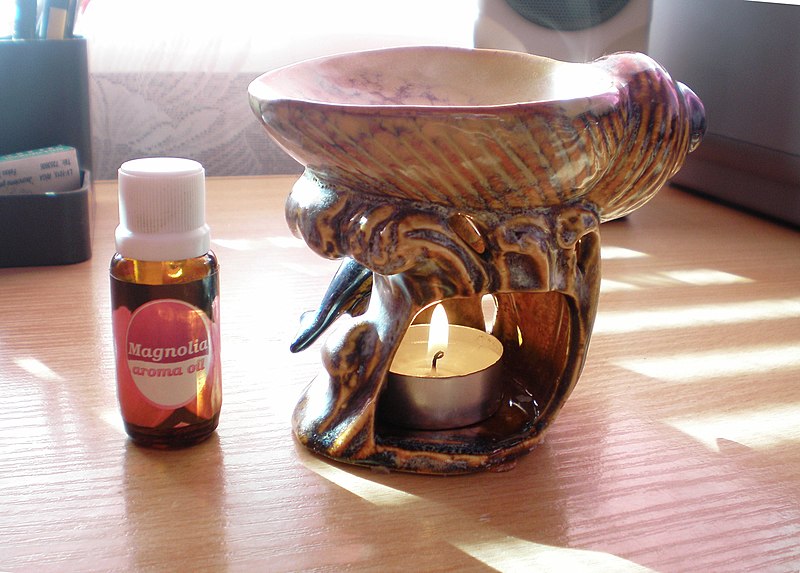
aromatherapy
Aromatherapy is a practice based on the use of aromatic materials, including essential oils and other aroma compounds, with claims for improving psychological well-being. It is used as a complementary therapy or as a form of alternative medicine, and typically is used via inhalation and not by ingestion.

mindfulness
Mindfulness is the cognitive skill, usually developed through exercises, of sustaining metacognitive awareness towards the contents of one's own mind and bodily sensations in the present moment. The term mindfulness derives from the Pali word sati, a significant element of Buddhist traditions, and the practice is based on ānāpānasati, Chan, and Tibetan meditation techniques.

trance
Trance is a state of semi-consciousness in which a person is not self-aware and is either altogether unresponsive to external stimuli (but nevertheless capable of pursuing and realizing an aim) or is selectively responsive in following the directions of the person (if any) who has induced the trance. Trance states may occur involuntarily and unbidden.

pilates
thumb|Pilates reformer machine
Pilates ( , ) is a type of mind–body exercise that encompasses the original discipline created by Joseph Pilates and the modifications to it that have arisen over the years. As of 2023, over 12 million people practice Pilates.

Pranayama
thumb|upright=1.35|A group practising Nadi Shodhana pranayama (alternate nostril breathing) on the [[International Day of Yoga in Kolkata, India, in 2017 ]]
psychosomatic medicine
interdisciplinary medical field exploring the relationships among social, psychological, and behavioral factors on bodily processes and quality of life in humans and animals
nocebo
A nocebo effect is said to occur when a patient's expectations for a treatment cause the treatment to have a worse effect than it otherwise would have. For example, when a patient anticipates a side effect of a medication, they can experience that effect even if the "medication" is actually an inert substance. The complementary concept, the placebo effect, is said to occur when expectations improve an outcome.

metacognition
alt=Diagram of a brain thinking about a brain|thumb|Metacognitive processes deal with information about other cognitive processes.
Metacognition is an awareness of one's thought processes and an understanding of the patterns behind them. The term comes from the root word meta, meaning "beyond", or "on top of". Metacognition can take many forms, such as reflecting on one's ways of thinking, and knowing when and how oneself and others use particular strategies for problem-solving. There are generally two components of metacognition: (1) cognitive conceptions and (2) a cognitive regulation system

hypnotherapy
Hypnotherapy, also known as hypnotic medicine, is the use of hypnosis in psychotherapy. Hypnosis is a state of deep focus and openness to suggestion that usually begins with relaxation and guided instructions. Some people respond more strongly than others, and researchers explain that hypnosis is not a magical trance but a form of concentrated attention and expectation (Heap & Naish, 2012). Hypnotherapy is generally not considered to be based on scientific evidence, and is rarely recommended in clinical practice guidelines. However, several psychological reviews and meta-analyses suggest that

eurythmy
Eurythmy is an expressive movement art originated by Rudolf Steiner in conjunction with his wife, Marie Steiner-von Sivers, in the early 20th century. Primarily a performance art, it is also used in education, especially in Waldorf schools, and – as part of anthroposophic medicine – for claimed therapeutic purposes.
psychoneuroimmunology
Psychoneuroimmunology (PNI), also referred to as psychoendoneuroimmunology (PENI) or psychoneuroendocrinoimmunology (PNEI), is the study of the interaction between psychological processes and the nervous and immune systems of the human body. It is a subfield of psychosomatic medicine. PNI takes an interdisciplinary approach, incorporating psychology, neuroscience, immunology, physiology, genetics, pharmacology, molecular biology, psychiatry, behavioral medicine, infectious diseases, endocrinology, and rheumatology.
Bach flowers
alternative medicine without scientific evidence

biofeedback
thumb|Biofeedback device for treating posttraumatic stress disorder
autogenic training
desensitation-relaxation technique developed by the German psychiatrist Johannes Heinrich Schultz by which a psychophysiologically determined relaxation response is obtained
hippotherapy
form of therapy in which a therapist uses the characteristic movements of a horse
family constellation
alternative therapeutic method

autosuggestion
Autosuggestion is a psychological technique related to the placebo effect, popularized internationally by pharmacist Émile Coué in the 1920s. It is a form of self-induced suggestion in which individuals guide their own thoughts, feelings, or behavior. The technique is often used in self-hypnosis.
thumb|A French print of Dr. Herbert A. Parkyn's Auto Suggestion, What It Is and How to Use It for Health, Happiness and Success. The book was extremely popular in France, where it would have a big influence on Emile Coué.''
While Émile Coué created an autosuggestion craze in America in the 1920s, the
Alexander technique
postural awareness technique
sati
concentration (dhyāna, jhāna); concept of mindfulness or awareness, a spiritual or psychological faculty (indriya) that forms an essential part of Buddhist practice
Feldenkrais Method
guild regulated movement education complementary to physical therapy
self-hypnosis
Self-hypnosis or auto-hypnosis (as distinct from hetero-hypnosis) is a form, a process, or the result of a self-induced hypnotic state.
self-compassion
In psychology, self-compassion is extending compassion to one's self in instances of perceived inadequacy, failure, or general suffering. American psychologist Kristin Neff has defined self-compassion as being composed of three main elements – self-kindness, common humanity, and mindfulness.
Self-kindness: Self-compassion entails being warm towards oneself when encountering pain and personal shortcomings, rather than ignoring them or hurting oneself with self-criticism.
Common humanity: Self-compassion also involves recognizing that suffering and personal failure is part of the shared human
Internal Family Systems
psychotherapy model

Paneurhythmy
Paneurhythmy (Bulgarian: Паневритмия) is a system of physical musical exercises developed by Peter Deunov between 1922 and 1944, focused on achieving inner balance and harmonization. The emphasis of the exercises is on giving and receiving, with the goal of creating a conscious exchange with the forces of nature. Paneurhythmy is practiced for both physical fitness and spiritual development. The creator of paneurhythmy defines it as a science: "Paneurhythmy is a science that regulates one's physical, spiritual, and mental functions and is a combination of human thoughts, feelings, and actions."

guided imagery
mind-body therapy

Gerda Alexander
German / Danish teacher (1908-1994)
seitai
Seitai (整体) is a form of bodywork and alternative medicine practice, originally developed as training tool within Health Education. It was developed in Japan by Haruchika Noguchi (1911–1976) in the mid-20th century. The kanji comprising the word are 整 sei, regulated, coordinated, in order, and 体 tai, "body, organism", therefore translated together as "the body in order".
Mind and Life Institute
American research institute for contemplative neuroscience
psychogenic disease
class of mental disorder
Tension myositis syndrome
medical condition causing back pain
Creative visualization
Mental process
Rosen Method Bodywork
physiotherapy technique
Abhyanga
Abhyanga ("oil massage") is a form of ayurvedic therapy that involves massage of the entire body from the head to the toe with Dosha-specific warm herb-infused oil. The oil is commonly pre-mixed with herbs for specific conditions. Traditionally, the base oil used is sesame but, ayurveda professionals base the oil section on the Dosha type & a mixture of base oils can be used to process Dosha appropriate herbs for Abhyanga.
bodywork
type of alternative physical therapy
mind–body interventions
health and fitness intervention that works on a physical and mental level such as yoga, tai chi, and pilates
brainspotting
Brainspotting is a psychotherapy approach developed in 2003 that aims to help individuals process psychological trauma and other distress by maintaining specific eye positions believed to be linked to unprocessed experiences. The evidence base for brainspotting is limited; small pilot and comparative studies suggest possible benefits, but its theoretical foundations have not been empirically validated. Several psychologists characterize brainspotting as a pseudoscience or fringe medicine, though some consider it to be an emerging therapy.
tinnitus retraining therapy
form of habituation therapy
Dinacharya
Dinacharya (Sanskrit: दिनचर्या "daily-routine") is a concept in Ayurvedic medicine which proposes the healthy routine to be followed in a day and night. Ayurveda contends that routines help establish balance and that understanding daily cycles is useful for promoting health. Dinacharya says that each day, two cycles of change occur, that correlate with the Ayurvedic concept of dosha. Routines covered by dinacharya include: waking time, elimination, hygiene, massage, exercise, bathing, meditation and prayer, meals, study, work, relaxation and sleeping.
Somatic Experiencing
form of therapy aimed at healing trauma