Category
page 1Phoenician characters in Greek mythology

Dionysus
In ancient Greek religion and myth, Dionysus (; ) is the god of wine-making, orchards, fruit, vegetation, fertility, festivity, insanity, ritual madness, religious ecstasy, and theatre. He was also known as Bacchus ( or ; ) by the Greeks (a name later adopted by the Romans) for a frenzy he is said to induce called baccheia. His wine, music, and ecstatic dance were considered to free his followers from self-conscious fear and care, and subvert the oppressive restraints of the powerful. His thyrsus, a fennel-stem sceptre, sometimes wound with ivy and dripping with honey, is both a beneficent wan
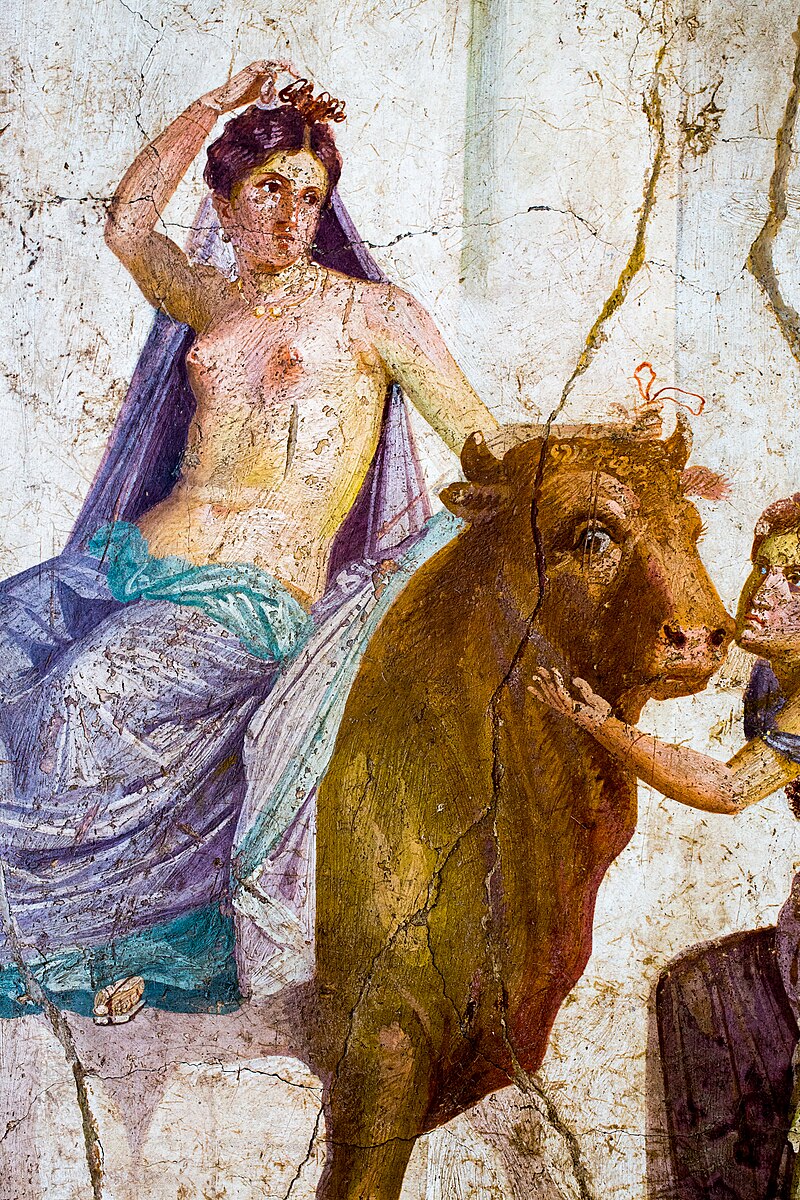
Europa
Phoenician character in Greek mythology, daughter of Agenor

Cadmus
In Greek mythology, Cadmus (; ) was the legendary Phoenician founder of Boeotian Thebes. He was, alongside Perseus and Bellerophon, the greatest hero and slayer of monsters before the days of Heracles. Commonly stated to be a prince of Phoenicia, the son of king Agenor and queen Telephassa of Tyre, the brother of Phoenix, Cilix and Europa, Cadmus traced his origins back to Poseidon and Libya.
.jpg)
Semele
In Greek mythology, Semele (; ), or Thyone (; ), was the youngest daughter of Cadmus and Harmonia, and the mother of Dionysus by Zeus (her own great-grandfather).

Pygmalion
legendary figure of Cyprus, sculptor

Agenor
Agenor () was in Greek mythology and history a Phoenician king of Tyre or Sidon. The Greek historian Herodotus (c. 484–425 BC), born in the city of Halicarnassus under the Achaemenid Empire, estimated that Agenor lived either 1000 or 1600 years prior to his visit to Tyre in 450 BC at the end of the Greco-Persian Wars (499–449 BC). He was said to have reigned in that city for 63 years.
Cepheus, King of Aethiopia
mythical character
Telephassa
Telephassa (; ), also spelled Telephaassa (; ) and Telephe (; ), is a lunar epithet in Greek mythology that is sometimes substituted for Argiope the wife of Agenor, according to his name a "leader of men" in Phoenicia, and mother of Cadmus.
%20p1.313%20PHRYGIA.jpg)
Cilix
Cilix (; Ancient Greek: Κίλιξ Kílix) was, according to Greek mythology, a Phoenician prince as the son of King Agenor and Telephassa or Argiope.

Phineus
thumb|250px|Phineus with the Boreads.

Cinyras
right|thumb|280px|Myrrha and Cinyras. [[Engraving by Virgil Solis for Ovid's Metamorphoses]]
The Phoenician Women
ancient Greek tragedy by Euripides
Phoenix
Greek mythology character, son of Agenor and Telephassa, eponym of Phoenicia
Thasus
In Greek mythology, Thasus or Thasos ( or ; ) was a son of Poseidon (or, in other versions, Agenor, Phoenix or Cilix). He was a Phoenician prince and one of those who set out from Phoenicia in search of Europa (Thasus' sister). His brother, Cadmus, gave him a part of the army and left him on an island (Thasos) where he "founded" the eponymous town of Thasos.
Astypalaea
In Greek mythology, Astypalaea (; ) or Astypale was a Phoenician princess as the daughter of King Phoenix and Perimede, daughter of Oeneus; thus she was the sister of Europa. In some accounts, her mother was called Telephe and her siblings were Peirus and again Europe. Astypale was a lover of Poseidon who seduced her, and had two sons by him: Ancaeus, King of Samos, and Eurypylos, King of Kos.
Beroe
nymph in Greek mythology
Alphesiboea
Alphesiboea () was the name of several characters in Greek mythology:
Arceophon
In Greek mythology, Arceophon () was a wealthy man of Salamis in Cyprus, son of Minnyrides (), a Phoenician.
Side
set index
Eurydamas
In Greek mythology, the name Eurydamas (Ancient Greek: Εὐρυδάμᾱς) may refer to: