Category
page 1Places in Greek mythology

Mount Etna
active stratovolcano on the east coast of Sicily, Italy

Troy
Troy (; /; ) or Ilion (; ) was an ancient city located in present-day Çanakkale, Turkey. It is best known as the setting for the Greek myth of the Trojan War. The archaeological site is open to the public as a tourist destination, and was added to the UNESCO World Heritage list in 1998.

Sparta
Sparta was a prominent city-state in Laconia in ancient Greece. In antiquity (pre-800 BCE), the state was known as Lacedaemon (), while "Sparta" referred to its capital, a group of villages in the valley of the Evrotas River in Laconia, in southeastern Peloponnese. Around 650 BC, it rose to become one of the major military powers in Greece, a status it retained until 371 BC.

Mount Olympus
mountain in Elassona municipality, Greece

Corfu
Corfu ( , ) or Kerkyra (, ) is one of the Ionian Islands in western Greece, and the northernmost island on Greece's west coast except for its satellite Diapontian Islands, which are also the westernmost point of all Greece. Corfu and the Diapontian Islands mark the International Hydrographic Organization border between the Ionian Sea to the south and the Adriatic Sea to the north. Within the Ionian Islands region, the regional unit of Corfu extends as far south as the Paxoi. The capital and largest city of the regional unit is also named Corfu.

Piraeus
Piraeus ( ; ; , Ancient: , Katharevousa: ) is a port city within the Athens urban area ("Greater Athens"), in the Attica region of Greece. It is located southwest of Athens city centre along the east coast of the Saronic Gulf in the Athens Riviera.

Mount Parnassus
mountain in Phthiotis Regional Unit, Greece

Elefsina
thumb|250px|Plan of ancient Eleusis

Icaria
Ikaria, also spelled Icaria (; ), is a Greek island in the Aegean Sea, 10 nautical miles (19 km) southwest of Samos. Administratively, Ikaria forms a separate municipality within the Ikaria regional unit, which is part of the North Aegean administrative region.

Megara
Megara (; , ) is a historic town and a municipality in West Attica, Greece. It lies in the northern section of the Isthmus of Corinth opposite the island of Salamis, which belonged to Megara in archaic times, before being taken by Athens. Megara was one of the four districts of Attica, embodied in the four mythic sons of King Pandion II, of whom Nisos was the ruler of Megara. Megara was also a trade port, its people using their ships and wealth as a way to gain leverage on armies of neighboring poleis. Megara specialized in the exportation of wool and other animal products including livestock

Tinos
Tinos ( ) is a Greek island situated in the Aegean Sea. It forms part of the Cyclades archipelago. The closest islands are Andros, Delos, and Mykonos. It has a land area of and a 2021 census population of 8,934 inhabitants.
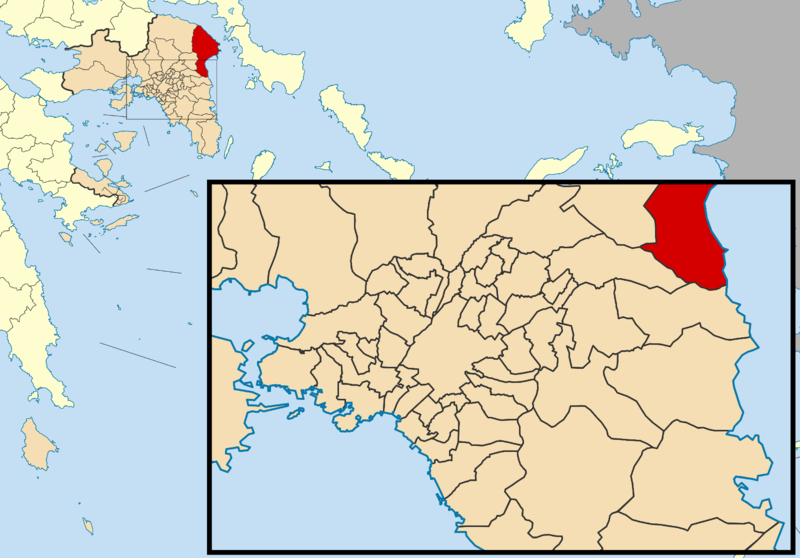
Marathon
modern town in Attica, Greece

Q208566
Skyros (, ), in some historical contexts Latinized Scyros (, ), is an island in Greece. It is the southernmost inhabited island of the Sporades, an archipelago in the Aegean Sea. Around the 2nd millennium BC, the island was known as The Island of the Magnetes; later, it was consecutively known as Pelasgia, Dolopia, and finally Skyros. At , it is the largest island of the Sporades, and had a population of about 3,000 in 2021.

labyrinth
thumb|Silver coin from Knossos displaying the 7-course "Classical" design to represent the Labyrinth,

Serifos
Serifos () is a Greek island in the Aegean Sea, located in the western Cyclades, south of Kythnos and northwest of Sifnos. It is part of the Milos regional unit. The area is and the population was 1,241 at the 2021 census. It is located about ESE of the Athenian port of Piraeus.

Pillars of Hercules
promontories that flank the entrance to the Strait of Gibraltar
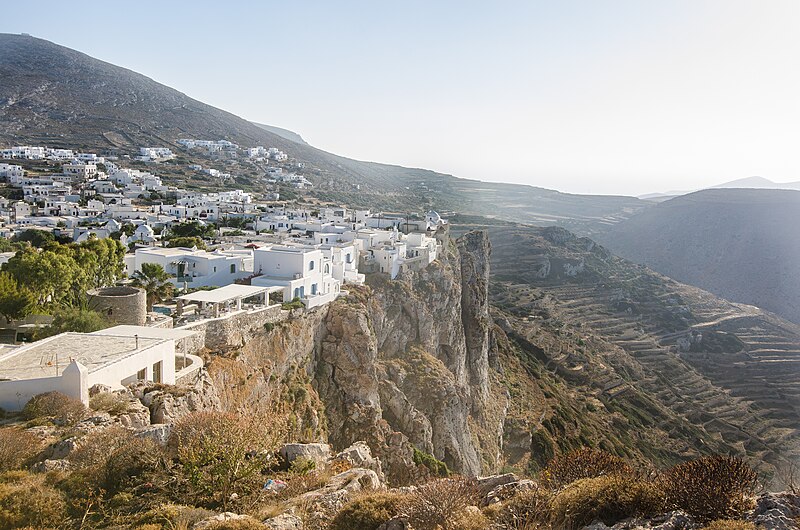
Folegandros
Folegandros (also Pholegandros; ) is a small Greek island in the Aegean Sea that, together with Sikinos, Ios, Anafi and Santorini, forms the southern part of the Cyclades. Its surface area is and it had 719 inhabitants as of 2021.

Chalcedon
Chalcedon (; ) was an ancient maritime town of Bithynia, in Asia Minor. It was located almost directly opposite Byzantium, south of Scutari (modern Üsküdar) and it is now a district of the city of Istanbul named Kadıköy. The name Chalcedon is a variant of Calchedon, found on all the coins of the town as well as in manuscripts of Herodotus's Histories, Xenophon's Hellenica, Arrian's Anabasis, and other works. Except for the Maiden's Tower, almost no above-ground vestiges of the ancient city survive in Kadıköy today; artifacts uncovered at Altıyol and other excavation sites are on display at the

Thule
thumb|upright=1.4|Thule as Tile on the Carta marina of 1539 by [[Olaus Magnus, where it is shown located to the northwest of the Orkney islands, with a "monster, seen in 1537", a whale ("balena"), and an orca nearby]]

Cape Matapan
cape at south tip of Greece, ancient Taenarum

Nemea
Nemea (; ; ) is an ancient site in the northeastern part of the Peloponnese, in Greece. Formerly part of the territory of Cleonae in ancient Argolis, it is today situated in the regional unit of Corinthia. The small village of Archaia Nemea (formerly known as "Iraklion") is immediately southwest of the archaeological site, while the new town of Nemea lies to the west.
Dia
Greek island
Cape St. Vincent
headland

Ortygia
Ortygia ( ; ; ) is a small island which is the historical centre of the city of Syracuse, Sicily. The island, also known as the (Old City), contains many historical landmarks.

Iolcos
Iolcus (; also rendered Iolkos ; and Ἰαωλκός; ; ) is an ancient city, a modern village and a former municipality in Magnesia, Thessaly, Greece. Since the 2011 local government reform it is part of Volos, of which it is a municipal unit. It is located in central Magnesia, north of the Pagasitic Gulf. Its land area is 1.981 km2. The municipal unit is divided into three communities, Agios Onoufrios (pop. 433), Anakasia (pop. 888) and Ano Volos (pop. 687), with a total population of 2,008 (2021 census). The seat of the former municipality was the village of Ano Volos.
Mount Othrys
mountain range in Greece, between Thessaly and Central Greece
Mount Kyllini
mountain in Corinthia Regional Unit, Greece

Matala
village in Greece

Ogygia

Helike
Helike (; , pronounced , modern ) was an ancient Greek polis or city-state that was submerged by a tsunami in the winter of 373 BC.
Cave of Euripides
cave in Greece

Hippocrene
thumb|Hippocrene source on Mount Helicon

Aeaea
thumb|Map of Italy with Aeaea marked south of Rome (Abraham Ortelius, 1624)
Fortunate Isles
legendary islands in the Atlantic Ocean

Gortyn
thumb|300px|Ruins of Gortyna.
Gortyna (; also known as Gortyn (Γορτύν)) was a town of ancient Crete which appears in the Homeric poems under the form of Γορτύν; but afterwards became usually Gortyna (Γόρτυνα). According to Stephanus of Byzantium it was originally called Larissa (Λάρισσα) and Cremnia or Kremnia (Κρήμνια).
Dikteon Andron
cave near Psychro village, Crete, Greece
Mieza
village in Ancient Macedon

Ithome
Mount Ithome (Greek: Ἰθώμη) or Ithomi, previously Vourkano(s) () or Voulcano(s) (), is the northernmost of twin peaks in Messenia, Greece. Mount Ithome rises to about , about over Valyra, the seat of Ithomi, the former municipality. The other peak is Mount Eva (), , connected to Mount Ithomi by a thin ridge long.
Dikti
Dikti or Dicte () (also Lasithiotika Ori; "Lasithian Mountains"; anciently, Aigaion oros () or ) is a mountain range on the east of the island of Crete in the regional unit of Lasithi. On the west it extends to the regional unit of Heraklion.
According to some versions of Greek mythology, Zeus was reared on this mountain in a cave called Dictaeon Antron (Psychro Cave).
On the north of the main massif, the Lasithi Plateau is located. The topology of the mountain range is rich with plateaus (Lasithi, Katharo, Omalos Viannou, Limnakaro), valleys and secondary peaks. Some important peaks are Spat
Parthenio
mountain range forming border of Arkadia and Argolis, Greece
Ladon
river in Peloponnese, Greece
Beşparmak Mountains
mountain range
Mount Lykaion
mountain in Megalopoli municipality, Greece

Symplegades
thumb|Illustration by Howard Davie for The Heroes by [[Charles Kingsley.]]
The Symplegades (; , Symplēgádes), also known as Clashing Rocks or Cyanean Rocks (Κυανέαι), were, according to Greek mythology, a pair of rocks at the Bosphorus that clashed together whenever a vessel went through. They were defeated by Jason and the Argonauts, who would have been lost and killed by the rocks except for Phineus's advice. Jason let a dove fly between the rocks to see exactly how fast they would have to row to beat the rocks; the dove lost only its tail feathers. The Argonauts rowed mightily to get throug
Themiscyra
ancient city of Pontus in modern-day Turkey

Cius
Cius (; Kios) was an Ancient Greek city bordering the Propontis (now known as the Sea of Marmara), in Bithynia and in Mysia (in modern northwestern Turkey). The city was later renamed to Prusias after King Prusias I of Bithynia, who once restored the city.
Cynthus
Mount Cynthus () is located on the isle of Delos, part of the Greek Cyclades.
Orchomenus
ancient Greek city-state of Boeotia
Aganippe
nymph of a spring near Mt. Helicon

Scheria
thumb|upright=1.2|Pieter Lastman: Odysseus and Nausicaa ([[oil on panel, 1619; Alte Pinakothek, Munich)]]
Scheria or Scherie (; or ), also known as Phaeacia () or Faiakia, was a region in Greek mythology, first mentioned in Homer's Odyssey as the home of the Phaeacians and the last destination of Odysseus in his 10-year journey before returning home to Ithaca. It is one of the earliest descriptions of a utopia.
Pagae
Pagae or Pagai (; ), or Pegae or Pegai () was a town of ancient Megaris, on the Alcyonian or Corinthian Gulf. According to some sources of greek mythology Pagae had been the home town of Tereus. It was the harbour of Megaris on the western coast, and was the most important place in the country next to the capital. According to Strabo it was situated on the narrowest part of the Megaric isthmus, the distance from Pagae to Nisaea being 120 stadia. When the Megarians joined Athens in 455 BCE, the Athenians garrisoned Pagae, and its harbour was of service to them in sending out an expedition
Trachis
Trachis (, Trakhís) was a region in ancient Greece. Situated south of the river Spercheios, it was populated by the Malians. It was also a polis (city-state).
Nysa
mountainous district
Corycian Cave
cave in Greece
Lousios
The Lousios (; ), also known in antiquity as Gortynius or Gortynios (), is a river and a gorge in western Arcadia that stretches from Karytaina north to Dimitsana in Greece. The river begins near Lykochori and flows through the Lousios Gorge. The river is treacherous and flows rapidly. It empties into the Alfeios northwest of Karytaina and south of Atsicholos.
Chaos
in cosmogony, the primordial state of the universe or cosmos

Leibethra
Leibethra or Libethra, in the modern pronunciation Leivithra (), was an ancient Macedonian city at the foot of Mount Olympus, near the present settlement of Skotina. Archaeologists have discovered tombs there from the late Bronze Age (13th–12th century BC) containing rich burial objects. Leivithra played a remarkable role in the history of Pieria.
Midea
Bronze Age citadel in the Argolid, Greece

Gelonus
Gelonus () was, according to Herodotus, the capital of the Gelonians.
Cyclopean Isles
island group