Category
page 1Polar regions of the Earth

Antarctica
Antarctica () is Earth's southernmost and least-populated continent. Situated almost entirely south of the Antarctic Circle and surrounded by the Southern Ocean (also known as the Antarctic Ocean), it contains the geographic South Pole. Antarctica is the fifth-largest continent, being about 40% larger than Europe, and has an area of . Most of Antarctica is covered by the Antarctic ice sheet, with an average thickness of .

North Pole
The North Pole, also known as the Geographic North Pole or Terrestrial North Pole, is the point in the Northern Hemisphere where the Earth's axis of rotation meets its surface. It is called the True North Pole to distinguish from the Magnetic North Pole.
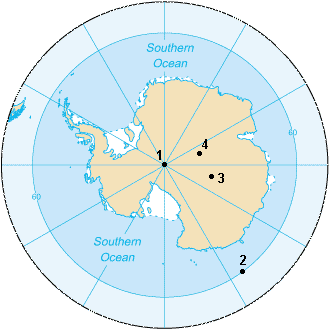
South Pole
one of the two points where the Earth's axis of rotation intersects its surface

Arctic
The Arctic (; ) is the polar region of Earth that surrounds the North Pole, lying north of the Arctic Circle. The Arctic region, from the IERS Reference Meridian travelling east, consists of parts of northern Norway (Nordland, Troms, Finnmark, Svalbard and Jan Mayen), northernmost Sweden (Västerbotten, Norrbotten and Lappland), northern Finland (North Ostrobothnia, Kainuu and Lappi), Russia (Murmansk, Siberia, Nenets Okrug, Novaya Zemlya), the United States (Alaska), Canada (Yukon, Northwest Territories, Nunavut), Danish Realm (Greenland), and northern Iceland (Grímsey and Kolbeinsey), along w

aurora
An aurora ( aurorae or auroras) is a natural light display in Earth’s upper atmosphere caused by charged particles from the Sun colliding with atoms in the atmosphere. These collisions excite oxygen and nitrogen, which then emit light of different colors such as green, red, and purple. When observed in high-latitude regions they are called polar lights and aurora polaris. In the Arctic they are called northern lights (aurora borealis); in the Antarctic, the terms southern lights (aurora australis) are used. Auroras display dynamic patterns of radiant light that appear as curtains, rays, spiral

geographical pole
point of intersection of a celestial body’s surface and its rotational axis

polar region
regions around the Earth's geographical poles

polar night
natural phenomenon when the night lasts for more than 24 hours, occuring only inside the polar circles

polar climate
climate of Earth's poles

polar vortex
persistent cold-core low-pressure area that circles one of the poles

North Magnetic Pole
point in the Arctic at which Earth's magnetic field points vertically downwards, at 86°N 175°E in the Arctic Ocean as of 2019
pole of inaccessibility
point on land or at sea that is the most distant from any coastline, either for an entire planet, or for a given landmass or body of water
Pole of Cold
coldest recorded Earth temperature

polynya
thumb|Coastal polynyas are produced in the Antarctic by katabatic winds
thumb|Katabatic wind spilling off an ice shelf|upright
thumb|A frosty Arctic condensation plume marks this polynya near the west shore of Hudson Bay. This one (and others nearby) are likely kept open by tidal currents. Mile-high west-facing aerial view.
South Magnetic Pole
wandering point on the Earth where the geomagnetic field lines are directed vertically upwards, at 64°S 137°E as of 2015 in the Southern Ocean
polar route
flight path over Earth's axis
circumpolar distribution
species distribution extending around the North or South pole
Three Poles Challenge
adventure challenge to reach the North Pole, the South Pole, and the summit of Mount Everest