Category
page 1Political movements in the Russian Empire
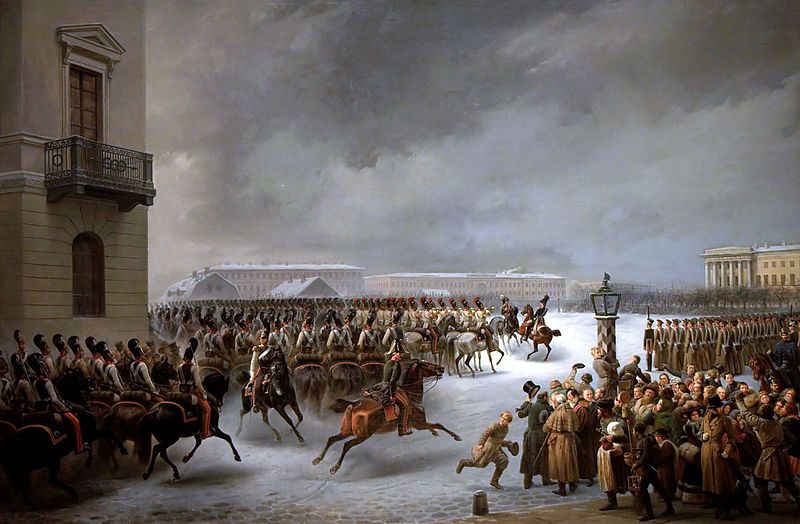
Decembrist revolt
1825 revolt and attempted coup in the Russian Empire

Narodniks
The Narodniks were members of a movement of the Russian Empire intelligentsia in the 1860s and 1870s, some of whom became involved in revolutionary agitation against tsarism. Their ideology, known as Narodism, Narodnism, or '''''', was a form of agrarian socialism, though it is often misunderstood as populism.
slavophilia
Slavophilia () was a movement originating from the 19th century that wanted the Russian Empire to be developed on the basis of values and institutions derived from Russia's early history. Slavophiles opposed the influences of Western Europe in Russia. Depending on the historical context, the opposite of Slavophilia could be seen as Slavophobia (a fear of Slavic culture) or also what some Russian intellectuals (such as Ivan Aksakov) called zapadnichestvo (westernism).
For example:
Emancipation reform of 1861
reform passed by Tsar Alexander II of Russia which effectively abolished serfdom throughout the Russian Empire
Stolypin reform
agrarian reform

economism
Economism is a direct reduction of any political or cultural phenomena or activities to economics.
nihilist movement
Russian movement in the 1860s that rejected all authorities
Westernizer
Westernizers (; , ) were a group of 19th-century intellectuals who believed that Russia's development depended upon the adoption of Western European technology and liberal government. In their view, Western ideas such as industrialisation needed to be implemented throughout Russia to make it a more successful country. The Russian term was ' (, "westernism"), and its adherents were known as the ' (, "westernists").
All-Russian nation
Imperial and modern Russian irredentist ideology
Pochvennichestvo
Pochvennichestvo ( ; , roughly "return to the native soil", from почва "soil") was a late 19th-century movement in Russia that tied in closely with its contemporary ideology, Slavophilia.
Lithuanian press ban
ban on Lithuanian language publications in Russia
Siberian regionalism
Siberian separatism from the 19th century onwards
Orthodoxy, Autocracy, and Nationality
imperialist ideological doctrine of Russian emperor Nicholas I
Antisemitism in the Russian Empire
Status and treatment of Jewish people in Russian territory during the Reign of the Tsars.
Wäisi movement
religious, social and political movement in Tatarstan and other Tatar-populated parts of Russia which took place in the late 19th and early 20th centuries
Bundism
Bundism () is a Jewish socialist movement that emerged in Europe in the late 19th century that aimed to promote working class politics, secularism, and foster Jewish political and cultural autonomy. As a part of that autonomism, it also sought to advocate Yiddishism—the promotion and vitalisation of the Yiddish language and Yiddish culture—and Doikayt (Yiddish, 'hereness'), the concept that Jews have a right to live and organise where they already reside.
Church reform of Peter the Great

Western Russianism
historical and ideological trend of scientific, socio-political, ethno-confessional and cultural life that arose in the North-Western Region, based on the postulate that Belarusians are an ethnographic group of the All-Russian people
Going to the People
Populist youth movement in Russia in the 1870s
Vekhovstvo
Vekhovstvo (vekhovtsy) was a philosophical and socio–political trend in the Russian intellectual environment at the beginning of the 20th century that received its name from the programmatic collection Vekhi (1909). The initiator of the publication of Vekhi was Mikhail Gershenzon.
Reforms of Alexander I
Russian system of government