Category
page 1Presidency of Harry S. Truman

Cold War
1947–1991 tension between the Soviet Union and the United States and their respective allies

Atomic bombings of Hiroshima and Nagasaki
On 6 and 9 August 1945, the United States detonated two atomic bombs over the Japanese cities of Hiroshima and Nagasaki, respectively, during the final days of World War II. The aerial bombings killed 150,000 to 246,000 people, most of whom were civilians, and remain the first and only uses of nuclear weapons in an armed conflict.
In the final year of World War II, the Allies prepared for a costly invasion of the Japanese mainland. This undertaking was preceded by a conventional bombing and firebombing campaign that devastated 64 Japanese cities, including an operation on Tokyo. The war in Europe concluded when Germany surrendered on 8 May 1945, and the Allies turned their full attention to the Pacific War. By July 1945, the Allies' Manhattan Project had produced two types of atomic bombs: "Little Boy", an enriched uranium gun-type fission weapon, and "Fat Man", a plutonium implosion-type nuclear weapon. The 509th Composite Group of the U.S. Army Air Forces was trained and equipped with the specialized Silverplate version of the Boeing B-29 Superfortress, and deployed to Tinian in the Mariana Islands. The Allies called for the unconditional surrender of the Imperial Japanese Armed Forces in the Potsdam Declaration on 26 July 1945, the alternative being "prompt and utter destruction". The Japanese government ignored the ultimatum. Japan announced its surrender to the Allies on 15 August, six days after the bombing of Nagasaki and the Soviet Union's declaration of war against Japan and invasion of Manchuria. The Japanese government signed an instrument of surrender on 2 September, ending the war.

Marshall Plan
American initiative for foreign aid to Western Europe following World War II
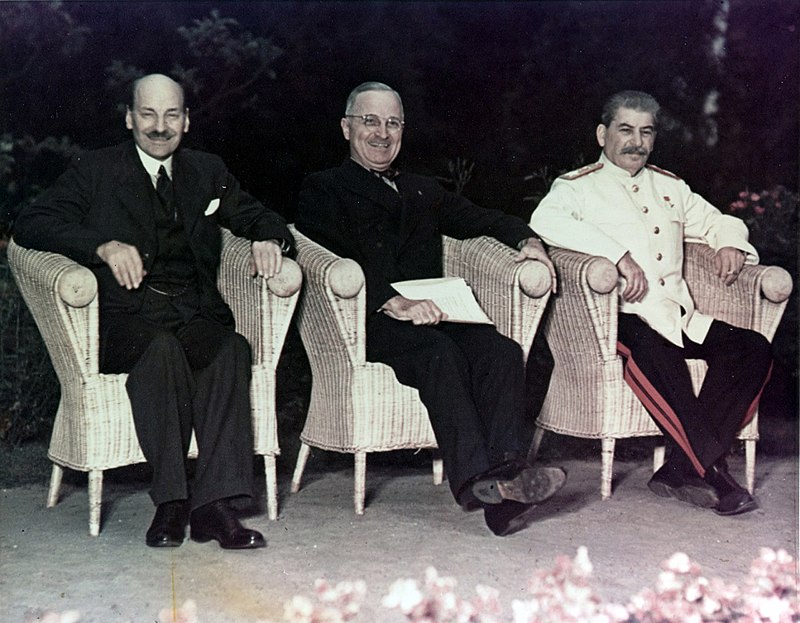
Potsdam Conference
meeting of the Allied heads of state near the end of World War II

Truman Doctrine
United States Cold War policy to contain communism in Europe and elsewhere

McCarthyism
McCarthyism is a political practice defined by the political repression and persecution of left-wing individuals and a campaign spreading fear of communist and Soviet influence on American institutions and of Soviet espionage in the United States during the late 1940s through the 1950s, heavily associated with the Second Red Scare, also known as the McCarthy era. After the mid-1950s, U.S. senator Joseph McCarthy, who had spearheaded the campaign, gradually lost his public popularity and credibility after several of his accusations were found to be false. The U.S. Supreme Court under Chief Just

occupation of Japan
1945 Allied occupation of Japan following WWII

containment
thumb|right|200px|United States Information Agency|United States Information Service propaganda poster distributed in Asia depicting [[Juan dela Cruz ready to defend the Philippines from the threat of communism]]
Trust Territory of the Pacific Islands
United Nations trust territory in the western Pacific administered by the United States from 1947 to 1994
1948 United States presidential election
41st quadrennial U.S. presidential election
Turkish Straits crisis
Cold War territorial conflict between USSR & Turkey
Majestic 12
purported organization that appears in UFO conspiracy theories
United Nations Secretariat Building
headquarters building of the United Nations
Medal of Freedom
civil decoration awarded 1945–1961, superceded by Presidential Medal of Freedom
Treaty of Manila
Treaty that declared the Philippines an independent sovereign state
presidency of Harry S. Truman
33rd presidential administration and cabinet of the USA (1945-1953)
Dewey Defeats Truman
erroneous newspaper headline about the 1948 U.S. presidential election

Kfar Truman
human settlement in Israel
Fair Deal
set of proposals put forward by U.S. President Harry S. Truman to Congress in his January 1949 State of the Union address
Point Four Program
Post World War II US technical assistance program to developing nations
Cold War (1947–1953)
first phase of the Cold War
Relief of Douglas MacArthur
President Harry S. Truman's dismissal of General Douglas MacArthur during the Korean War for publicly disputing Truman's policies
first inauguration of Harry S. Truman
7th United States intra-term presidential inauguration
Revolt of the Admirals
US Cold War incident involving funding and policy dispute about the US Navy
second inauguration of Harry S. Truman
41st United States presidential inauguration
attempted assassination of Harry S. Truman
assassination attempt on U.S. President Truman on 1 November 1950
Wake Island Conference
1950 conference between US President Harry S. Truman and General Douglas MacArthur to confer about the progress of the Korean War
Anglo-American loan
loan made to the United Kingdom by the United States following World War II
Immigration and Nationality Act of 1952
American immigration law