Category
page 1Provinces of the Sasanian Empire

Kingdom of Iberia
ancient Georgian kingdom of Kartli

Media
Ancient region of north-western Iran

Parthia
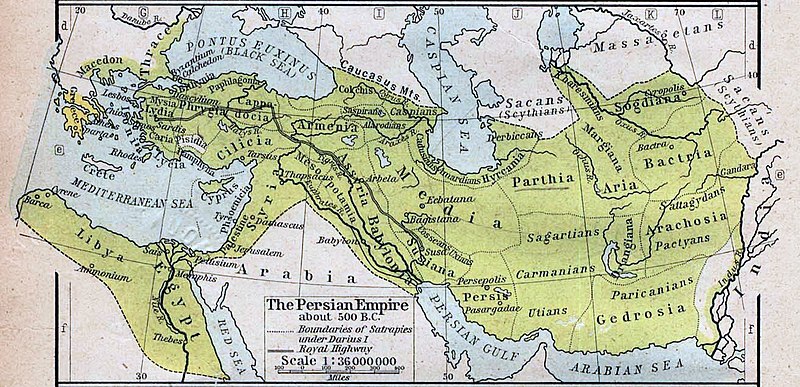
Parthia ( Parθava; Parθaw; Pahlaw) is a historical region located in northeastern Greater Iran. It was conquered and subjugated by the empire of the Medes during the 7th century BC, was incorporated into the subsequent Achaemenid Empire under Cyrus the Great in the 6th century BC, and formed part of the Hellenistic Seleucid Empire after the 4th-century BC conquests of Alexander the Great. The region later served as the political and cultural base of the Eastern Iranian Parni people and Arsacid dynasty, rulers of the Parthian Empire (247 BC – 224 AD). The Sasanian Empire, the last state of pre-
Hyrcania
Hyrcania (; Hyrkanía, Old Persian: 𐎺𐎼𐎣𐎠𐎴 Varkâna, Middle Persian: 𐭢𐭥𐭫𐭢𐭠𐭭 Gurgān, Akkadian: Urqananu) is a historical region composed of the land south-east of the Caspian Sea in modern-day Iran and Turkmenistan, bound in the south by the Alborz mountain range and the Kopet Dag in the east.

Adiabene
Adiabene (Greek: Αδιαβηνή, ) was an ancient kingdom in northern Mesopotamia, corresponding to the northwestern part of ancient Assyria. The size of the kingdom varied over time; initially encompassing an area between the Zab Rivers, it eventually gained control of Nineveh and starting at least with the rule of Monobazos I (late 1st-century BCE), Gordyene became an Adiabenian dependency. It reached its zenith under Izates II, who was granted the district of Nisibis by the Parthian king Artabanus II () as a reward for helping him regain his throne. Adiabene's eastern borders stopped at the Zagro

Margiana
Margiana ( Margianḗ, Old Persian: Marguš, Middle Persian: Marv) is a historical region centred on the oasis of Merv and was a minor satrapy within the Achaemenid satrapy of Bactria, and a province within its successors, the Seleucid, Parthian and Sasanian empires.
Lazica
The Kingdom of Lazica (; ; ), sometimes called Lazian Empire, was a state in the territory of west Georgia in the Roman period, from about the 1st century BC. Created as a result of the collapse of the kingdom of Colchis and the gaining of independence by the tribal-territorial units included in it in 131 AD.
Sasanian Armenia
province of the Sasanian Empire
Asuristan
Asoristan (, , ), also known as Suristan, was the name of the Sasanian province of Assyria and Babylonia from 226 to 637 CE.
Machelones
The Machelones () (Machelônes, Machelonoi; ) were a Colchian tribe located to the far south of the Phasis (modern-day Rioni River, western Georgia). There are several references to them in Classical sources. This group may be the Machorones of Pliny (NH 6.4.11) who placed them between the Ophis (modern Of, Turkey) and Prytanis rivers.
Template:Sasanian Provinces
Wikimedia template
Caucasian Albania (Sasanian province)
Province of the Sassanid Empire
Beth Garmai
historical region around the city of Kirkuk in northern Iraq
Sasanian Egypt
short-lived province of the Sasanian Empire
Sakastan
Province of the Sasanian Empire
Abarshahr
Abarshahr (Persian: اَبَرشهر) or Nishapur (Persian: نیشاپور) was a Sasanian satrapy (province) in Late Antiquity, that lay within the kust of Khorasan. The province bordered Media in the west, Hyrcania in the north west, Margiana in the north east, and Harev in the south east. The governor of Abarshahr is attested to have held the unique title of kanarang, distinguished from the title of marzban given to governors of frontier provinces. Abarshahr came to be known as one of the nicknames of the city of Nishapur which was considered to be the capital city of the province of Abarshahr during the
An Ibéir Shasainid
occupied territory of the former kingdom of Iberia during the period of Sasanian suzerainty
Adurbadagan
Adurbadagan (Middle Persian: Ādurbādagān/Āδarbāyagān, Parthian: Āturpātākān) was a northwestern province in the Sasanian Empire, mostly overlapping the present-day Azerbaijan region in Iran. Governed by a marzban ("margrave"), it functioned as an important frontier (and later religious) region against the neighbouring country of Armenia. It is also the root word of the modern Iranian "Azerbaijan" region as well as the country of Azerbaijan.
Pars
former Sasanian province in Late Antiquity
Kushanshahr Satrapy
thumb|300px|The province of Kushanshar was located at the eastern edge of the Sasanian Empire.
thumb|300px|Kushano-Sasanian ruler Ardashir I Kushanshah, circa 230-250 CE. [[Merv mint.]]
Kushanshahr was a province of the Sasanian Empire comprising the region between Kabul Valley and Peshawar Valley. The Kushanshar territory centered on Tukharistan, and covered the area from Tirmidh to Peshawar. The establishment of Sasanian rule in Kushanshar permitted the control of Central Asian trade routes. The Kushano-Sasanids were in charge of the area. They issued coinage which was following the Kushan s
Zabdicene
Zabdicene (; ; ; ) was a Carduchian principality in Anatolia, in today's Turkey. It was located west of Ake, southwest of Anjewaci and north of Adiabene.
Balasagan
thumb|Map of the eastern part of Transcaucasia under the [[Sasanian Empire]]
Balāsagān (an Iranian toponym meaning "country of Balas"; Armenian: Bałasakan, the inhabitants known as Bałasičkʻ, Arabic: Balāsajān/Balāšajān), also known as Bazgan, was a region located in the area of the Kura and Aras rivers, adjacent to the Caspian Sea. To the south, it bordered Atropatene/Adurbadagan and Gilan. It roughly corresponded to the Armenian province of Paytakaran, albeit extending farther into the north. It has been suggested that under the Sasanians the region extended as far as the stronghold of Derbe
Mazun (Sasanian province)
Province of the Sasanian Empire
Kirman
Province of the Sasanian Empire
Maishan Satrapy
Meshan (Middle Persian: 𐭬𐭩𐭱𐭠𐭭) was a province of the Sasanian Empire. It consisted of the Parthian vassal kingdom of Characene and reached north along the Shatt al-Arab river and then the lower Tigris to Madhar and possibly further. Its inhabitants were primarily Babylonians and Arabs, with minorities of Iranians and even some Indians and Malays (the Malays may have been slaves brought from the Indian sub-continent). The province was very fertile, the best place for barley according to Strabo, and contained many date palms. It was also an important trading province along the Persian Gulf.
Arbayistan Satrapy
Arbāyistān ( [ʾrb]ystn; Middle Persian: Arbāyistān, Arāwastān, Arwāstān; Armenian: Arvastan) or Beth Arabaye (Syriac: Bēṯ ʿArbāyē) was a Sasanian province in Late Antiquity. Due to its situation and its road systems, the province was a source of income from commercial traffic, as well as a constant area of contention during the Roman–Persian Wars.
Padishkhwargar
Padishkhwārgar was a Sasanian province in Late Antiquity, which almost corresponded to the present-day provinces of Mazandaran and Gilan. The province bordered Adurbadagan and Balasagan in the west, Gurgan in the east, and Spahan in south. The main cities of the province were Amol and Chalus.
Paradan
Paradan or Paratan was a province of the Paratarajas and the Sasanian Empire. It was constituted from the present-day Balochistan region, which is divided between Iran, Pakistan and Afghanistan.