Category
page 1Serpens

Serpens
Serpens () is a constellation in the northern celestial hemisphere. One of the 48 constellations listed by the 2nd-century astronomer Ptolemy, it remains one of the 88 modern constellations designated by the International Astronomical Union. It is unique among the modern constellations in being split into two non-contiguous parts, Serpens Caput (Serpent Head) to the west and Serpens Cauda (Serpent Tail) to the east. Between these two halves lies the constellation of Ophiuchus, the "Serpent-Bearer". In figurative representations, the body of the serpent is represented as passing behind Ophiuchu

Eagle Nebula
eagle-like animal nebula

Messier 5
Globular cluster
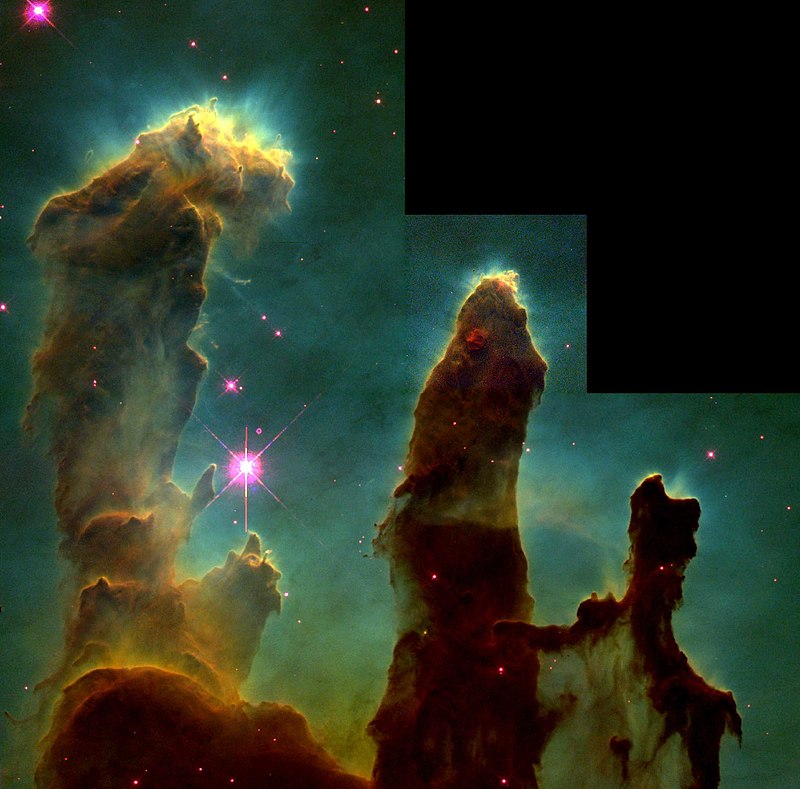
Pillars of Creation
astrophotograph by the Hubble Space Telescope
Hoag's Object
non-typical galaxy of the type known as a ring galaxy
NGC 5921
galaxy
NGC 6604
open cluster
NGC 5964
galaxy
NGC 6118
galaxy
Alpha Serpentis
star
NGC 6008
spiral galaxy in the constellation Serpens
Gliese 710
star in the constellation Serpens
NGC 5970
barred spiral galaxy in the constellation Serpens
NGC 5957
galaxy
NGC 5962
galaxy
NGC 5920
galaxy
NGC 6051
elliptical galaxy in the constellation Serpens
NGC 6605
galaxy
NGC 5988
galaxy
NGC 5936
galaxy
NGC 6070
galaxy
NGC 6539
globular cluster
Arp 220
luminous infrared galaxy
NGC 5996
galaxy
NGC 5980
galaxy
NGC 5953
Galaxy in the constellation Serpens
NGC 5940
galaxy
NGC 5910
galaxy
Seyfert's Sextet
group of galaxies in Serpens Caput constellation
NGC 6027
galaxy in the constellation Serpens
NGC 6535
globular cluster
NGC 6027b
galaxy
NGC 6027a
galaxy
NGC 6027c
galaxy
NGC 6027d
galaxy
NGC 6027e
tidal tail of NGC 6027
list of stars in Serpens
Wikimedia list article
IC 4756
open cluster in Serpens Cauda
Lambda Serpentis
star in the constellation Serpens
COROT-9b
CoRoT-9b is an exoplanet orbiting the star CoRoT-9, approximately 1500 light years away in the constellation Serpens. CoRoT-9b's distance of nearest approach to its parent star of approximately 0.36 AU was the largest of all known transiting planets at the time of its discovery, with an orbital period of 95 days. The transit of this planet lasts 8 hours. The planet is at a distance from its star where there is a strong increase in albedo as the temperature decreases, because of the condensation of reflective water clouds in the atmosphere. This suggests its atmosphere may be locked into one of
Epsilon Serpentis
star in the constellation Serpens
Beta Serpentis
star in the constellation Serpens
Gamma Serpentis
star in the constellation Serpens
Theta Serpentis
multiple star
Eta Serpentis
star
Delta Serpentis
star in the constellation Serpens
Xi Serpentis
star in the constellation Serpens
Palomar 5
globular cluster
Alasia
star in the constellation Serpens
PSR J1719-1432 b
exoplanet
Chi Serpentis
star in the constellation Serpens
Psi Serpentis
star in the constellation Serpens
PSR J1719-1438
Pulsar

Mu Serpentis
star in the constellation Serpens
NN Serpentis
star in the constellation Serpens
IC 4537
galaxy
IC 4588
galaxy
Tau7 Serpentis
star in the constellation Serpens
HD 143436
star in the constellation Serpens
HD 168443
star in the constellation Serpens