Category
page 1Shakespeare apocrypha
Edward III
play often attributed to Shakespeare

The Spanish Tragedy
Play by Thomas Kyd
The Passionate Pilgrim
anthology
Love's Labour's Won
c. 1600 English play attributed to William Shakespeare

Ur-Hamlet
The Ur-Hamlet (the German prefix Ur- means "original") is a play by an unknown author, thought to be either Thomas Kyd or William Shakespeare, dated by scholars to the second half of 1587. No copy of the play survives today. The play was staged in London, more specifically at The Theatre in Shoreditch as recalled by Elizabethan author Thomas Lodge. It includes a character named Hamlet; the only other known character from the play is a ghost who, according to Thomas Lodge in his 1596 publication Wits Misery and the Worlds Madnesse, cries "Hamlet, revenge!"

Sir Thomas More
Eponymous Elizabethan play by Anthony Munday
The History of Cardenio
lost Shakespearean play, mostly rewritten as "Double Falsehood" by another playwright
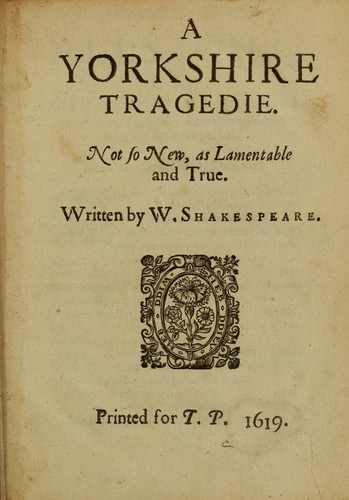
A Yorkshire Tragedy
play probably mistakenly attributed to Shakespeare

Thomas Lord Cromwell
play (probably mistakenly) attributed to Shakespeare
Arden of Faversham
play
Sir John Oldcastle
play (probably mistakenly) attributed to Shakespeare
The London Prodigal
play sometimes attributed to Shakespeare
Vortigern and Rowena
play written by William Henry Ireland
Shakespeare apocrypha
plays and poems occasionally attributed to Shakespeare but not generally accepted

Double Falsehood
play written by Lewis Theobald and W. Shakespeare; thought to be the lost paly "Cardenio".

Edmund Ironside
play, attributed by some to Shakespeare

Thomas of Woodstock
play attributed by some to Shakespeare

To the Queen
1599 poem written by William Shakespeare

The Puritan
play (probably falsely) attributed to Shakespeare

The Second Maiden's Tragedy
play (probably mistakenly) attributed to Shakespeare

Locrine
thumb|Title page of Locrine (1595)
Locrine is an Elizabethan play depicting the legendary Trojan founders of the nation of England and of Troynovant (London). The play presents a cluster of complex and unresolved problems for scholars of English Renaissance theatre.