Category
page 1States and territories disestablished in the 2nd century BC

Sparta
Sparta was a prominent city-state in Laconia in ancient Greece. In antiquity (pre-800 BCE), the state was known as Lacedaemon (), while "Sparta" referred to its capital, a group of villages in the valley of the Evrotas River in Laconia, in southeastern Peloponnese. Around 650 BC, it rose to become one of the major military powers in Greece, a status it retained until 371 BC.

Macedonia
ancient Hellenic kingdom

Maurya empire
ancient Indian empire (322–184 BCE)

Colchis
In classical antiquity and Greco-Roman geography, Colchis (; ) was an exonym for the Georgian polity of Egrisi () located on the eastern coast of the Black Sea, centered in present-day western Georgia also including the region of Abkhazia.

Ancient Carthage
Phoenician city-state and empire

Edom
Edom (; ; ; ; Ancient Egyptian: jdwmꜥ) was an ancient kingdom that stretched across areas in the south of present-day Jordan, Palestine and Israel. Edom and the Edomites appear in several written sources relating to the late Bronze Age and to the Iron Age in the Levant, including the list of the Egyptian pharaoh Seti I from c. 1215 BC as well as in the chronicle of a campaign by Ramesses III (r. 1186–1155 BC), and the Hebrew Bible.

Greco-Bactrian Kingdom
Hellenistic-era Greek kingdom (256–120 BCE)

Gojoseon
ancient state, based in northern Korean peninsula and Manchuria

Achaean League
Hellenistic-era confederation of Greek city states

Antigonid dynasty
dynasty of Hellenistic kings

Nanyue
Nanyue (, , ) was an ancient kingdom founded in 204 BC by the Chinese general Zhao Tuo, whose family (known in Vietnamese as the Triệu dynasty) continued to rule until 111 BC. Nanyue's geographical expanse covered the modern Chinese subdivisions of Guangdong, Guangxi, Hainan, Hong Kong, Macau, southern Fujian and central to northern Vietnam. Zhao Tuo, then Commander of Nanhai Commandery of the Qin dynasty, established Nanyue in 204 BC after the collapse of the Qin dynasty. At first, it consisted of the commanderies of Nanhai, Guilin, and Xiang.
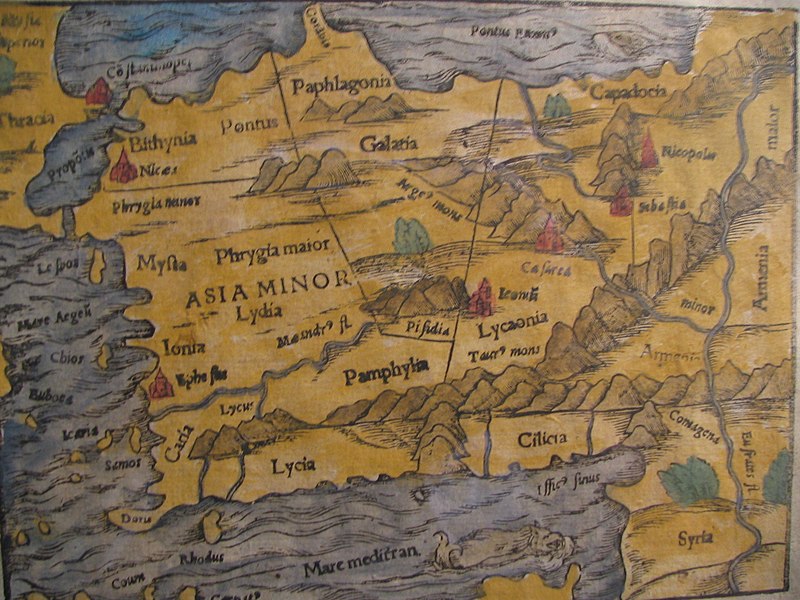
Paphlagonia
Paphlagonia (; , modern translit. Paflagonía; ) was an ancient region on the Black Sea coast of north-central Anatolia, situated between Bithynia to the west and Pontus to the east, and separated from Phrygia (later, Galatia) by a prolongation to the east of the Bithynian Olympus. According to Strabo, the region was bounded by the river Parthenius to the west and the Halys River to the east.
Paphlagonia was said to be named after Paphlagon, a son of the mythical Phineus.
Epirus
ancient Greek state and kingdom, located in the geographical region of Epirus
Kingdom of Pergamon
Greek state during the Hellenistic period
Jin
Korean state during the Iron Age
Donghu people
Nomadic confederacy, 697-150 BCE
Âu Lạc
former country

Minyue
The location of Minyue kingdom before the conquest of the Han dynasty|thumb
Minyue (; Pinyin: Mǐnyuè, Mínyuè) was an ancient kingdom in what is now the Fujian province in southern China. It was a contemporary of the Han dynasty, and was later annexed by the Han empire as the dynasty expanded southward. The kingdom existed approximately from 306 BC to 110 BC.
.jpg)
Paropamisadae
Paropamisadae or Parapamisadae () was a satrapy of the Alexandrian Empire in modern Pakistan, which largely coincided with the Achaemenid province of Parupraesanna. It consisted of the districts of Sattagydia (Bannu basin), Gandhara (Kabul, Peshawar, and Taxila), and Oddiyana (Swat Valley). Paruparaesanna is mentioned in the Akkadian language and Elamite language versions of the Behistun Inscription of Darius the Great, whereas in the Old Persian version it is called Gandāra. The entire satrapy was subsequently ceded by Seleucus I Nicator to Chandragupta Maurya after Mauryan Victory in Selucid
.png)
Pauravas
The Pauravas were an ancient tribe in the northern Indus valley, to which Raja Porus may have belonged.
Triệu dynasty
Vietnamese dynasty
Dong'ou Kingdom
'''Dong'ou (), also known as Ouyue''' (), was an ancient kingdom in modern Wenzhou and Taizhou, Zhejiang Province, China. The realm of Dong'ou was given to Zou Yao by Emperor Gaozu of Han in 192 BC. During the Han campaigns against Minyue in 138 BC, the king of Dong'ou no longer wished to live in his realm after the incident, having submitted himself in an prostrating gesture, which was indicative of his final acquiescence as a mere supplicant to have him and his people's eventual fates to be absorbed into the Han empire. After Zou Yushan's unsuccessful uprising against General Yang Pu's consp
Hellenistic Palestine