Category
page 1States and territories disestablished in the 7th century BC

Assyrian Empire
Assyria was a major ancient Mesopotamian civilization that existed as a city-state from the 21st century BC to the 14th century BC and eventually expanded into an empire from the 14th century BC to the 7th century BC.

Phrygia
In classical antiquity, Phrygia ( ; , Phrygía) was a kingdom in the west-central part of Anatolia, in what is now Asian Turkey, centered on the Sangarios River.
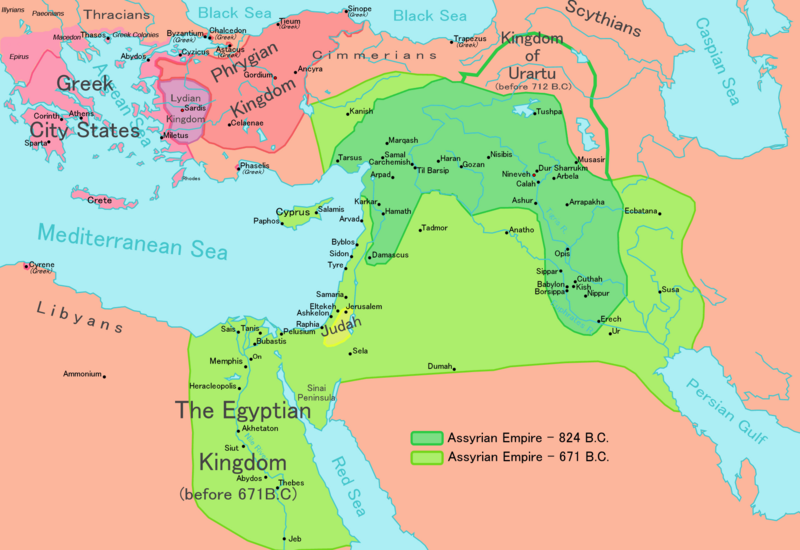
Neo-Assyrian Empire
historical state in Mesopotamia
Twenty-fifth Dynasty of Egypt
Kushite rule in Egypt during the third intermediate period
Neo-Hittite states
successor states of the Hittite empire in the ancient Near East
Videha
Videha (Prākrit: ; Pāli: ; Sanskrit: ) was an ancient Indo-Aryan tribe of north-eastern South Asia whose existence is attested during the Iron Age. The population of Videha, the Vaidehas, were initially organised into a monarchy but later became a Gaṇasaṅgha| (an aristocratic oligarchic republic), presently referred to as the Videha Republic, which was part of the larger Vajjika League.

Deng
ancient Chinese state
Ji
ancient state in northeastern China under the Shang and Zhou
Guzhu
Guzhu () was a vassal state of the Shang and Zhou dynasties located in the vicinity of modern Tangshan, Hebei province. It was a Dongyi state and had close relations with King Tang of Shang whom they share the same clan name Zi. During the Western Zhou dynasty, the Lichi and Shanrong tribes rose up in the north-west and north-east respectively, causing concerns to Guzhu's southern neighbors, the states of Qi and Yan. In 664 BC, the monarch of an already-weakened Guzhu was killed by a Qi-Yan coalition during an expedition against the Shanrong. Finally, in 660 BC, Qi and Yan annexed Gu
Huang
vassal state that existed during the Zhou dynasty
Huo (state)
vassal state in China
Xian
Zhou dynasty state