Category
page 1States and territories established in the 2nd century BC

Aquileia
Aquileia is a (municipality) in the Friuli-Venezia Giulia region of northeastern Italy. It is situated at the head of the Adriatic at the edge of the lagoons, about from the sea, on the river Natiso (modern Natisone), the course of which has changed somewhat since the Roman era.

Africa
Roman province on the northern African coast covering parts of present-day Tunisia, Algeria, and Libya

Indo-Greek Kingdoms
Hellenistic-era Greek kingdom in northwestern South Asia (200 BCE–10 CE)
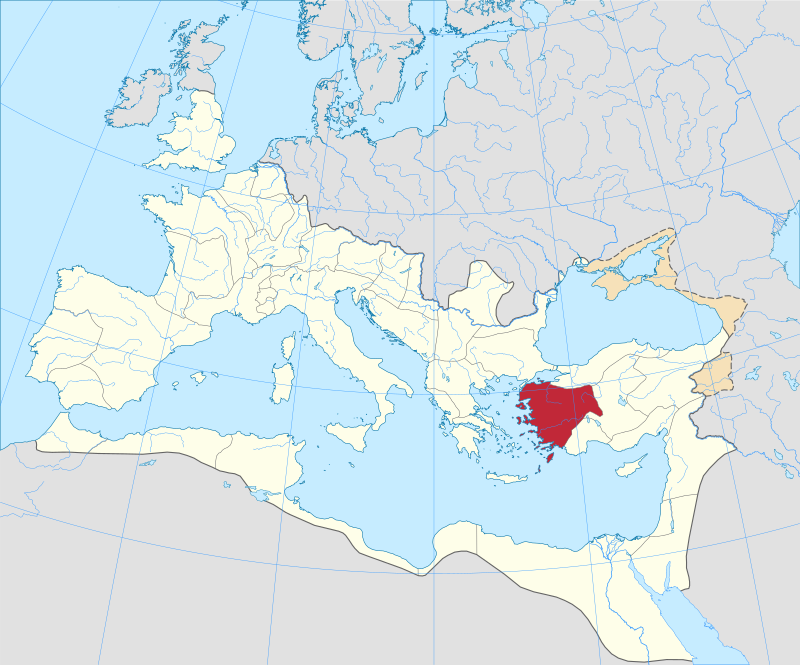
Asia
Roman province

Macedonia
Roman province

Achaea
Roman province

Himyarite kingdom
Himyar was a polity in the southern highlands of Yemen, as well as the name of the region which it claimed. Until 110 BCE, it was integrated into the Qatabanian kingdom; afterward, it was recognized as an independent kingdom. According to classical sources, their capital was the ancient city of Zafar, relatively near the modern-day city of Sanaa. Himyarite power eventually shifted to Sanaa as the population increased in the fifth century. After the establishment of their kingdom, it was ruled by kings from the dhū-Raydān tribe. The kingdom was named Raydān.

Indo-Scythians
former country

Gallia Narbonensis
Roman Empire province from 121 BC until 5th century

Osroene
Osroene or Osrhoene (; ) was an ancient kingdom and region in Upper Mesopotamia. The Kingdom of Osroene, also known as the "Kingdom of Edessa" ( / "Kingdom of Urhay"), according to the name of its capital city (now Şanlıurfa, Turkey), existed from the 2nd century BC up to the 3rd century AD, and was ruled by the Nabataean Arab Abgarid dynasty. They were generally allied with the Parthians.

Shunga Empire
Indian empire (184 BCE-75 BCE)

Pyu city-states
group of city-states in present-day Myanmar

Kingdom of Commagene
300px|thumb|Anatolia in the early 1st century AD with Commagene as a Roman client state
Commagene () was an ancient Greco-Iranian kingdom ruled by a Hellenized branch of the Orontids, a dynasty of Iranian origin, that had ruled over the Satrapy of Armenia. The kingdom was located in and around the ancient city of Samosata, which served as its capital. The Iron Age name of Samosata, Kummuh, probably gives its name to Commagene.

Buyeo
Buyeo or Puyŏ (; ), also rendered as Fuyu () in Chinese, was an ancient kingdom that was centered in northern Manchuria in modern-day northeast China. It had deep ties to the Yemaek people, who are considered to be the ancestors of modern Koreans. It is also called Northern Buyeo () according to its founding legend.

Adiabene
Adiabene (Greek: Αδιαβηνή, ) was an ancient kingdom in northern Mesopotamia, corresponding to the northwestern part of ancient Assyria. The size of the kingdom varied over time; initially encompassing an area between the Zab Rivers, it eventually gained control of Nineveh and starting at least with the rule of Monobazos I (late 1st-century BCE), Gordyene became an Adiabenian dependency. It reached its zenith under Izates II, who was granted the district of Nisibis by the Parthian king Artabanus II () as a reward for helping him regain his throne. Adiabene's eastern borders stopped at the Zagro
Hispania Citerior
Roman province
Sophene
Sophene ( or , ; ) was a province of the ancient kingdom of Armenia, located in the south-west of the kingdom, and of the Roman Empire. The region lies in what is now southeastern Turkey.
Tongzhou District
district of Beijing, China
Hispania Ulterior
Roman province

Okjeo
Okjeo () was an ancient Korean tribal state which arose in the northern Korean peninsula from perhaps the 2nd century BCE to the 5th century CE.
Roman Gaul
Gaul as a province of the Roman Empire

Vaspurakan
Vaspurakan (, Western Armenian pronunciation: Vasbouragan) was the eighth province of the ancient kingdom of Armenia, which later became an independent kingdom during the Middle Ages, centered on Lake Van. Located in what is now southeastern Turkey and northwestern Iran, the region is considered to be the cradle of Armenian civilization.

Characene
Characene (Ancient Greek: Χαρακηνή), also known as Mesene (Μεσσήνη) or Meshan, was a kingdom founded by the Iranian Hyspaosines located at the head of the Persian Gulf mostly within modern day Iraq. Its capital, Charax Spasinou (Χάραξ Σπασινού), was an important port for trade between Mesopotamia and India, and also provided port facilities for the city of Susa further up the Karun River. The kingdom was frequently a vassal of the Parthian Empire. Characene was mainly populated by Arabs, who spoke Aramaic as their cultural language. All rulers of the principality had Iranian names. Members of
Kuninda kingdom
ancient Hindu dynasty of India

Elymais
Elymais or Elamais (Ἐλυμαΐς, Hellenic form of the more ancient name, Elam) was an autonomous state of the 2nd century BC to the early 3rd century AD, frequently a vassal under Parthian control. It was located at the head of the Persian Gulf in Susiana (the present-day region of Khuzestan, Iran). Most of the population probably descended from the ancient Elamites, who once had control of that area.

Utik
thumb|300px|Utik within the Kingdom of Armenia in 150 AD. The area around the confluence of the Kura and Arax is placed in Paytakaran instead of Utik, per Yeremian but rejected by Hewsen and Harutiunian.
Utik (), also known as Uti, was a historical province and principality within the Kingdom of Armenia. It was ceded to Caucasian Albania following the partition of Armenia between Sassanid Persia and the Eastern Roman Empire in 387 AD. Most of the region is located within present-day Azerbaijan immediately west of the Kura River, while a part of it lies within the Tavush province of present-day
Hasmonean Judea
Jewish monarchy in Judea and surrounding regions during the Second Temple period (140–37 BCE)

Ayrarat
Ayrarat () was the central province of the ancient kingdom of Armenia, located in the plain of the upper Aras River. Most of the historical capitals of Armenia were located in this province, including Armavir, Yervandashat, Artashat, Vagharshapat, Dvin, Bagaran, Shirakavan, Kars and Ani (the current capital of Armenia, Yerevan, is also located on the territory of historical Ayrarat).
Gugark
Gugark (, , ) was the 13th province of the ancient kingdom of Armenia. It now comprises parts of northern Armenia, northeast Turkey, and southwest Georgia.
Upper Armenia
historical province of Greater Armenia
Turuberan
Turuberan (), also known as Tavruberan () was the fourth Armenian region that was part of the ancient Kingdom of Armenia from 189 BC to 387 AD. Then it was part of the Sassanid Empire, Byzantine Empire, Arab Caliphate, medieval Kingdom of Armenia, Zakarian Armenia, various Turco-Mongol states, Safavid Empire, and finally the Ottoman Empire. A very large Armenian population remained until the Armenian genocide in 1915. Currently it is situated in Turkey's south-east.
Syunik (historic province)
historical province of Greater Armenia
Dong'ou Kingdom
'''Dong'ou (), also known as Ouyue''' (), was an ancient kingdom in modern Wenzhou and Taizhou, Zhejiang Province, China. The realm of Dong'ou was given to Zou Yao by Emperor Gaozu of Han in 192 BC. During the Han campaigns against Minyue in 138 BC, the king of Dong'ou no longer wished to live in his realm after the incident, having submitted himself in an prostrating gesture, which was indicative of his final acquiescence as a mere supplicant to have him and his people's eventual fates to be absorbed into the Han empire. After Zou Yushan's unsuccessful uprising against General Yang Pu's consp
Shule Kingdom
historical country
Kings of Persis
Persian kings who were vassals to the Parthians until they formed the Sasanian Empire