Category
page 1Technical factors of Western astrology
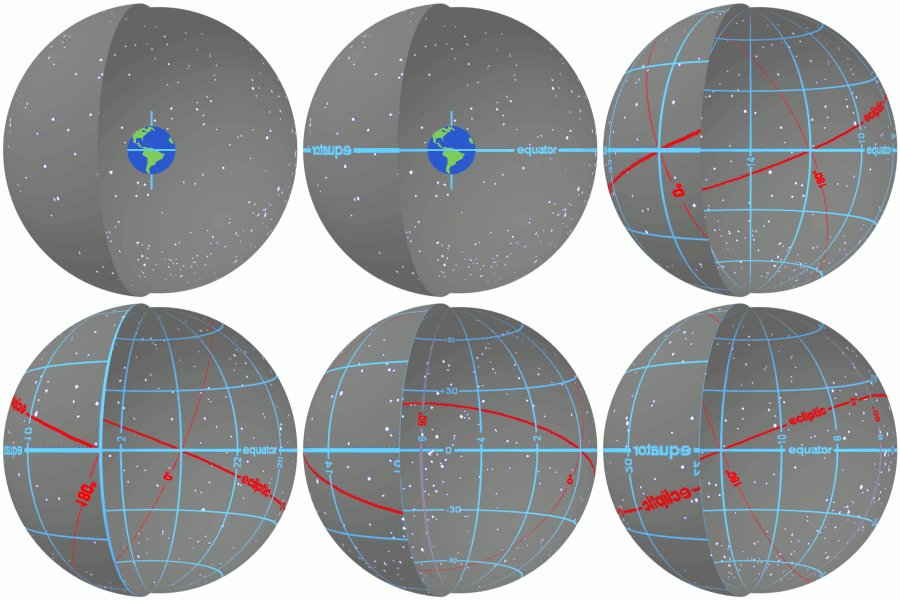
right ascension
astronomical equivalent of longitude
first point of Aries
point on the celestial sphere
Lunar node
point in space where the moon moves into the northern/southern ecliptic hemisphere
astrological aspect
angle the planets make to each other in the horoscope

ascendant
thumb|right|The ascendant in this example is marked Asc and is usually in the nine o'clock position of the horoscope.
house
in astrology, division of the horoscope into 12 sectors, corresponding to the zodiac signs
decans
thumb|upright=1.35|'Diagonal star table' from the late Eleventh Dynasty of Egypt|Eleventh Dynasty coffin lid; found at [[Asyut, Egypt. Roemer- und Pelizaeus-Museum Hildesheim]]
The decans (; ) are 36 groups of stars (small constellations) used in ancient Egyptian astronomy to conveniently divide the 360 degree ecliptic into 36 parts of 10 degrees each, both for theurgical and heliacal chronometrical purposes. The decans each appeared, geocentrically, to rise consecutively on the horizon throughout each daily Earth rotation. The rising of each decan marked the beginning of a new decanal "hour"
Essential dignity
Astrological concept
astrological compatibility
branch of astrology that studies relationships by comparing natal horoscopes
decan
subdivision of an astrological sign into periods of approximately ten days
exaltation
in astrology, one of the 5 essential dignities of a planet: 19th degree ♈︎ (Sun); 3rd deg. ♉︎ (Moon); 15th deg. ♍︎ (Mercury); 27th deg. ♓︎ (Venus); 28th deg. ♑︎ (Mars); 15th deg. ♋︎ (Jupiter); 21st deg. ♎︎ (Saturn)
Behenian fixed star
group of fixed stars of significance in medieval astrology
Arabic parts
in astrology, constructed points based on mathematical calculations of three horoscopic entities such as planets or angles
cusp
imaginary line that separates a pair of consecutive astrological signs in the zodiac or houses in the horoscope