Category
page 1Tripiṭaka
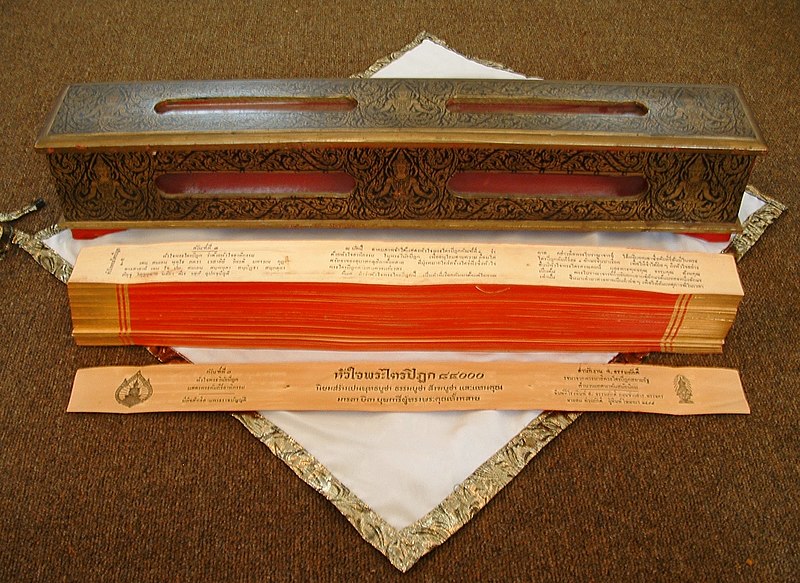
Tripitaka
Buddhist scriptures

Pāli Canon
Buddhist scriptures preserved in the Pāli language by the Theravada tradition

Abhidhamma Piṭaka
Pāli version of the advanced theology of Buddhism
Tripitaka Koreana
collection of wooden blocks imprinted with Korean buddhist scriptures housed in a temple
Āgama
collection of early Buddhist texts
Taishō Tripiṭaka
a Japanese edition of the Chinese Buddhist canon published in 1934

tengyur
The Tengyur or Tanjur or Bstan-’gyur (Tibetan: "Translation of Teachings") is the collected commentaries by great buddhist masters on Buddha Shakyamuni's teachings. The Tengyur is included in the Tibetan Buddhist Canon, which consists of all of Buddha Shakyamuni's teachings together with the commentaries on the Buddha's teachings. The Canon also includes the Kangyur, which is repository of the Buddha's recorded teachings, placed before the Tengyur in the Canon.
thumb|Printing the scriptures, Sera Monastery
nikāya
Nikāya () is a Pāli word meaning "volume". It is often used like the Sanskrit word āgama () to mean "collection", "assemblage", "class" or "group" in both Pāḷi and Sanskrit. It is most commonly used in reference to the Pali Buddhist texts of the Tripitaka namely those found in the Sutta Piṭaka. It is also used to refer to monastic lineages, where it is sometimes translated as a 'monastic fraternity'.
kangyur
The Tibetan Buddhist canon is a defined collection of sacred texts recognized by various schools of Tibetan Buddhism, comprising the Kangyur and the Tengyur. The Kangyur or Kanjur is Buddha's recorded teachings (or the 'Translation of the Word'), and the Tengyur or Tanjur is the commentaries by great masters on Buddha's teachings (or the 'Translation of Treatises').

Chinese Buddhist canon
canon of Chinese Buddhism, and much of the Sinosphere
Ekottara Āgama
early Indian Buddhist text
bhāṇaka
Bhāṇaka (Pali: reciter) were Buddhist monks who specialized in the memorization and recitation of a specific collection of texts within the Buddhist canon. Lineages of bhāṇakas were responsible for preserving and transmitting the teachings of the Buddha until the canon was committed to writing in the 1st century BC, and declined as the oral transmission of early Buddhism was replaced by writing.
Madhyama Āgama
Indian Buddhist text
Tetsugen Doko
Japanese Zen Master
Dīrgha Āgama
collection of 30 longer sūtras in four sections, originating from the Dharmaguptaka School, roughly parallel to the Pāli Dīgha Nikāya
Zhaocheng Jin Tripitaka
an edition of Chinese Buddhist canon published in Jin dynasty, dicovered in Zhaocheng, Shanxi
Buddhayaśas
thumb|right|200px|Buddhayaśas
Buddhayaśas was a Dharmaguptaka monk and translator. He is recorded as having learned both Śrāvakayāna and Mahāyāna treatises. He translated the Dharmaguptaka Vinaya, the Dīrgha Āgama, and other Mahāyāna texts including the Ākāśagarbha Bodhisattva Sūtra. Buddhayaśas' preface for his translation of the Dharmaguptaka Vinaya states that the Dharmaguptakas had assimilated the body of Mahāyāna sutras.
Maha Lawkamarazein or Kuthodaw Inscription Shrines
729 marble slabs inscribed with the Tripitaka at the Kuthodaw Inscription Shrines, Kuthodaw Pagoda, Mandalay, Myanmar
Buddhist Institute, Cambodia
principal Buddhist institution of the government of Cambodia, whose primary facilities are located in Phnom Penh; founded on May 12, 1930 by King Sisowath Monivong of Cambodia, King Sisavong Vong of Laos, Pierre Pasquier, and George Cœdès