Category
page 1Units of measurement in astronomy

light-year
A light-year, alternatively spelled light year (ly or lyr), is a unit of length used to express astronomical distances and is equal to exactly , which is approximately 9.46 trillion kilometres or 5.88 trillion miles. As defined by the International Astronomical Union (IAU), a light-year is the distance that light travels in vacuum in one Julian year (365.25 days). Despite its inclusion of the word "year", the term is not a unit of time.

astronomical unit
mean distance between Earth and the Sun, common length reference in astronomy

parsec
The parsec (symbol: pc) is a unit of length used to measure the large distances to astronomical objects outside the Solar System, approximately equal to or (au), i.e. . The parsec unit is obtained by the use of parallax and trigonometry, and is defined as the distance at which 1 au subtends an angle of one arcsecond ( of a degree). The nearest star, Proxima Centauri, is about from the Sun: from that distance, the gap between the Earth and the Sun spans slightly less than one arcsecond. Most stars visible to the naked eye are within a few hundred parsecs of the Sun, with the most distant a

solar mass
standard unit of mass in astronomy which is equal to 1.98892 × 10³⁰ kg
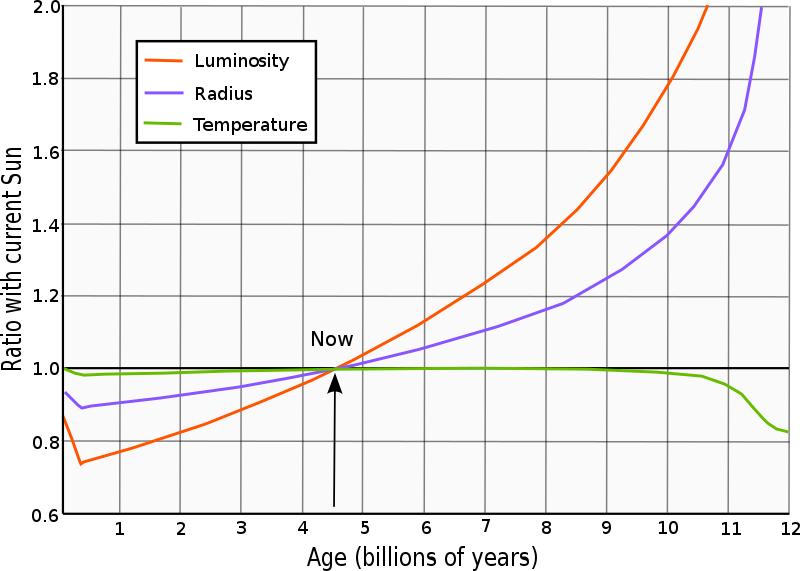
solar radius
unit of measurement

magnitude
logarithmic measure of the brightness of an astronomical object

Earth mass
unit of mass equal to that of Earth
solar luminosity
unit of radiant flux in astronomy

solar constant
intensity of sunlight

Jupiter mass
mass of planet Jupiter, used as unit of mass
megaannum
unit of a quantity of 1,000,000 years
Earth radius
mean distance from the Earth's center to its surface
Torino Scale
measure of hazard posed by near-Earth objects

light-second
The light-second is a unit of length useful in astronomy, telecommunications and relativistic physics. It is defined as the distance that light travels in free space in one second, and is equal to exactly (approximately or ).
lunar distance
distance from center of Earth to center of Moon
jansky
The jansky (symbol Jy, plural janskys) is a non-SI unit of spectral flux density, or spectral irradiance, used especially in radio astronomy. It is equivalent to 10−26 watts per square metre per hertz.
Jupiter radius
unit of radius equal to the total radius of the planet Jupiter
astronomical system of units
system of measurement developed for use in astronomy
astronomical constant
type of constant
Population index
meteor shower
Crab
astrophotometrical unit for x-ray sources
planetary mass
measure of the mass of a planet-like object