Category
page 1Virus-related cutaneous conditions

Ebola hemorrhagic fever
Ebola, also known as Ebola virus disease (EVD) and Ebola hemorrhagic fever (EHF), is a zoonotic viral hemorrhagic fever in humans and other primates, caused by four of the six known ebolaviruses. Symptoms typically start anywhere between two days and three weeks after infection. The first symptoms are usually fever, sore throat, muscle pain, and headaches. These are usually followed by vomiting, diarrhoea, rash, hepatic and renal dysfunction, at which point some people begin to bleed both internally and externally. The disease causes a mortality rate of anywhere between 25 and 90%, averaging o
smallpox
Smallpox was an infectious disease caused by Variola virus (often called Smallpox virus), which belongs to the genus Orthopoxvirus. The last naturally occurring case was diagnosed in October 1977, and the World Health Organization (WHO) certified the global eradication of the disease in 1980, making smallpox the only human disease to have been eradicated.
measles
Measles (probably from Middle Dutch or Middle High German masel(e), meaning "blemish, blood blister") is a highly contagious, vaccine-preventable infectious disease caused by measles virus. Other names include morbilli, rubeola, 9-day measles, red measles, and English measles.

chickenpox
Chickenpox, also known as varicella ( ), is a highly contagious disease caused by varicella zoster virus (VZV), a member of the herpesvirus family. The disease results in a characteristic skin rash that forms small, itchy blisters, which eventually scab over. It usually starts on the chest, back, and face. It then spreads to the rest of the body. The rash and other symptoms, such as fever, tiredness, and headaches, usually last five to seven days. Complications may occasionally include pneumonia, inflammation of the brain, and bacterial skin infections. The disease is usually more severe in ad

hepatitis B
human viral infection

mpox
Mpox (, ; originally known as monkeypox) is an infectious viral disease that can occur in humans and other animals. Symptoms include a rash that forms blisters and then crusts over, as well as fever and swollen lymph nodes. The illness is usually mild, and most infected individuals recover within a few weeks without treatment. The time from exposure to the onset of symptoms ranges from three to seventeen days, and symptoms typically last from two to four weeks. However, cases may be severe, especially in children, pregnant women, or people with suppressed immune systems.

wart
Warts are non-cancerous viral growths usually occurring on the hands and feet but which can also affect other locations, such as the genitals or face. One or many warts may appear. They are distinguished from cancerous tumors as they are caused by a viral infection, such as a human papillomavirus, rather than a cancer growth.

rubella
Rubella, also known as German measles or three-day measles, is a vaccine-preventable infection caused by the rubella virus. This disease is often mild, with half of people not realizing that they are infected. A rash may start around two weeks after exposure and last for three days. It usually starts on the face and spreads to the rest of the body. The rash is sometimes itchy and is not as bright as that of measles. Swollen lymph nodes are common and may last a few weeks. A fever, sore throat, and fatigue may also occur. Joint pain is common in adults. Complications may include bleeding proble

herpes zoster
Shingles, also known as herpes zoster or zona, is a viral disease characterized by a painful skin rash with blisters in a localized area. Typically the rash occurs in a single, wide mark either on the left or right side of the body or face. Two to four days before the rash occurs, there may be tingling or local pain in the area. Other common symptoms are fever, headache, and tiredness. The rash usually heals within two to four weeks, but some people develop ongoing nerve pain which can last for months or years, a condition called postherpetic neuralgia (PHN). In those with poor immune function

herpes simplex
Herpes simplex, often known simply as herpes, is a viral infection caused by the herpes simplex virus. Herpes infections are categorized by the area of the body that is infected. The two major types of herpes are oral herpes and genital herpes, though other forms also exist.
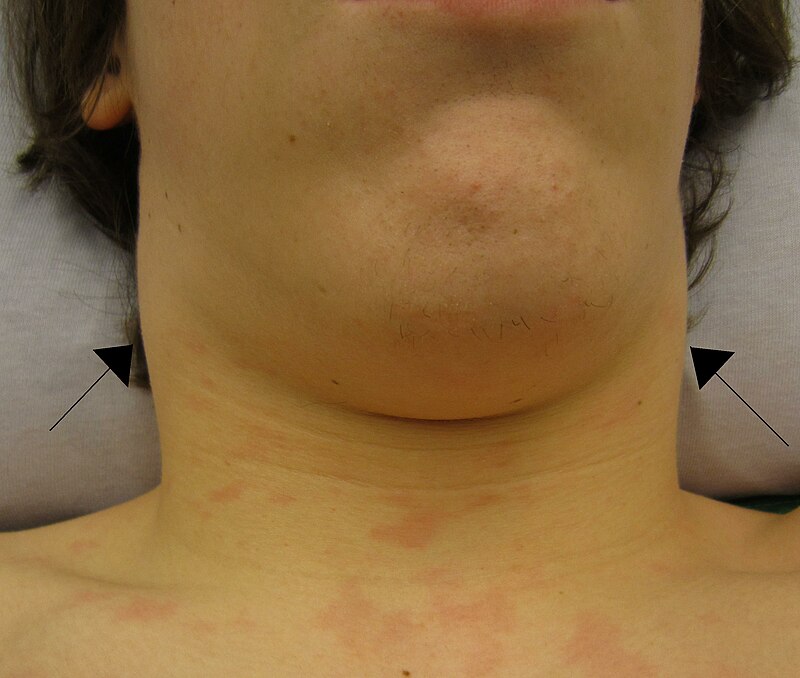
infectious mononucleosis
common viral infectious disease

hand, foot and mouth disease
human disease

anogenital venereal wart
sexually transmitted disease

Rift Valley fever
human disease

Orthoebolavirus zairense
species of virus

molluscum contagiosum
viral infection of the skin
.jpg)
exanthema subitum
Roseola, also known as sixth disease, is an infectious disease caused by certain types of human herpes viruses. Most infections occur before the age of three. Symptoms vary from absent to the classic presentation of a fever of rapid onset followed by a rash. The fever generally lasts for three to five days, while the rash is generally pink and lasts for less than three days. Complications may include febrile seizures, with serious complications being rare.
Kaposi's sarcoma
connective tissue cancer, common among early AIDS patients
genital herpes
infection by herpes simplex virus (HSV) of the genitals
Lassa fever
viral disease
Herpes labialis
Herpes simplex virus that primarily affects the lip
erythema infectiosum
Human disease

Ebolavirus
thumb|Phylogenetic tree comparing ebolaviruses and marburgviruses. Numbers indicate percent confidence of branches.
.png)
cowpox
Cowpox is an infectious disease caused by Cowpox virus (CPXV). It presents with large blisters in the skin, a fever and swollen glands, historically typically following contact with an infected cow, though in the last several decades more often (though overall rarely) from infected cats. The hands and face are most frequently affected and the spots are generally very painful.
Marburg virus disease
human disease

Parvovirus B19
human virus
lumpy skin disease
bovine disease
herpangina
Herpangina, also called mouth blisters, is a painful mouth infection caused by coxsackieviruses. Usually, herpangina is produced by one particular strain of coxsackie virus A (and the term "herpangina virus" refers to coxsackievirus A), but it can also be caused by coxsackievirus B or echoviruses. Most cases of herpangina occur in the summer, affecting mostly children. However, it occasionally occurs in adolescents and adults. It was first characterized in 1920.
plantar wart
viral infectious disease that results in benign epithelial tumors located in skin of the sole or toes of the foot, has material basis in human papillomavirus (types 1, 2, 4 or 63), has symptom lesions that appear on the sole of the foot
epidermodysplasia verruciformis
Human disease
contagious pustular dermatitis
skin disease and general infection in sheep, goats, chamois, reindeer and muskrats
congenital rubella syndrome
human disease

Zaire ebolavirus
species within the genus Ebolavirus

vaccinia virus
The vaccinia virus (VACV or VV) is a large, complex, enveloped virus belonging to the poxvirus family. It has a linear, double-stranded DNA genome approximately 190 kbp in length, which encodes approximately 250 genes. The dimensions of the virion are roughly 360 × 270 × 250 nm, with a mass of approximately 5–10 fg. The vaccinia virus is the source of the modern smallpox vaccine, which the World Health Organization (WHO) used to eradicate smallpox in a global vaccination campaign in 1958–1977. Although smallpox no longer exists in the wild, vaccinia virus is still studied widely by scient
postherpetic neuralgia
medical condition

human betaherpesvirus 5
species of virus
immune reconstitution inflammatory syndrome
complication of anti-HIV treatment
Gianotti–Crosti syndrome
medical condition
eczema herpeticum
Human disease

Sheeppox virus
Sheeppox (or sheep pox, known as in Latin, in French, in German) is a highly contagious disease of sheep caused by a poxvirus different from the benign orf (or contagious ecthyma). This virus is in the family Poxviridae and genus Capripoxvirus. Sheeppox virus (SPV) is the most severe of all the animal pox diseases and can result in some of the most significant economic consequences due to poor wool and leather quality.
neonatal herpes simplex
Medical condition
Reston virus
species of virus
Ravn virus
virus that causes hemorrhagic fever
laryngeal papillomatosis
medical condition
giant condyloma acuminatum
exophytic tumor of the anogenital region associated with HPV infections
herpetic whitlow
painful blister of the periungual skin that is caused by herpes simplex virus type 1 or 2
Tai Forest ebolavirus
species of virus
Sudan ebolavirus
species of virus
verruca plana
Human disease
Bundibugyo ebolavirus
species of virus
Bowenoid papulosis
Human disease
Lloviu viruses
taxon containing Lloviu cuevavirus
Eczema vaccinatum
medical condition
Lipschütz ulcer
medical condition
acrodermatitis
Acrodermatitis /ac·ro·der·ma·ti·tis/ is a childhood form of dermatitis selectively affecting the hands and feet and may be accompanied by mild symptoms of fever and malaise. It may also be associated with hepatitis B and other viral infections.
The lesions appear as small coppery-red, flat-topped firm papules that appear in crops and sometimes in long linear strings, often symmetric.
It is a diffuse chronic skin disease usually confined to the limbs, seen mainly in women in Northern, Central, and Eastern Europe, and characterized initially by an erythematous, oedematous, pruritic phase followe