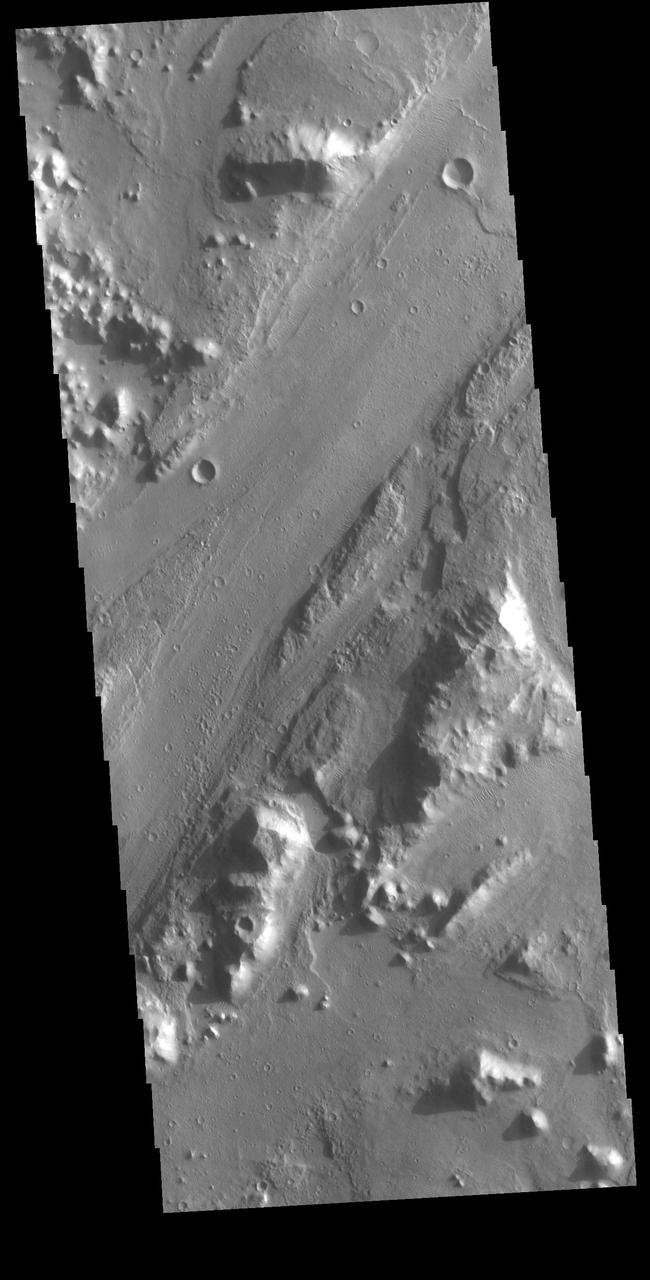
Morava Valles · NASA · NASA — public domain
Morava
Sign in to saveWASP-60, also named Morava, is a F-type main-sequence star about 1,400 light-years away in the constellation Pegasus. The star's age is much younger than the Sun's at 1.7 billion years. WASP-60 is enriched in heavy elements, having 180% of the solar abundance of iron. The star does not have noticeable starspot activity, an unexpected observation for a relatively young star. The age of WASP-60 determined by different methods is highly discrepant though, and it may actually be an old star which experienced an episode of spin-up in the past.
Astronomical data · SIMBAD
- Object type
- *
- Spectral type
- G1V
- Distance
- 1,403 light-years
- Redshift
- z = -0.0000887374547186015
- Coordinates
- RA 356.6666° · Dec 31.1559°
via SIMBAD · CDS Strasbourg
Wikidata facts
- Constellation
- Pegasus
- Distance from Earth
- 436.376
- Diameter
- 1480000
- Radius
- 1.14
- Mass
- 1.078
Show 19 more facts
- catalog code
- TIC 288246496
- effective temperature
- 5900
- parallax
- 2.3243
- apparent magnitude
- 12.010265
- radial velocity
- -26.604
- spectral class
- G1V
- epoch
- J2000.0
- stellar rotational velocity
- 3.4
- metallicity
- -0.04
- surface gravity
- 22910
- name
- Morava
- luminosity
- 2.2257936
- right ascension component of proper motion
- 30.247
- declination component of proper motion
- -6.005
- right ascension
- 356.66656138098
- declination
- 31.15593732252
- discoverer or inventor
- Hipparcos
- time of discovery or invention
- 1997-00-00
- age estimated by a dating method
- 3.6
via Wikidata · CC0
~2 min read
Encyclopedic overview
3 sectionsContents
- Nomenclature
- Planetary system
- References
WASP-60, also named Morava, is a F-type main-sequence star about 1,400 light-years away in the constellation Pegasus. The star's age is much younger than the Sun's at 1.7 billion years. WASP-60 is enriched in heavy elements, having 180% of the solar abundance of iron. The star does not have noticeable starspot activity, an unexpected observation for a relatively young star. The age of WASP-60 determined by different methods is highly discrepant though, and it may actually be an old star which experienced an episode of spin-up in the past.
A multiplicity survey in 2015 did not detect any stellar companions to WASP-60.
Excerpted from Wikipedia’s “Morava” article, available under the CC BY-SA 4.0 licence.