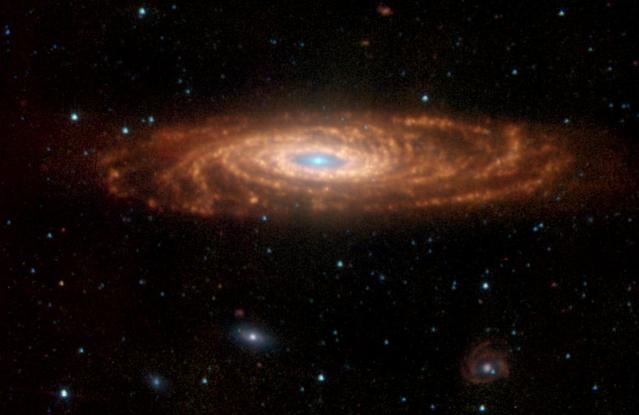
Morphology of Our Galaxy Twin · NASA · NASA — public domain
Astronomical data · SIMBAD
- Object type
- Sy2
- Redshift
- z = 0.0077866811957210125
- Morphology
- SB(r)c
- Coordinates
- RA 76.3630° · Dec -11.8714°
via SIMBAD · CDS Strasbourg
Key facts
- Constellation
- Lepus
- Right ascension
- 05 05 27.1307
- Declination
- −11 ° 52 ′ 16.766 ″
- Redshift
- 0.007735 ± 0.000010
- Heliocentric radial velocity
- 2,319 ± 3 km/ s
- Distance
- 79.4 ± 14.5 Mly (24.3 ± 4.4 Mpc )
- Type
- SB(r)c
- Size
- ~103,900 ly (31.86 kpc ) (estimated)
- Apparent size v
- 4.0 ′ × 2.5 ′
via Wikipedia infobox
Wikidata facts
- Instance of
- spiral galaxy
- Constellation
- Lepus
- Distance from Earth
- 31.80
- Image
- NGC 1784 DSS.jpg
Show 11 more facts
- radial velocity
- 2325.3
- catalog code
- [VDD93] 43
- discoverer or inventor
- John Frederick William Herschel
- time of discovery or invention
- 1836-12-11
- redshift
- 0.007725
- apparent magnitude
- 8.515
- galaxy morphological type
- SB(r)c
- right ascension
- 76.3629917
- declination
- -11.8714222
- epoch
- J2000.0
- Commons category
- NGC 1784
Sources (1)
via Wikidata · CC0
~2 min read
Encyclopedic overview
NGC 1784 is a barred spiral galaxy in the constellation Lepus. The galaxy lies about 80 million light years away from Earth based on redshift independent methods, which means, given its apparent dimensions, that NGC 1784 is approximately 100,000 light years across. Its distance based on redshift is 102 Mly. It was discovered by British astronomer John Herschel on 11 December 1836.
NGC 1784 has a strong bar with dust lanes and patches. Two spiral arms emerge from the end of the bar and form a nearly complete inner ring. The outer spiral arm of the galaxy consists of low-surface-brightness spiral fragments, which complete up to a quarter of revolution before fading. These arms have many knots. Imaging in the hydrogen line shows the presence of a narrow but bright ring. The hydrogen ring is more prominent at the eastern side of the galaxy. Also, the hydrogen appears wrapped, indicative of an interaction with another galaxy. The total hydrogen mass of the galaxy is estimated to be 1.17×10 M☉.
Excerpted from Wikipedia’s “NGC 1784” article, available under the CC BY-SA 4.0 licence.
Available in 29 languages
- Français
- Deutsch
- 中文
- Русский
- Português
- Italiano
- العربية
- Azerbaijani
- Basque
- Belarusian
- Bosnian
- Chechen
- Croatian
- Egyptian Arabic
- Esperanto
- Kazakh
- Macedonian
- Nederlands
via Wikidata sitelinks · CC0