File:SN1994D.jpg · Wikimedia Commons · See Wikimedia Commons
Key facts
- Constellation
- Virgo
- Right ascension
- 12 34 03.029
- Declination
- +07 ° 41 ′ 56.90 ″
- Redshift
- 0.002 058 ± 0.000 017
- Heliocentric radial velocity
- 617 ± 5 km/s
- Distance
- 55 ± 5 Mly ( 16.9 ± 1.6 Mpc ) , 52 Mly (15.8 Mpc )
- Type
- SAB(s)0°
- Size
- ~114,400 ly (35.07 kpc ) (estimated)
- Apparent size v
- 7.2′ × 2.4′
via Wikipedia infobox
Wikidata facts
- Instance of
- lenticular galaxy
- Constellation
- Virgo
- Distance from Earth
- 18.65
- Image
- NGC 4526 imaged by the Vera C. Rubin Observatory.png
Show 11 more facts
- discoverer or inventor
- William Herschel
- catalog code
- LEDA 41772
- radial velocity
- 341
- time of discovery or invention
- 1784-04-13
- Commons category
- NGC 4526
- apparent magnitude
- 9.991
- galaxy morphological type
- S0
- right ascension
- 188.5126208
- declination
- 7.6991389
- redshift
- 0.00272
- epoch
- J2000.0
Sources (1)
via Wikidata · CC0
~2 min read
Encyclopedic overview
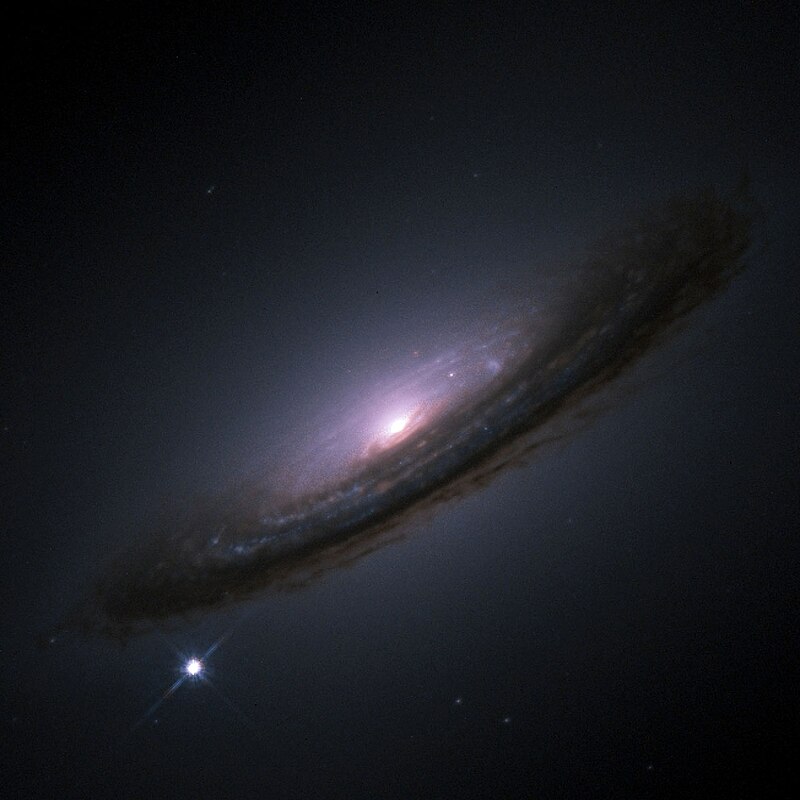
NGC 4526 (also listed as NGC 4560) is a lenticular galaxy with an embedded dusty disc, located approximately 55 million light-years from the Solar System in the Virgo constellation and discovered on 13 April 1784 by William Herschel. Herschel observed it again on 28 December 1785, resulting in the galaxy being entered twice into the New General Catalogue.
NGC 4526 imaged by the Vera C. Rubin Observatory The galaxy is seen nearly edge-on. The morphological classification is SAB(s)0°, which indicates a lenticular structure with a weak bar across the center and pure spiral arms without a ring. It belongs to the Virgo Cluster and is one of the brightest known lenticular galaxies. In the galaxy's outer halo, globular cluster orbital velocities indicate abnormal poverty of dark matter: only 43±18% of the mass within 5 effective radii.
Excerpted from Wikipedia’s “NGC 4526” article, available under the CC BY-SA 4.0 licence.