Category
page 1Ancient history of Iran

Shiraz
Shiraz is the fifth-most-populous city of Iran and the capital of Fars province, which is historically known by the exonym Persia proper. As of the 2016 national census, the population of the city was 1,565,572 people, and its built-up area with Sadra was home to almost 1,800,000 inhabitants. A census in 2021 showed an increase in the city's population to 1,995,500 people. Shiraz is located in southwestern Iran on the () seasonal river. The city has a moderate climate and has been a regional trade center for over a thousand years.

Seleucid Empire
Hellenistic-era Greek state in Western Asia (312–63 BC)

Elam
Elam () was an ancient civilization centered in the far west and southwest of what is today Iran, stretching from the lowlands of Ilam and Khuzestan as well as a small part of modern-day southern Iraq. The modern name Elam stems from the Sumerian transliteration elam(a), along with the later Akkadian elamtu, and the Elamite haltamti. Elamite states were among the leading political forces of the Ancient Near East. In classical literature, Elam was also known as Susiana ( ; Sousiānḗ), a name derived from its capital Susa.

Urartu
Urartu was an Iron Age kingdom centered around the Armenian highlands between Lake Van, Lake Urmia, and Lake Sevan. The territory of the ancient kingdom of Urartu extended over the modern frontiers of Turkey, Iran, Iraq, Armenia, the southern regions of Georgia, and western regions of Azerbaijan. Its kings left behind cuneiform inscriptions in the Urartian language, a member of the Hurro-Urartian language family.
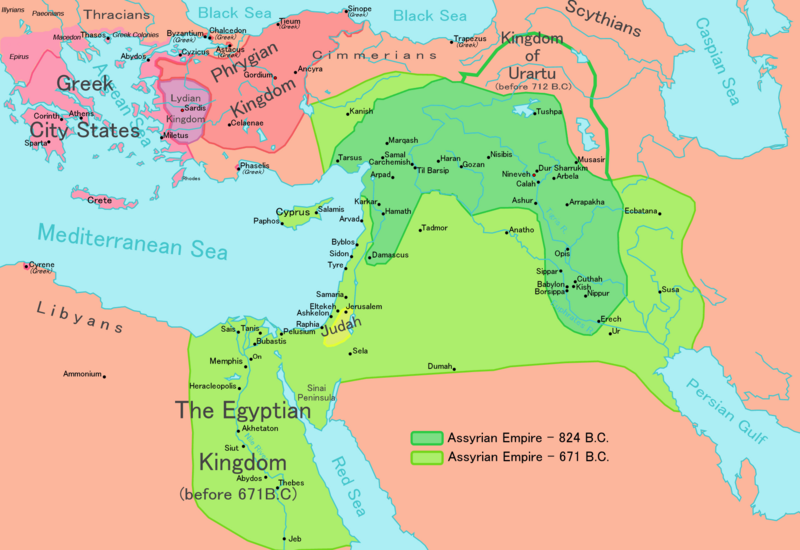
Neo-Assyrian Empire
historical state in Mesopotamia

Gutian people
The Guti (), also known by the derived exonyms Gutians or Guteans, were a people of the ancient Near East who both appeared and disappeared during the Bronze Age. Their homeland was known as Gutium (Sumerian: , GutūmKI or , GutiumKI).
Conflict between people from Gutium and the Akkadian Empire has been linked to the collapse of the empire, towards the end of the although economic factors, climate change and internal strife also played a part. The Guti subsequently overran southern Mesopotamia and formed the short-lived Gutian dynasty of Sumer, overseeing a period of economic and cultural decli
Mannaea
Mannaea (, sometimes written as Mannea; Akkadian: Mannai, Biblical Hebrew: Minni (מנּי)) was an ancient kingdom that flourished in northwestern Iran, primarily south and southeast of Lake Urmia, during the early first millennium BCE, roughly from the 10th to the 7th century BCE. It developed into a prominent regional power along the northeastern frontier of the Neo-Assyrian Empire, situated between major neighbors like Urartu and a constellation of smaller buffer states, such as Zikirta and Musasir. The capital of Mannaea was likely at Izirtu, near modern-day Saqqez.

Lullubi
Lullubi, Lulubi (), more commonly known as Lullu, were a group of Bronze Age tribes who existed and disappeared during the 3rd millennium BC. They were from a region known as Lulubum, now the Sharazor plain of the Zagros Mountains of modern-day Sulaymaniyah Governorate in Kurdistan Region, Iraq. Lullubi was a neighbour and sometimes ally with the Hurrian Simurrum kingdom and came into conflict with the Semitic Akkadian Empire and Assyria. Frayne (1990) identified their city Lulubuna or Luluban with the region's modern town of Halabja.

yakhchal
thumb|right|300px|Yakhchāl of Moayedi, Iran
A yakhchāl (; yakh meaning 'ice' and chāl meaning 'pit') is an ancient type of ice house, which also made ice. They are primarily found in the Dasht-e Lut and Dasht-e-Kavir deserts, whose climates range from cold (BWk) to hot (BWh) desert regions.

Caspians
thumb|332x332px|Ethnic map of the Caucasus in the 5th and 4th centuries BC.
The Caspians (, Kaspyn; , Káspioi; Aramaic: ܟܣܦܝ, kspy; , Kaspk’; , Caspiani) were a people of antiquity who dwelt along the southwestern shores of the Caspian Sea, in the region known as Caspiane. Caspian is the English version of the Greek ethnonym Kaspioi, mentioned twice by Herodotus among the Achaemenid satrapies of Darius the Great and applied by Strabo. The name is not attested in Old Iranian. According to Vasily Struve, the 'Caspians' was the name given to those Saka-Massagetae tribes that were located along th
Airyanem Vaejah
mythological homeland of the early Iranians

Turukkaeans
The Turukkaeans were a Bronze and Iron Age people of Zagros Mountains. Their endonym has sometimes been reconstructed as Tukri.
Parsua
Parsua (earlier Parsuash, Parsumash) was an ancient tribal kingdom/chiefdom (860-600 BC) located between Zamua (formerly: Lullubi) and Ellipi, in central Zagros to the southwest of Sanandaj, western Iran. The name Parsua is from an old Iranian word Parsava and it is presumed to mean border or borderland.
Susiana
Susiana (; ) was an ancient cultural and geographical region located in southwestern Iran.
It broadly corresponds to the alluvial lowlands surrounding the city of Susa, forming the core area of the early Elamite civilization, which today make up most of modern Khuzestan Province.
Aniran
Anērān (Middle Persian, ) or Anīrân (Modern Persian, ) is an ethno-linguistic term that signifies "non-Iranian" or "non-Iran" (non-Aryan). Thus, in a general sense, 'Aniran' signifies lands where Iranian languages are not spoken. In a pejorative sense, it denotes "a political and religious enemy of Iran and Zoroastrianism."
Ellipi
thumb|Map of 5 Ellipi Provinces
ancient Iranian medicine
study and practice of medicine in ancient Iran/Persia
Talish-Mughan culture
archaeological culture in Iran and Azerbaijan
Matiene
thumb|250px|Location of Matiene, between Corduene and Atropatene
Matiene was the name of a kingdom in northwestern Iran on the lands of the earlier kingdom of the Mannae. Ancient historians including Strabo, Ptolemy, Herodotus, Polybius, and Pliny mention names such as Mantiane, Martiane, Matiana, Matiani, Matiene, Martuni to designate a region located to the northwest of Media."
Uxii
The Uxii () were a tribal confederation of non-Iranian semi-nomadic people who lived somewhere in the Zagros Mountains. They were classified by Nearchus as among the four predatory peoples of the southwest along with the Mardi, Sousii, and Elymaei. They raided the settled people of Iran and raised sheep. The Uxii also tolled passing armies until they were defeated by Alexander the Great at the Battle of the Uxian Defile. After some time, the Uxians regained independence. Some think that the tolling was a gift tradition from the Persian kings to local tribes, and wasn't forced (especially as th
Traditional water sources of Persian antiquity
Aspect of Iranian history

Avestan period
early period in the history of the Iranian peoples