Category
page 1Christian denominations established in the 4th century

Maronite Church
Eastern Catholic sui iuris particular church of the Catholic Church

Donatism
thumb|alt=Painting of Augustine of Hippo arguing with a man before an audience|Charles-André van Loo's 18th-century Augustine arguing with Donatists
Donatism was a schism from the Catholic Church in the Archdiocese of Carthage from the fourth to the sixth centuries. Donatists argued that Christian clergy must be faultless for their ministry to be effective and their prayers and sacraments to be valid. Donatism had its roots in the long-established Christian community of the Roman province Africa Proconsularis (present-day Tunisia, the northeast of Algeria, and the western coast of Libya) and M
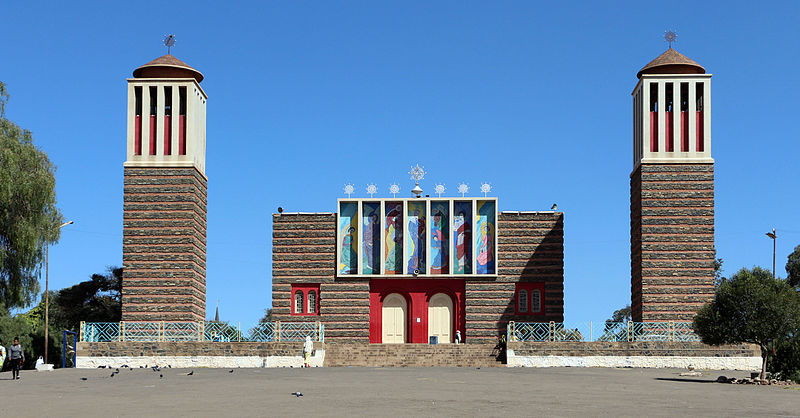
Eritrean Orthodox Tewahedo Church
Oriental Orthodox church
Priscillian
Priscillian (in Latin: Priscillianus; Gallaecia, – Augusta Treverorum, Gallia Belgica, ) was a wealthy nobleman of Roman Hispania who promoted a strict form of Christian asceticism. He became bishop of Ávila in 380. Certain practices of his followers (such as meeting at country villas instead of attending church) were denounced at the Council of Zaragoza in 380. Tensions between Priscillian and bishops opposed to his views continued, as well as political maneuvering by both sides. Around 385, Priscillian was charged with sorcery and executed by authority of the Emperor Maximus. The ascetic mov
Circumcellions
The Circumcellions, or Agonistici (as called by Donatists), were bands of Roman Christian radicals in North Africa in the early to mid-4th century. They were initially concerned with remedying social grievances. They condemned poverty and slavery and advocated canceling debt and freeing slaves. The term "Circumcellions" may have been coined by critics who referred to them as "circum cellas euntes" (they go around larders) because "they roved about among the peasants, living on those they sought to indoctrinate."
Pneumatomachi
The Pneumatomachi (; ), also known as Macedonians or Semi-Arians in Constantinople and the Tropici in Alexandria, were an anti-Nicene Creed sect which flourished in the regions adjacent to the Hellespont during the latter half of the fourth, and the beginning of the fifth centuries. They denied the godhood of the Holy Ghost, hence the Greek name Pneumatomachi or 'Combators against the Spirit' (from πνεῦμα pneuma, spirit + μάχη machē, battle).
Abelians
Abelians (; also Abelites, Abeloites or Abelonians) were a Christian sect that emerged in the 4th century in the countryside near Hippo Regius in north Africa during the reign of Arcadius. They lived in continence as they affirmed Abel did. They were required to be married but were forbidden to consummate the marriage. Each couple was required to adopt two children, a boy and a girl. When their adoptive parents died, these adoptees would then form a couple and adopt further two children. Because no children of Abel are mentioned in Scripture, the Abelians assumed that he had none. This view wa
Ticonius
Ticonius, also spelled Tyconius or Tychonius (active 370–390 AD), was a major theologian of 4th-century North African Latin Christianity. He was a Donatist writer whose conception of the City of God influenced St. Augustine of Hippo (who wrote a book on the same topic).
Collyridianism
Collyridianism (or Kollyridianism) is an alleged Christian heresy said to have worshiped Mary, the mother of Jesus, as a goddess and member of the Trinity.
Meletians
thumb | right | Melitian manuscript from 1524.
The Melitians, sometimes called the Church of the Martyrs, were an early Christian sect in Egypt. They were founded about 306 by Bishop Melitius of Lycopolis and survived as a small group into the eighth century. The point on which they broke with the larger catholic church was the same as that of the contemporary Donatists in the province of Africa: the ease with which lapsed Christians were received back into communion. The resultant division in the church of Egypt is known as the Melitian schism.