Category
page 1Cruise missiles of the Cold War
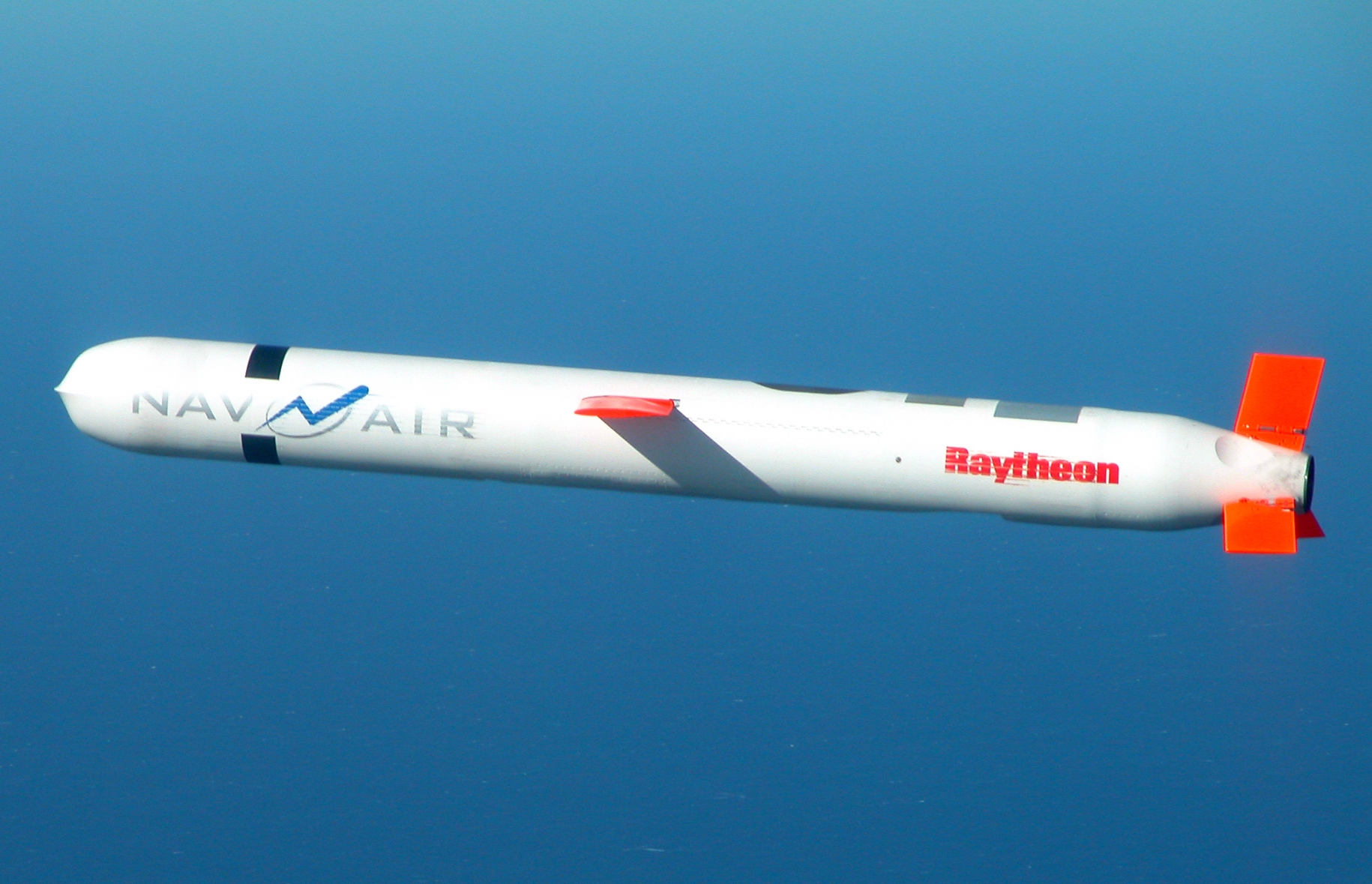
Tomahawk missile
The BGM-109 Tomahawk Land Attack Missile (TLAM) is an American long-range, all-weather, jet-powered, subsonic cruise missile that is used by the United States Navy, Royal Australian Navy, Royal Netherlands Navy and Royal Navy in ship and submarine-based land-attack operations.
AGM-86 ALCM
1974 air-to-surface cruise missile family by Boeing

Kh-55
The Kh-55 (, also known as RKV-500; NATO reporting name: AS-15 "Kent") is a Soviet/Russian subsonic air-launched cruise missile, designed by MKB Raduga in the 1970s. It has a range of up to and can carry nuclear warheads. Kh-55 is launched exclusively from bomber aircraft and has spawned a number of conventionally armed variants mainly for tactical use, such as the Kh-65SE and Kh-SD, but only the Kh-555 appears to have been put into service. The Kh-55 was not the basis of the submarine and ground-launched S-10 Granat or RK-55 Relief (SS-N-21"Sampson" and SSC-X-4"Slingshot") designed by NPO Nov
P-500 Bazalt
Russia ship-launched cruise missile
AGM-28 Hound Dog
supersonic, jet propelled, air-launched cruise missile
MGM-1 Matador
surface-to-surface cruise missile
SSM-N-8 Regulus
cruise missile
P-120 Malakhit
anti-ship missile
RK-55 Relief and S-10 Granat
The Novator 'RK-55 Relief''''' ( 'Relief'; NATO: '''SSC-X-4 'Slingshot'; GRAU: 3K12) is a Russian Navy cruise missile that is launched either from submarines (SLCM) or from surface ships. It can have a nuclear warhead developed in the Soviet Union. A version launched from submarine torpedo tubes, the S-10 Granat (SS-N-21 'Sampson''''; GRAU: 3K10), has apparently been converted to carry conventional warheads and continues in service to this day. The Russian Federation was reported to have deployed the derivative SS-CX-7/SS-CX-8 systems on 14 February 2017. The land launched version is called th
P-5
submarine-launched cruise missile
SM-62 Snark
missile
MGM-13 Mace
US tactical cruise missile
BGM-109G Ground Launched Cruise Missile
defunct American surface-launched cruise missile system
P-70 Ametist
submarine-launched anti-ship missile

ADM-20 Quail
type of Decoy cruise missile

SM-64 Navaho
supersonic intercontinental cruise missile project
GAM-63 RASCAL
type of air-to-surface missile
Supersonic Low Altitude Missile
Proposed type of nuclear-powered cruise missile
SSM-N-9 Regulus II
cruise missile
KSShch
The KSShch (; tr.:Korabelny snaryad Shchuka (KSShch); ) was a Soviet anti-ship cruise missile design that carried a nuclear warhead. Its GRAU designation is 4K32. It was sometimes referred to as P-1 Strela (П-1 «Стрела», "Arrow"). It was used in the 1950s and 1960s. The missile's NATO reporting name was SS-N-1 Scrubber. It was tested in 1953–1954 on the destroyer Bedovyy (Kildin-class) and entered service in 1955, being deployed on Kildin- and Krupnyy (later converted to Kanin)-class ships. It was fired from a heavy rail launcher SM-59, with an armoured hangar. As those ships were retrof
Burya
The Burya ("Storm" in Russian; ) was a supersonic, intercontinental cruise missile, developed by the Lavochkin design bureau (chief designer Naum Semyonovich Chernyakov) under designation La-350 () from 1954 until the program cancellation in February 1960. The request for proposal issued by the Soviet government in 1954, called for a cruise missile capable of delivering a nuclear payload to the United States. Analogous developments in the United States were the SM-62 Snark and SM-64 Navaho cruise missiles, particularly the latter, which used parallel technology and had similar performance goal