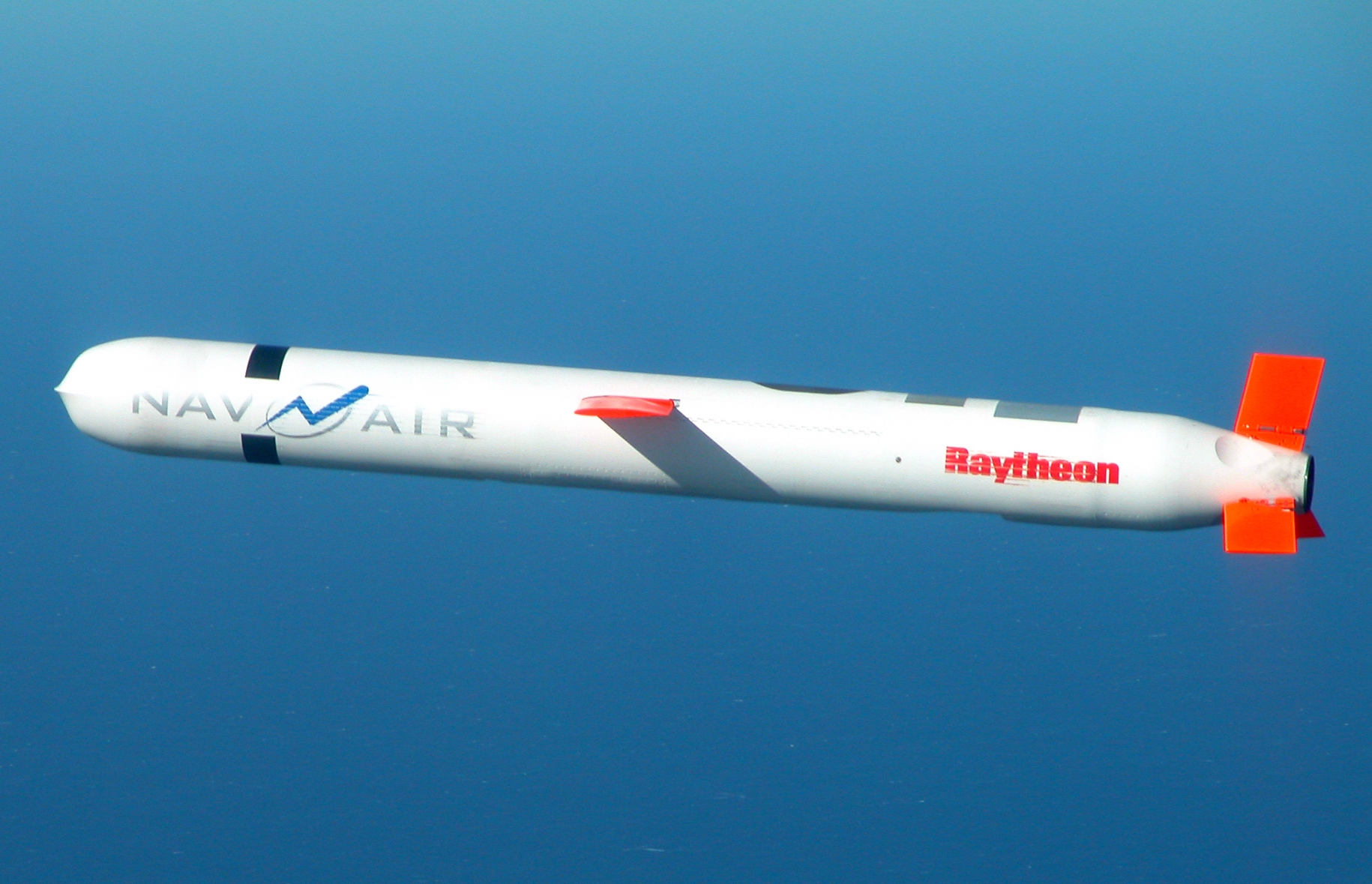
Tomahawk missile
Sign in to saveAlso known as Tomahawk, Tomahawk cruise missile
The BGM-109 Tomahawk Land Attack Missile (TLAM) is an American long-range, all-weather, jet-powered, subsonic cruise missile that is used by the United States Navy, Royal Australian Navy, Royal Netherlands Navy and Royal Navy in ship and submarine-based land-attack operations.
The Tomahawk is a long-range American cruise missile that can be launched from ships and submarines to attack targets on land in all weather conditions. It matters because it has become a key weapon for the U.S. Navy and several allied navies in conducting military operations from a distance.
AI-generated from the Wikipedia summary — may contain errors.
Wikipedia views (30d)
46,040 totalvia Wikimedia Pageviews API
Key facts
- Type
- Cruise missile , Anti-ship missile (Block V & TASM variants), Submarine-launched cruise missile , Land-attack missile , Surface-to-surface missile
- Place of origin
- United States
- In service
- 1983–present
- Used by
- United States , United Kingdom , Australia , Netherlands
- Manufacturer
- General Dynamics (initially), McDonnell Douglas , Hughes Aircraft Company , Raytheon Missiles & Defense
- Unit cost
- $3.1M (FY1986) $1.87M (FY2017) (Block IV) $2.5M (FY2026) (Block V) Export cost: $4M (FY2023)
- Mass
- 2,900 lb (1,300 kg), 3,500 lb (1,600 kg) with booster
- Length
- 18 ft 3 in (5.56 m) without booster; 20 ft 6 in (6.25 m) with booster
- Diameter
- 20.4 in (0.52 m)
- Wingspan
- 8 ft 9 in (2.67 m)
- Detonation mechanism
- FMU-148 since TLAM Block III, others for special applications
- Engine
- Williams International F107-WR-402 turbofan , using TH-dimer fuel , and a solid-fuel rocket booster
- Flight altitude
- 98–164 ft (30–50 m) AGL
- Maximum speed of vehicle or missile span
- Subsonic; ~Mach 0.74. about 570 mph (500 kn; 920 km/h)
- Guidance system
- GPS , INS , TERCOM , DSMAC , active radar homing (RGM/UGM-109B)
- Launch platform
- Mark 41 Vertical Launching System , Torpedo tubes , Surface ships , Submarines , TELs
via Wikipedia infobox
Wikidata facts
- Subclass of
- cruise missile
- Named after
- tomahawk
- Operator
- Royal Navy
- Country of origin
- United States
- Diameter
- 0.52
- Mass
- 1440
- Manufacturer
- McDonnell Douglas
- Image
- Tomahawk Land Attack Missile ( Cruise Missile) (TLAM) flying through the air. 12-04-2000 MOD 45138116.jpg
Show 6 more facts
- Commons category
- BGM-109 Tomahawk
- powered by
- Williams F107
- guidance system
- TERCOM
- service entry
- 1983-01-01
- Commons gallery
- BGM-109 Tomahawk
- capital cost
- 1590000
Sources (3)
via Wikidata · CC0
~39 min read
Encyclopedic overview
The BGM-109 Tomahawk Land Attack Missile (TLAM) is an American long-range, all-weather, jet-powered, subsonic cruise missile that is used by the United States Navy, Royal Australian Navy, Royal Netherlands Navy and Royal Navy in ship and submarine-based land-attack operations.
Developed at the Applied Physics Laboratory of Johns Hopkins University under James H. Walker near Laurel, Maryland, the Tomahawk emerged in the 1970s as a modular cruise missile first manufactured by General Dynamics. Early tests of the missile took place between 1983 and 1993, during which time 23 cruise missiles were tested over northern Canada under the "Canada–U.S. Test and Evaluation Program". The goal of the program was to simulate the climate and terrain similar to that of the northern Soviet Union, and to allow the North American Aerospace Defence Command (NORAD) to develop an anti-cruise capability. The Tomahawk aimed to fulfill the need for a medium- to long-range, low-altitude missile with diverse capabilities. Its modular design allows for compatibility with a range of warheads, including high-explosive, submunitions, and bunker-busters. The Tomahawk can use a variety of guidance systems, including GPS, inertial navigation, and terrain contour matching. Over a dozen variants and upgraded versions have been developed since the original design, including air-, sub-, and ground-launched configurations with both conventional and nuclear armaments. The Tomahawk's manufacturing history has seen several transitions. General Dynamics served as the sole supplier in the 1970s. From 1992 until 1994, McDonnell Douglas was the sole supplier of Tomahawks, producing Block II and Block III versions and remanufacturing many Tomahawks to Block III specifications. In 1994, Hughes Aircraft, having purchased General Dynamics' missile division in 1992, outbid McDonnell Douglas to become the sole supplier of Tomahawks. A joint venture between Hughes and Raytheon manufactured the missile from 1995 until Raytheon's acquisition of Hughes in 1997, solidifying their position as the sole supplier. In 2016, the US Department of Defense purchased 149 Tomahawk Block IV missiles for $202.3 million. As of 2024, Raytheon remains the sole manufacturer of non-nuclear, sea-launched Tomahawk variants.
Excerpted from Wikipedia’s “Tomahawk missile” article, available under the CC BY-SA 4.0 licence.