Category
page 1Hebrew words and phrases in Jewish law

Torah
thumb|An opened Torah scroll (Book of Genesis part).

Talmud
thumb|The Talmud on display in the Jewish Museum of Switzerland brings together parts from the first two Talmud prints by [[Daniel Bomberg and Ambrosius Froben.|250x250px]]

Rosh Hashanah
Rosh Hashanah is the New Year in Judaism. The biblical name for this holiday is Yom Teruah. It is the first of the High Holy Days, as specified by Leviticus 23:23–25, that occur in the late summer/early autumn of the Northern Hemisphere. Rosh Hashanah begins the Ten Days of Repentance, culminating in Yom Kippur, the day of atonement. It is followed by the festival of Sukkot, which ends with Shemini Atzeret in Israel and Simchat Torah everywhere else.

kashrut
' (also or , ) is a set of dietary laws dealing with the foods that Jewish people are permitted to eat and how those foods must be prepared according to Jewish religious law. Food that may be consumed is deemed kosher' ( in English, ), from the Ashkenazi pronunciation of the term that in Sephardi or Modern Hebrew is pronounced kashér (), meaning "fit" (in this context: "fit for consumption"). Food that may not be consumed is deemed treif ( in English, ), also spelled treyf (). In case of objects the opposite of kosher is pasúl ( in English, Yiddish: פָּסוּל).

Sukkot
thumb|Sukkot's Four species|4 Holy Species from left to right: [[Hadass (myrtle), Lulav (palm frond), Aravah (willow branch), Etrog (citron) carrier, Etrog (citron) outside its carrier]]

kippah
thumb|300px|Crocheted kippot for sale in Jerusalem
Ketuvim
The '''''' (; ) is the third and final section of the Hebrew Bible, after the ("instruction") and the "Prophets". In English translations of the Hebrew Bible, this section is usually titled "Writings" or "Hagiographa".

midrash
thumb|250px|Title page, Midrash Tehillim
Midrash (; ; or midrashot) is an expansive Jewish Biblical exegesis using a rabbinic mode of interpretation prominent in the Talmud. The word itself means "textual interpretation", "study", or "exegesis", derived from the root verb (), which means "resort to, seek, seek with care, enquire, require".

Siddur
thumb|200px|The Afghan Liturgical Quire, the oldest known siddur in the world. From the 8th century
A siddur ( sīddūr, ; plural siddurim ) is a Jewish prayer book containing a set order of daily prayers. The word comes from the Hebrew root , meaning 'order.'

Mezuzah
thumb|upright|Ashkenazi Jews|Ashkenazi mezuzah. The case is tilted and features the Hebrew letter (Shin).
thumb|upright|A Sephardi Jews|Sephardic mezuzah. The mezuzah case is vertical and features the Hebrew letter (Shin).
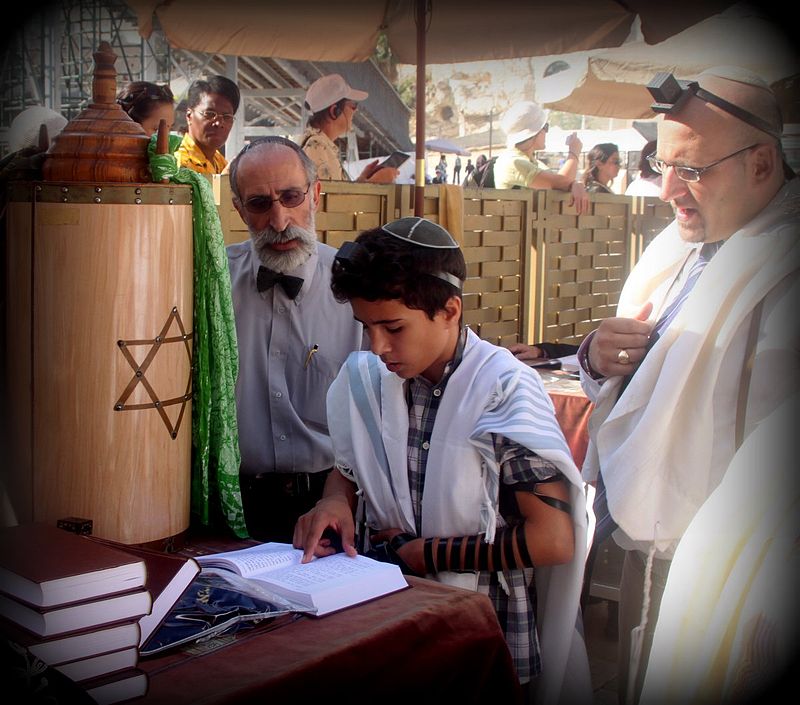
bar and bat mitzvah
Jewish coming-of-age rituals

tefillin
Tefillin ( or ; ), or phylacteries, are sets of small black leather boxes with leather straps containing scrolls of parchment inscribed with verses from the Torah. Tefillin are traditionally worn by male adult Jews during Shacharit on weekdays.

mikveh
thumb|Mikvah Mei Chaya Mushka in Crown Heights, Brooklyn

tallit
alt=A close-up photograph of a framed, long rectangular silver lace neckband for a prayer shawl, featuring intricate symmetrical patterns of interlaced metallic threads on a dark background.|thumb

Nevi'im
The '''''' (; ) is the second major division of the Tanakh (the Hebrew Bible), lying between the first division, the () and the third division, (). The Nevi'im are divided into two groups. The Former Prophets ( ) consists of the narrative books of Joshua, Judges, Samuel and Kings; while the Latter Prophets ( ) include the books of Isaiah, Jeremiah, Ezekiel, and the Twelve Minor Prophets.

shofar
thumbnail|Shofar
thumbnail|Shofar
thumbnail|Blowing the shofar
A shofar ( ; from , ) is an ancient musical horn, typically a ram's horn, used for Jewish ritual purposes. Like the modern bugle, the shofar lacks pitch-altering devices, with all pitch control done by the player's varying their embouchure. The shofar is blown in synagogue services on Rosh Hashanah and at the end of Yom Kippur; it is also blown every weekday morning in the month of Elul running up to Rosh Hashanah. Shofars come in a variety of sizes and shapes, depending on the choice of animal and level of finish.
hanukkiah
nine-branched candelabrum lit during the eight-day holiday of Hanukkah
Shulchan Aruch
book of Jewish law by Rabbi Joseph Karo
brit milah
Jewish religious male circumcision ceremony performed by a mohel on the eighth day of a male infant's life
Simchat Torah
Jewish holiday marking the conclusion of public Torah readings

mitzvah
In its primary meaning, the Hebrew word '''''' (; , ; ) refers to a commandment from God to be performed as a religious duty. Jewish law () in large part consists of discussions of these commandments. According to religious tradition, there are 613 commandments.

Tzitzit
Tzitzit ( ṣīṣīṯ, ; plural ṣīṣiyyōṯ, Ashkenazi: '; and Samaritan: ') are specially knotted ritual fringes, or tassels, worn in antiquity by Israelites and also modern observant Jews and Samaritans. are usually attached to the four corners of the tallit gadol (prayer shawl), usually referred to simply as a or ; and tallit katan (everyday undershirt). Through synecdoche, a may be referred to as .

hazzan
A hazzan (; , ) or chazzan (, plural ; ; ) is a Jewish musician or precentor trained in the vocal arts who leads the congregation in songful Jewish prayer. In English, a hazzan is often referred to as a cantor, a term also used in Christianity.
%20box%2C%20Charleston%2C%201820%2C%20silver%2C%20National%20Museum%20of%20American%20Jewish%20History.JPG)
Tzedakah
thumb|Tzedakah box (Pushke), Charleston, 1820, silver, [[National Museum of American Jewish History]]
Tzedakah ( ṣədāqā, ) is a Hebrew word meaning "righteousness", but commonly used to signify charity. This concept of "charity" differs from the modern Western understanding of "charity". The latter is typically understood as a spontaneous act of goodwill and a marker of generosity; tzedakah is an ethical obligation, and it is not properly "charity", like in Christendom, but a way to empower poor people to support themselves, helping them in developing their talents and skills. The Medieval Jew

Shechita
In Judaism, shechita (anglicized: ; ; ; also transliterated shehitah, shechitah, shehita) is ritual slaughtering of certain mammals and birds for food according to kashrut. One who practices this, a kosher butcher, is called a shochet.

tzadik
thumb|Joseph (Genesis)|Joseph interprets Pharaoh's Dream (Genesis 41:15–41). Of the biblical figures in Judaism, Joseph is customarily called the Tzadik.
Mishneh Torah
code of Jewish religious law authored by Maimonides

ketubah
thumbnail|right|Marriage document of Ananiah and Tamut, written in Aramaic, July 3, 449 B.C.E., Brooklyn Museum
thumb|right|250px|An Illuminated manuscript|illuminated ketubah
A ketubah (; ) is a Jewish marriage contract. It is considered an integral part of a traditional Jewish marriage, and outlines the rights and responsibilities of the groom, in relation to the bride. In modern practice, the ketubah has no agreed monetary value, and is seldom enforced by civil courts, except in Israel.
Shemini Atzeret
Jewish holiday
Sefer Torah
handwritten copy of the Torah
Pidyon haben
Jewish ceremony
Birkat Hamazon
Jewish blessings after meals

chuppah
thumb|right|A chuppah at the Sixth & I Historic Synagogue|Sixth & I Synagogue in [[Washington, D.C.]]
thumb|A chuppah wedding in kibbutz [[Eilot, Israel]]
thumb|Orthodox Judaism|Orthodox Jewish wedding with chuppah in [[Vienna's first district, 2007]]
thumb|Chuppa at a synagogue in [[Toronto, Canada]]
A chuppah (, ) is a canopy under which a Jewish couple stand during their wedding ceremony. It consists of a cloth or sheet, sometimes a tallit, stretched or supported over four poles, or sometimes manually held up by attendants to the ceremony. A chuppah symbolizes the home that the couple will

sukkah
250px|thumb|Canvas-sided sukkah on a roof, topped with palm branches and bamboo s'chach
250px|thumb|Sukkah with walls made of cardboard signs in Oakland, California

Chametz
Chametz (also chometz, '', ḥameṣ, ḥameç'' and other spellings transliterated from ; ) are foods with leavening agents that are forbidden to Jews on the holiday of Passover.

Niddah
A niddah (alternative forms: nidda, nida, or nidah; nidá), in traditional Judaism, is a woman who has experienced a uterine discharge of blood (most commonly during menstruation), or a woman who has menstruated and not yet completed the associated requirement of immersion in a mikveh (ritual bath).
Hoshana Rabbah
7th day of Sukkot; 21st of Tishrei

Lulav
thumb|300px|Four Species, with the lulav longest in the middle
Shiva
week-long mourning period in Judaism for first-degree relatives
Minhag
A minhag (; ) is an accepted tradition or group of traditions in Judaism. A related concept, nusach (; ), refers to the traditional ordering and forms of Jewish prayer.
get
Jewish divorce document
Mishnah Berurah
Book written by the Rabbi Israel Meir Kegan

eruv
thumb|upright|An eruv pole and wire outside the Tower of David, [[Jerusalem. Only the higher of the two visible wires is used by the eruv.]]

etrog
thumb|An Greek citron|Israeli etrog, with pitam and [[gartel (trough around the center)]]
Etrog (, plural: ; Ashkenazi Hebrew: , plural: ), also spelled esrog is the yellow citron (Citrus medica) used by Jews during the weeklong holiday of Sukkot as one of the four species. Together with the lulav, hadass, and aravah, the etrog is taken in hand and held or waved during specific portions of the holiday prayers. Special care is often given to selecting an etrog for the performance of the Sukkot holiday rituals.

Tzniut
Tzniut ( , , ; "modesty" or "privacy"; ) describes the character trait of modesty and discretion, as well as a group of Jewish laws pertaining to conduct. The concept is most important within Orthodox Judaism.
Arba'ah Turim
book written by the Rabbi Jacob ben Asher

pareve
thumb|A Non-dairy creamer|non-dairy coffee creamer marked with a pareve label

Mechitza
thumbnail|Separation between men and women at the Western Wall
A mechitza (, partition or division, pl.: , ) in Judaism is a partition, particularly one that is used to separate men and women.
Zeved habat
Jewish naming ceremony for newborn girls
.jpg)
Tashlikh
thumb|200px|Holiday card depicting Tashlikh (early 20th century)
Tashlikh or Tashlich ( "cast off") is an customary Jewish atonement ritual performed during the High Holy Days on Rosh Hashanah for Ashkenazi Jews. In some Judaeo-Spanish-speaking communities the practice is referred to as sakudirse las faldas ('to shake the flaps [of clothing]') or simply as faldas.
Chol HaMoed
middle days of some Jewish holidays
Orach Chayim
Section of the books Arba Turim of the Rabbi Asher ben Jehiel, and the Shulchan Aruch of the Rabbi Joseph Karo.
lashon hara
halakhic term for derogatory speech about another person
Kiddush Levanah
Jewish ritual for blessing the Moon.

Tzaraath
Tzaraath (Hebrew: ṣāraʿaṯ), variously transcribed into English and frequently translated as leprosy (though it is not Hansen's disease, the disease known as "leprosy" in modern times), is a term used in the Bible to describe various ritually impure disfigurative conditions of the human skin, clothing, and houses. Skin tzaraath generally involves patches that are white and contain unusually colored hair. Clothing and house tzaraath consists of a reddish or greenish discoloration.
Pikuach nefesh
Principle in Jewish law

Tachanun
A man reciting tachnun|thumb
Tachanun (), also referred to as (), is a supplicatory and confessional component of () and (), the morning and afternoon prayer services of Judaism, respectively. The recitation of Tachanun follows the Amidah, the central part of the daily Jewish prayer services. It is also recited at the end of the Selichot service. It is omitted on Shabbat, Jewish holidays, and many other celebratory occasions (e.g., in the presence of a groom in the week following his marriage). Most traditions recite a longer prayer on Mondays and Thursdays.

Semikhah
Semikhah () is the traditional term for rabbinic ordination in Judaism.
Terumot
Terumot (, lit. "Priestly dues" and often, "heave-offering") is the sixth tractate of Seder Zeraim ("Order of Seeds") of the Mishnah and of the Jerusalem Talmud. This tractate discusses the laws of teruma, a gift of produce that an Israelite farmer was required to set aside and give to a kohen (priest). There were two kinds of terumot given to the priest: the regular heave-offering, known also as the terumah gedolah ("great heave-offering"), which the Israelites were required to give to the priest from the produce of their fields; the other was the ''terumat ma'aser'' ("tithe of the heave-offe

Kitniyot
thumb|Kitniyot in the market
Kitniyot (, ) is a Hebrew word meaning legumes. During the Passover holiday, however, the word kitniyot (or kitniyos in Ashkenazi dialects) takes on a broader meaning to include grains and seeds such as rice, corn, sunflower seeds, and sesame seeds, in addition to legumes such as beans, peas, and lentils.