Category
page 1History of clothing

fashion
Fashion is a term used interchangeably to describe the creation of clothing, footwear, accessories, cosmetics, and jewellery of different cultural aesthetics and their mix and match into outfits that depict distinctive ways of dressing (styles and trends) as signifiers of social status, self-expression, and group belonging. As a multifaceted term, fashion describes an industry, designs, aesthetics, and trends.

shirt
A shirt is a cloth garment for the upper body (from the neck to the waist).

sock
thumb|A hand-knitting|knitted sock
thumb|Argyle (pattern)|Argyle socks
A sock is a piece of clothing worn on the feet and often covering the ankle or some part of the calf. Some types of shoes or boots are typically worn over socks. In ancient times, socks were made from leather or matted animal hair. Machine-knit socks were first produced in the late 16th century. Until the 1800s, both hand-made and machine-knit socks were manufactured, with the latter technique becoming more common in the 19th century, and continuing until the modern day.

skirt
A skirt is the lower part of a dress or a separate outer garment that covers a person from the waist downwards.

button
thumb|Brass buttons from the uniform of a Danish World War I artillery lieutenant
thumb|Modern buttons made from vegetable ivory

dress
A dress (also known as a frock or a gown) is a one-piece outer garment that is worn on the torso, hanging down over the legs. Dresses often consist of a bodice attached to a skirt.

veil
thumb|right|upright|Roman statue of a veiled Vestal Virgin

mourning
thumb|Girl in a mourning dress holding a framed photograph of her father, who presumably died during the American Civil War
thumb|Egyptian women in a sorrowful gesture of professional mourning
thumb|In a painting by Félix Taunay, Baron of Taunay|Félix Taunay, Emperor [[Pedro II of Brazil and his sisters, Princesses Francisca and Januária, are depicted wearing mourning clothes due to the death of their father Pedro I in 1834.]]

mitre
The mitre (Commonwealth English) or miter (American English; see spelling differences; both pronounced ; ) is a type of headgear now known as the traditional, ceremonial headdress of bishops and certain abbots in traditional Christianity. Mitres are worn in the Catholic Church, Malankara Orthodox Syrian Church (IOC), Malankara Syrian Orthodox Church (Jacobites), Eastern Orthodox Church, Oriental Orthodox Churches, the Anglican Communion, some Lutheran churches, for important ceremonies, by the Metropolitan of the Malankara Mar Thoma Syrian Church, and also, in the Catholic Church, all cardinal

stocking
Stockings (also known as hose, especially in a historical context) are close-fitting, variously elastic garments covering the leg from the foot up to the knee or possibly part or all of the thigh. Stockings vary in color, design, and transparency. Today, stockings are primarily worn for fashion and aesthetics, usually in association with mid-length or short skirts.

cloak
thumb|A young man in an evening cloak, 1823.
thumb|Cloak, 1580–1600 Victoria and Albert Museum, No. 793-1901
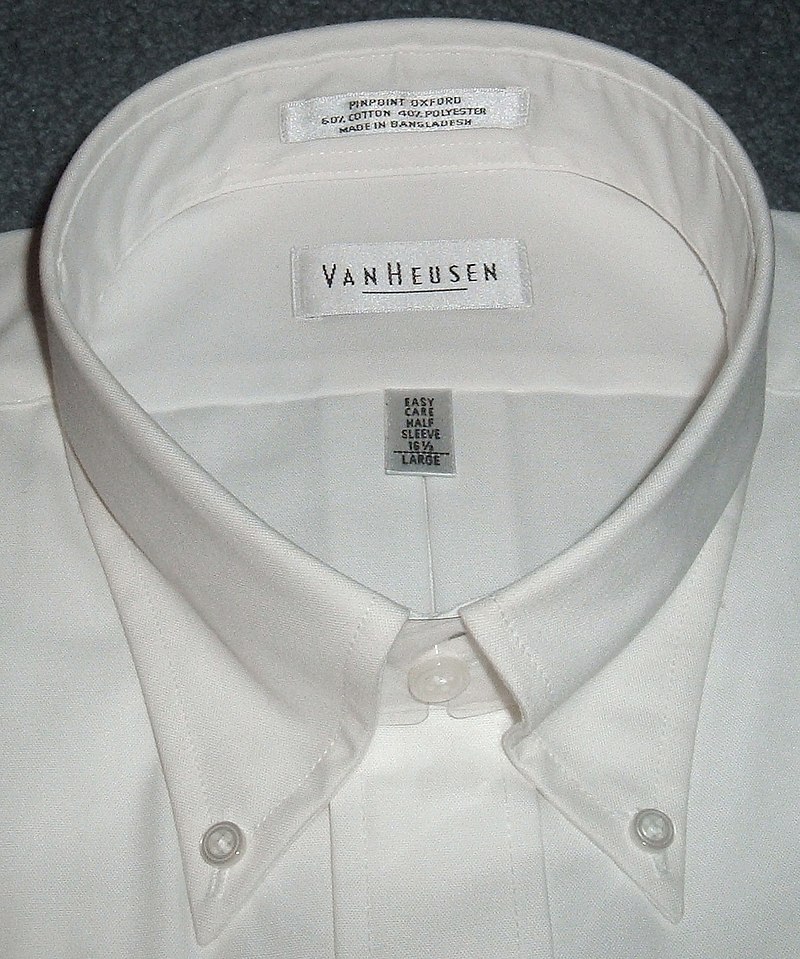
collar
shaped neckwear that fastens around or frames the neck, either attached to a garment or as a separate accessory

cassock
thumb|First native Catholic priest in the Belgian Congo, wearing a Roman cassock with the standard 33 buttons. Early 1900s.

chasuble
thumb|Bishop Czeslaw Kozon, the Roman Catholic Diocese of Copenhagen|Catholic bishop of Copenhagen, in pontifical liturgical vestments including the Chasuble.
The chasuble () is the outermost liturgical vestment worn by clergy for the celebration of the Eucharist in Western-tradition Christian churches that use full vestments, primarily in Roman Catholic, Anglican, and Lutheran churches. In the Eastern Orthodox Church and in the Eastern Catholic Churches, the equivalent vestment is the phelonion.

alb
thumb|A white alb under a purple Stole (vestment)|stole (running around the neck) and maniple (on arm)

fur clothing
clothing made of furry animal hides
stole
long narrow cloth band worn around the neck and falling from the shoulders as part of ecclesiastical dress

zucchetto
thumb|right|Cardinal Franciszek Macharski with a scarlet zucchetto
The zucchetto (, also , , ; meaning 'small gourd', from zucca 'pumpkin' or more generally 'gourd'; plural in English: zucchettos) or solideo, officially a pileolus, is a small, hemispherical, form-fitting ecclesiastical skullcap worn by clerics of the Catholic Church, the Syriac Orthodox Church, and by senior clergy in certain denominations of Lutheranism, Anglicanism, and Methodism.

biretta
thumb|A traditional black biretta.

dalmatic
thumb|upright|A Roman Catholic deacon wearing a dalmatic and a biretta during a service in the Traditional Latin Rite
thumb|upright|Ornately embroidered dalmatic (shown from the back with a collarin)
The dalmatic is a long, wide-sleeved tunic, which serves as a liturgical vestment in the Catholic, Lutheran, Anglican, United Methodist, and some other churches. When used, it is the proper vestment of a deacon at Mass, Holy Communion or other services such as baptism or marriage held in the context of a Eucharistic service. Although infrequent, it may also be worn by bishops above the alb and bel
garter
thumb|right|Sketch of a garter. The band goes around the leg, and the hook on the lower side attaches to the top of the stocking.
A garter is an article of clothing comprising a narrow band of fabric fastened about the leg to keep up stockings. In the to centuries, they were tied just below the knee, where the leg is most slender, to keep the stocking from slipping. The advent of elastic has made them less necessary from this functional standpoint, although they are still often worn for fashion. Garters have been widely worn by men and women, depending on fashion trends.

cope
thumbnail|200px|Johan Bonny, a Catholic [[bishop, wearing a gold-embroidered cope, Antwerp, Belgium]]A cope ( ("rain coat") or ("cape")) is a liturgical long mantle or cloak, open at the front and fastened at the breast with a band or clasp. It may be of any liturgical colour.
vintage clothing
generic term for garments originating from a previous era, as elements of contemporary dress

Liturgical vestments and insignia
thumb|250px|Different vestments of kneeling clergy at the elevation of the chalice (cup)|chalice at a Mass according to the Neo-Gallican Rite of Versailles
thumb|250px|Karl XIV Johans kröning by Per Krafft the Younger (1818) depicting Evangelical-Lutheran bishops in vestments during the coronation of [[Charles XIV John in Stockholm Cathedral]]
Vestments are liturgical garments and articles associated primarily with the Christian religion, especially by Eastern Churches, Catholics (of all rites), Lutherans, and Anglicans. Many other groups also make use of liturgical garments; among the Reforme

surplice
thumb|Seminarian vested in a pleated Roman-style surplice with lace inserts, holding a thurible.thumb|An Anglicanism|Anglican [[priest wearing a black cassock, white English-style surplice, academic hood, and black tippet as his choir dress.]]
thumb|The Death of St. Bede, the monastic clergy are wearing surplices over their [[cowls (original painting at St. Cuthbert's College, Ushaw).]]
thumb|Abbess Joanna van Doorselaer de ten Ryen, in choir dress. Waasmunster Roosenberg Abbey.

phelonion
thumb|alt=Chrysostomos of Smyrna|Icon of Saint Chrysostomos of Smyrna wearing a polystavrion (“many crosses”) phelonion.
religious habit
distinctive set of garments worn by members of a religious order

fulling
thumb|Scotswomen walking (fulling) woollen cloth, singing a [[waulking song, 1772 (engraving made by Thomas Pennant on one of his tours)]]

omophorion
thumb|Fresco from the 14th century depicting St. [[Gregory the Illuminator of Armenia wearing a white omophorion.]]
thumb|300px|Benjamin Peterson, archbishop of the Orthodox Church in America Diocese of Alaska, wearing an omophorion.
In the Eastern Orthodox and Eastern Catholic liturgical tradition, the omophorion (, meaning "[something] borne on the shoulders"; Slavonic: омофоръ, omofor) is the distinguishing vestment of a bishop and the symbol of his spiritual and ecclesiastical authority. Originally woven of wool, it is a band of brocade decorated with four crosses and an eight-pointed star
The Philippi Collection
private collection of religious headgear

epitrachil
thumb|Epitrachelion
The epitrachelion ( "around the neck"; Slavic: Епитрахи́ль - Epitrakhíl’; often called simply a stole in casual English-language usage) is the liturgical vestment worn by priests and bishops of the Orthodox Church and Eastern Catholic Churches as the symbol of their priesthood, corresponding to the Western stole. It is essentially the orarion adapted for priests and bishops, worn around the neck with two ends of equal length hanging down in front of the clergyman's body (more or less to the ankle) and with the two adjacent sides sewn or buttoned together up the center, leav
clothing in ancient Egypt
aspect of history
.jpg)
epigonation
thumb|Embroidered palitza (photograph c. 1911 by Sergei Mikhailovich Prokudin-Gorskii).
thumb|Fresco of St [[Gregory the Illuminator wearing a gold epigonation (the half-visible rhombus behind the Omophorion) embroidered with an icon (14th century, Mistra).]]
The epigonation (Greek: , literally meaning "over the knee"), or pálitsa (Russian: , "club"), is a vestment used in some Eastern Christian churches.
sumptuary law
law intended to control consumption, particulary such a law regulating apparel and textiles which may be worn by people of specified social strata

tights
upright|thumb|200px|Drawing of tights with reinforced gusset|crotch and toes. Actual most similar item can be with seams on the sides of the legs or seamless
history of costume
study of fashion and clothing by period in time
clothing in ancient Rome
clothing style in ancient Rome

Sticharion
thumb|200px|Greek Orthodox deacon wearing a red sticharion and [[Orarion.]]
mantle
ecclesiastical overgarment
clothing in ancient Greece
clothing style in ancient Greece
.png)
cowl
thumb|100px|Drawing showing a cowl-wearing monk

sakkos
thumb|17th-century sakkos. It has 16 buttons on each side, plus 1 at the collar to make a total of 33: the traditional number of years in the earthly life of Jesus (Benaki Museum, [[Athens, Greece).]]
thumb|Priest in phelonion (left) and archbishop of Prague Joachim in sakkos
thumb|right|Greek Catholic Church|Greek-Catholic [[bishop wearing a sakkos. What appears to be a collar is a separate vestment, called the omophorion (Prešov, Slovakia).]]
cincture
The cincture is a rope-like or ribbon-like article sometimes worn with certain Christian liturgical vestments, encircling the body around or above the waist. As usual with vestments, both the term and the object are taken from ordinary everyday dress of the distant past. There are two types of cinctures: one is a rope-like narrow girdle or rope-like belt around the waist. The other type is a broad ribbon of cloth that runs around the waist and usually has a section that hangs down from the waist; this type is often called a "band cincture" – it would be a "waist-sash" in secular contexts. One

shibori
thumb|right|alt=A rectangle of indigo blue and white cloth lying on a wooden table covered with a tatami mat, viewed diagonally from the corner.|A section of (spider ) dyed with indigo, next to that has not been dyed yet
is a Japanese manual tie-dyeing technique, which produces a number of different patterns on fabric.
choir dress
a traditional costume of clerics, seminarians and religious of Christian churches
Léon Heuzey
French archaeologist and historian (1831-1922)
zone
vestment; form of girdle or belt common in the ancient eastern Mediterranean

smock
thumb|right|200px|A 19th-century shepherd in a smock-frock. Detail from Found by Dante Gabriel Rossetti, 1854.
thumb|Old man wearing a smock and carrying a whip
A smock-frock or smock is an outer garment traditionally worn by rural workers, especially shepherds and waggoners. Today, the word smock refers to a loose overgarment worn to protect one's clothing, for instance by a painter.
clerical clothing
distinctive clothing worn by Christian clergy
history of nudity
Aspect of history

tunicle
thumb|alt=refer to caption|A pontifical tunicle.
The tunicle is a liturgical vestment associated with Roman Catholicism, Anglo-Catholic, and Lutheranism.
Template:Historical clothing
Wikimedia template
Stewart%2C%20Later%203rd%20Marquess%20of%20Londonderry%2C%201812%2C%20oil%20on%20canvas%2C%20National%20Portrait%20Gallery%2C%20London.jpg)
pelisse
thumb|250px|right|upright| Charles Vane, 3rd Marquess of Londonderry|Charles Stewart, in [[hussar uniform with a military pelisse slung over the shoulder, 1812 portrait by Thomas Lawrence]]

Tarkhan dress
oldest surviving piece of clothing
history of brassieres
aspect of history

decoration
thumb|right|150px|The principal adornment of these girls from the Bundu tribe in Sierra Leone is the adornment of bodies and faces with markings produced by the smearing on by the fingers of a substance called "wojeh", composed of white clay and animal fat.
thumb|Calabar adornments Bird Feather stalks
An adornment is generally an accessory or ornament worn to enhance the beauty or status of the wearer. They are often worn to embellish, enhance, or distinguish the wearer, and to define cultural, social, or religious status within a specific community. When worn to show economic status, the item
Bandhani
thumb|300px|Bandhani craft
Pontifical vestments
Liturgical vestments worn by bishops
Jewish religious clothing
religious clothing of Jews

hemline
thumb|Prom dresses, with hemlines varying from above-the-ankle (tea length) to floor length
The hemline is the line formed by the lower edge of a garment, such as a skirt, dress or coat, measured from the floor.