Category
page 1History of Shia Islam

Mid Sha'ban
'''Mid-Sha'ban' ( or laylat niṣf min šaʿbān'' "night on the half of Sha'ban") is a Muslim holiday observed by Shia and Sunni Muslim communities on the eve of 15th of Sha'ban (i.e., the night following the sunset on the 14th day) — the same night as Shab-e-barat or Laylat al-Bara’ah ().
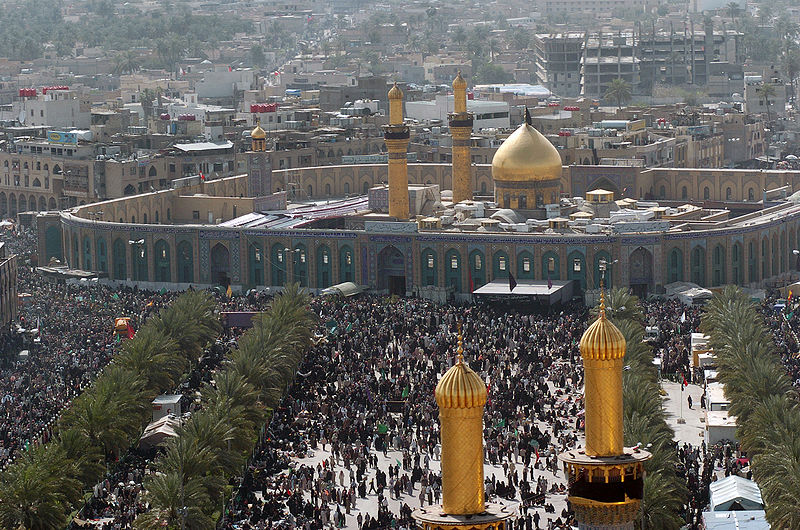
Arba'een
In Shia Islam, '''Arba'in''' () marks forty days after Ashura, which is the martyrdom anniversary of Husayn ibn Ali, grandson of the Islamic prophet Muhammad and the third Shia imam. Husayn was killed, alongside most of his relatives and his small retinue, in the Battle of Karbala on 10 Muharram 61 AH (680 CE) against the army of the Umayyad caliph Yazid ibn Mu'awiya (). The battle followed Husayn's refusal to pledge his allegiance to Yazid, who is often portrayed by Muslim historians as impious and immoral. In Shia Islam, Karbala symbolizes the eternal struggle between good and evil, the pinn
Fadak
Fadak () was a village with fertile land in an oasis near Medina. The takeover of Fadak by Muslims in 629 CE was peaceful and a share of it thus belonged to the Islamic prophet Muhammad. After Muhammad died in 632, Fadak was confiscated from his daughter Fatima and administered as public property, despite her objections. Fadak later changed hands many times as a fief.
Muslim ibn Aqil
Son of Aqil ibn Abi Talib and cousin of Husain ibn Ali (died 680)
Battle of Fakhkh
battle in June 786 between Abbasids and Al-Husayn ibn Ali (Sahib Fakhkh)
Jafar ibn Ali al-Hadi
Son of the tenth Shia Imam (c. 840–885)
history of Shi'a Islam
aspect of history
Event of Mubahala
meeting between the Islamic prophet Muhammad and Najranite Christians
Sermon of Fadak
speech in Medina delivered by Fatima after Muhammad’s death
Shia days of remembrance
days recognised by Shi'a Muslims