File:Kerbela_Hussein_Moschee.jpg · Wikimedia Commons · See Wikimedia Commons
Arba'een
Sign in to saveAlso known as Arba'in, Arba‘īn
In Shia Islam, '''Arba'in''' () marks forty days after Ashura, which is the martyrdom anniversary of Husayn ibn Ali, grandson of the Islamic prophet Muhammad and the third Shia imam. Husayn was killed, alongside most of his relatives and his small retinue, in the Battle of Karbala on 10 Muharram 61 AH (680 CE) against the army of the Umayyad caliph Yazid ibn Mu'awiya (). The battle followed Husayn's refusal to pledge his allegiance to Yazid, who is often portrayed by Muslim historians as impious and immoral. In Shia Islam, Karbala symbolizes the eternal struggle between good and evil, the pinn
Key facts
- Holiday.holiday_name
- Arba'in
- Holiday.image
- Kerbela Hussein Moschee.jpg
- Holiday.caption
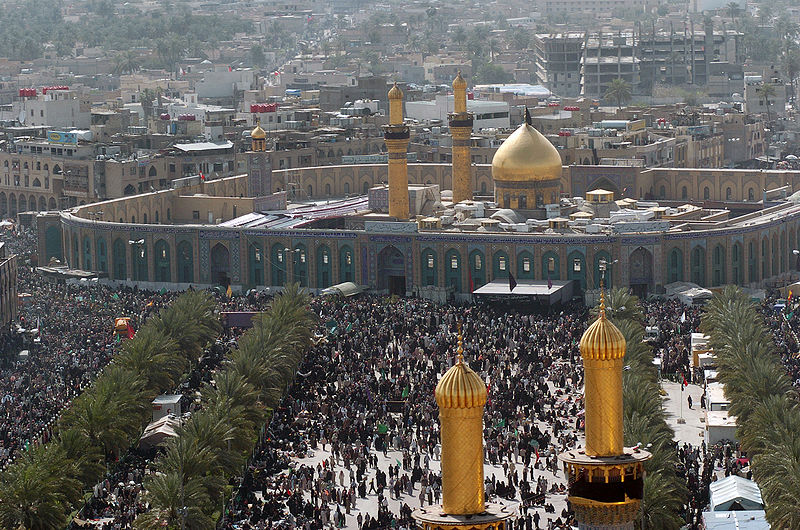
- Congregation of worshippers on Arba'in in the shrine of Husayn ibn Ali, Karbala, Iraq
- Holiday.duration
- 1 day
- Holiday.frequency
- annual (Islamic year)
- Holiday.observedby
- Shia Muslims
- Holiday.date
- 20 Safar
- Holiday.observances
- Pilgrimage to the shrine of Husayn ibn Ali in Karbala
- Holiday.significance
- Forty days after Ashura, the death anniversary of Husayn ibn Ali, grandson of the Islamic prophet Muhammad and the third Shia imam
- Holiday.type
- Islamic
via Wikipedia infobox
Wikidata facts
- Image
- Kerbela Hussein Moschee.jpg
Show 4 more facts
- day in year for periodic occurrence
- 20 Safar
- Commons category
- Arba'een
- different from
- Arbaine
- on focus list of Wikimedia project
- Wiki Loves Folklore
via Wikidata · CC0
~9 min read
Encyclopedic overview
9 sectionsContents
- Significance in Shia Islam
- Arba'in in Shia tradition
- Arba'in pilgrimage
- Arba'in in the Gregorian calendar
- Al Mawakib
- Gallery
- See also
- Footnotes
- References
In Shia Islam, '''Arba'in''' () marks forty days after Ashura, which is the martyrdom anniversary of Husayn ibn Ali, grandson of the Islamic prophet Muhammad and the third Shia imam. Husayn was killed, alongside most of his relatives and his small retinue, in the Battle of Karbala on 10 Muharram 61 AH (680 CE) against the army of the Umayyad caliph Yazid ibn Mu'awiya (). The battle followed Husayn's refusal to pledge his allegiance to Yazid, who is often portrayed by Muslim historians as impious and immoral. In Shia Islam, Karbala symbolizes the eternal struggle between good and evil, the pinnacle of self-sacrifice, and the ultimate sabotage of Muhammad's prophetic mission.
Arba'in coincides with the twentieth of Safar, the second month of the Islamic calendar, and its commemoration is rooted in early Islamic funerary traditions. Shia Muslims annually observe the day through mourning gatherings, dramatic reenactments of Karbala narratives, and charitable acts. Arba'in is also a day of pilgrimage to the shrine of Husayn in Karbala, Iraq. Pilgrims arrive there in large numbers, often on foot, and many from the city of Najaf, some eighty kilometers away, home to the shrine of Ali ibn Abi Talib, the first Shia imam. The Arba'in pilgrimage, banned under the Iraqi president Saddam Hussein, has grown after his deposal in 2003 from two million participants in that year to around twenty million in 2014. As with Ashura, Arba'in can be an occasion for violence against Shia Muslims.
Excerpted from Wikipedia’s “Arba'een” article, available under the CC BY-SA 4.0 licence.
Gallery (6)
Available in 38 languages
- Español
- Français
- Deutsch
- 日本語
- Русский
- العربية
- हिन्दी
- azb
- Azerbaijani
- Bahasa Indonesia
- Bangla
- Bhojpuri
- Central Kurdish
- Czech
- Egyptian Arabic
- Hausa
- Hebrew
- Kannada
Show 19 more
via Wikidata sitelinks · CC0